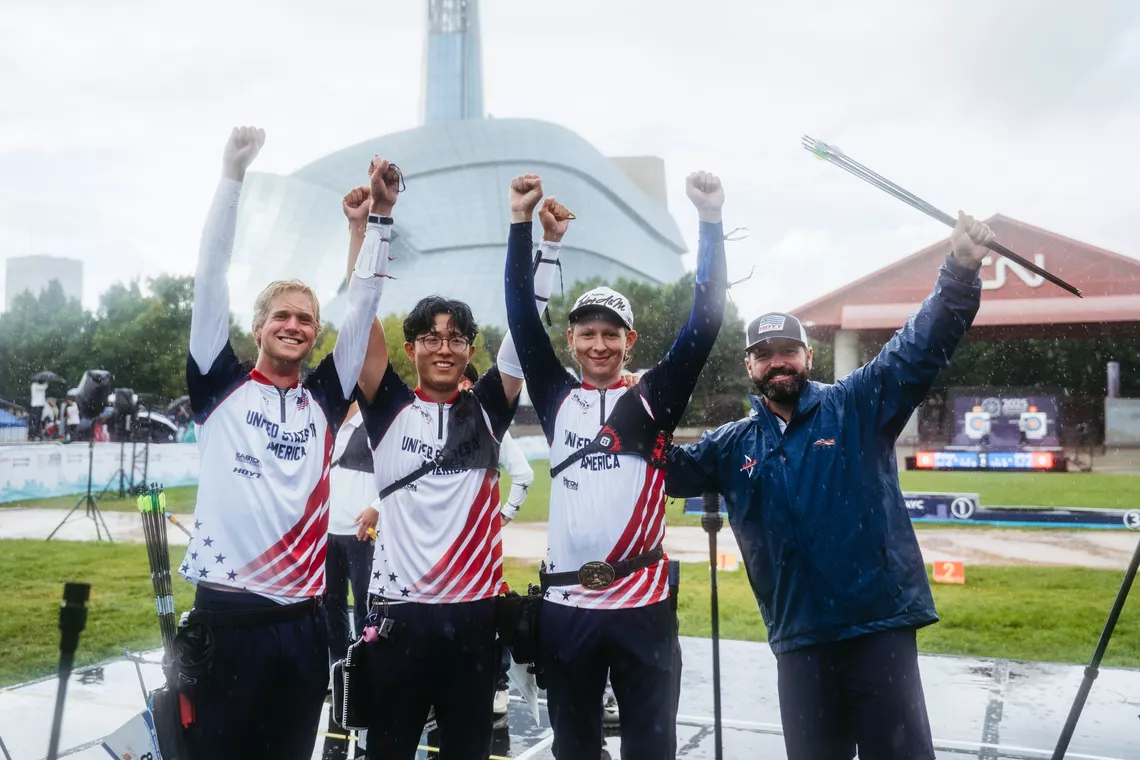
Just a couple of weeks before the Gwangju 2025 Hyundai World Archery Championships, the USA’s under-21 men beat Korea for the world title at the World Archery Youth Championships in rainy Winnipeg.
While the youth event celebrates potential, it felt like a landmark moment. Korea’s youth sides are as dominant as their senior counterparts, and this was the only team recurve final the host nation lost all week.
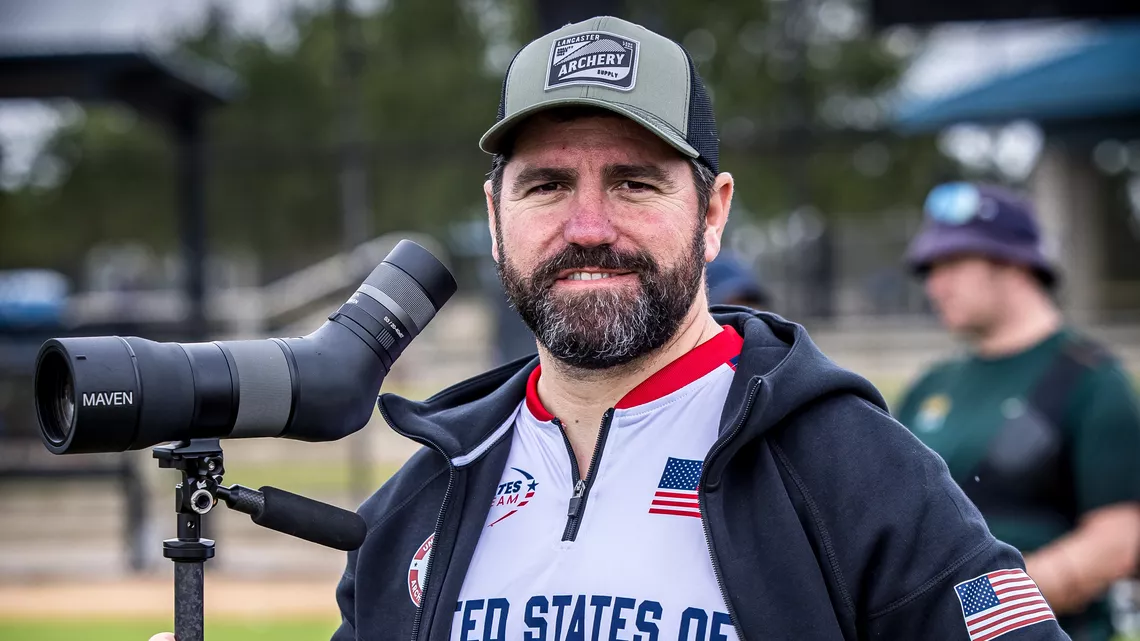
Behind the scope in Winnipeg was Elias Cuesta, the Spaniard who has started his USA coaching tenure with an impressive collection of international medals.
“What did I tell the athletes? I told them that of course we had the opportunity to be world champions. Our objective is what we can control, because if we think about the score, we are not doing what we need to control,” he explained.
“You can’t think about the score. You can lose a set with 55, and win a set with 49.”
It was a typically pragmatic response from Cuesta – and the USA dominated the match, winning 5-1 in difficult conditions.
In Gwangju, the senior men will again face Korea in one of the biggest finals of all.
On Wednesday, Christian Stoddard, Trenton Cowles and Brady Ellison will meet Olympic gold medallists Kim Woojin, Lee Woo Seok, and Kim Je Deok for gold. Stoddard, just 19, was also on the winning team in Winnipeg.
It’s a big ask – but is it?
“Honestly, I always want to win all the tournaments,” said Cuesta. “And I don’t care if we are shooting against Korea or someone else. But honestly, beating Korea in a final at a world championship – it’s the final everybody wants to see, and the final everybody wants to win, right?”
Cuesta, from Granada, shot at London 2012 and many other international tournaments before moving into coaching in 2016. He led the Spanish national side for six years before accepting the USA head coach role late last year, as the country prepares for a home Olympic Games.
“Joining one of the most successful delegations in the history of the Olympic Games is the greatest honour that can be given to a coach,” he said at the time.
He wasted no time.
“Before I came to the USA I had in my mind what I needed to change. One of the things I saw from Spain, because I was an archer in the past – when I went to tournaments I remember the team: everybody arrived at the field at the same time, everybody went to the training field together. They were really a team. I did not see that recently.”
“In my head I knew I needed to change the spirit of the thing. I think when everybody goes training together, eats together, comes to the field together, and meets every night to talk about the tournament, it makes a difference. I wanted to create that team spirit again.”
Based at the national centre in Chula Vista, he inherited a system led by KiSik Lee for 18 years, which included the National Training System (NTS), the technical shooting model developed for USA Archery.
“It’s one of the biggest questions everybody asked me when I arrived in the USA,” he said. “As a coach, you need your own method, your own way to teach the athletes.”
“And of course I follow NTS because I’m a sports scientist, and I believe in biomechanics. But I have experience with a Russian coach, with a Korean coach in the past, with a Slovenian coach, with different kinds of coaches. I love to learn new styles.”
“If you start training with me, you will learn NTS. But we have people on the team, for example Casey Kaufhold, who doesn’t shoot NTS. I can work with her too, no problem.”
Cuesta has also focused on the mental game.
“In my opinion you have two different worlds. One is the mental game for shooting an arrow. The other is creating the mentality to win big tournaments like the Olympic Games.
“You have to teach how to win the tournament without winning the tournament. You can’t think all the time: ‘I need to win’. Even with the perfect score, you can still lose. So the most important thing is to convince the athlete that the biggest chance to win is just to control what we can control.”
“The most important is where you pay attention during the shot and how long you can concentrate. I’m really obsessed with staying focused during the 10 seconds you have for shooting. I don’t care what happens after.”
“But the moment you start the expansion and when you finish the shot, where you put the focus and how you maintain this focus during these two, three seconds – for me this is the most important.”
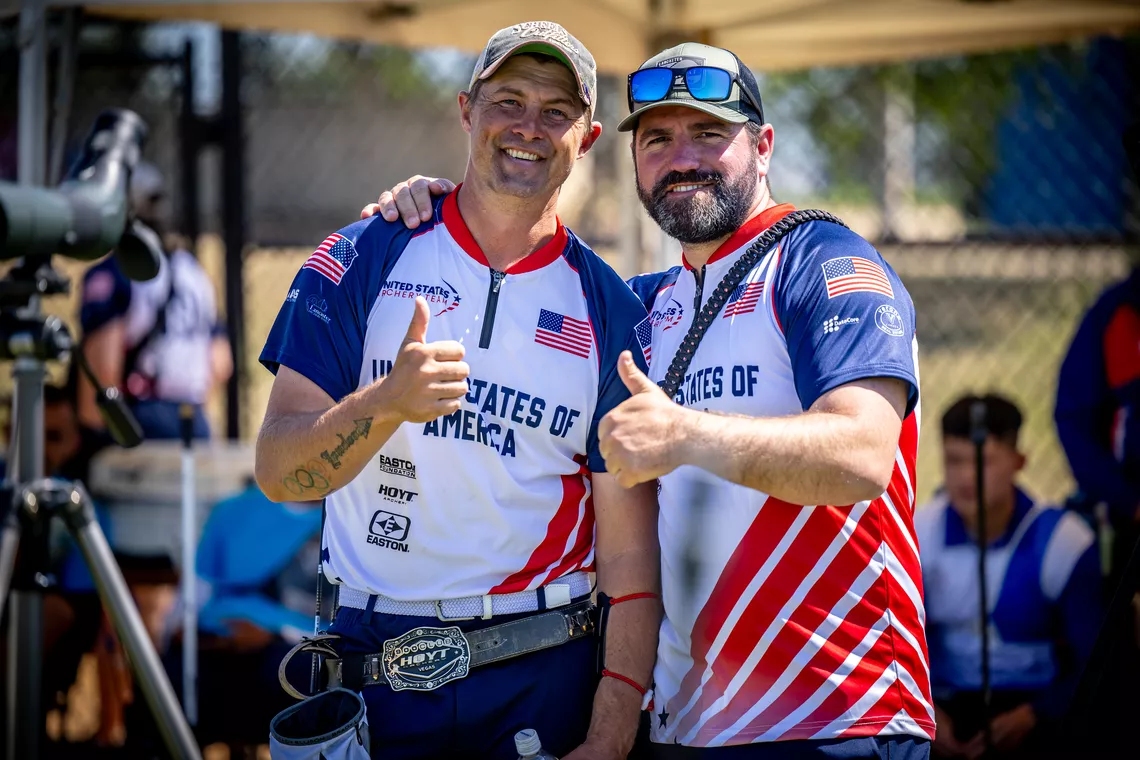
Cuesta is one of the most recognisable and well-liked coaches on the circuit, with a knack for connecting with athletes.
“Everybody knows me – that I laugh all the time, joking and doing funny things. One of the most important things in archery is remembering why we train, why we come to tournaments.”
“Of course we want to win, but we want to enjoy life, enjoy the journey. Part of the coach’s work is to help athletes do that and to make connections with them.”
“One of the keys is to make some jokes, help the athletes relax, and then as a coach you can switch from a joke to what you need them to focus on. It can be part of the process.”
Whatever the result on Wednesday, there is a sense that a door has been opened.
This year has already brought USA medals at junior level in Winnipeg, at the World University Games and at the Junior Pan American Games.
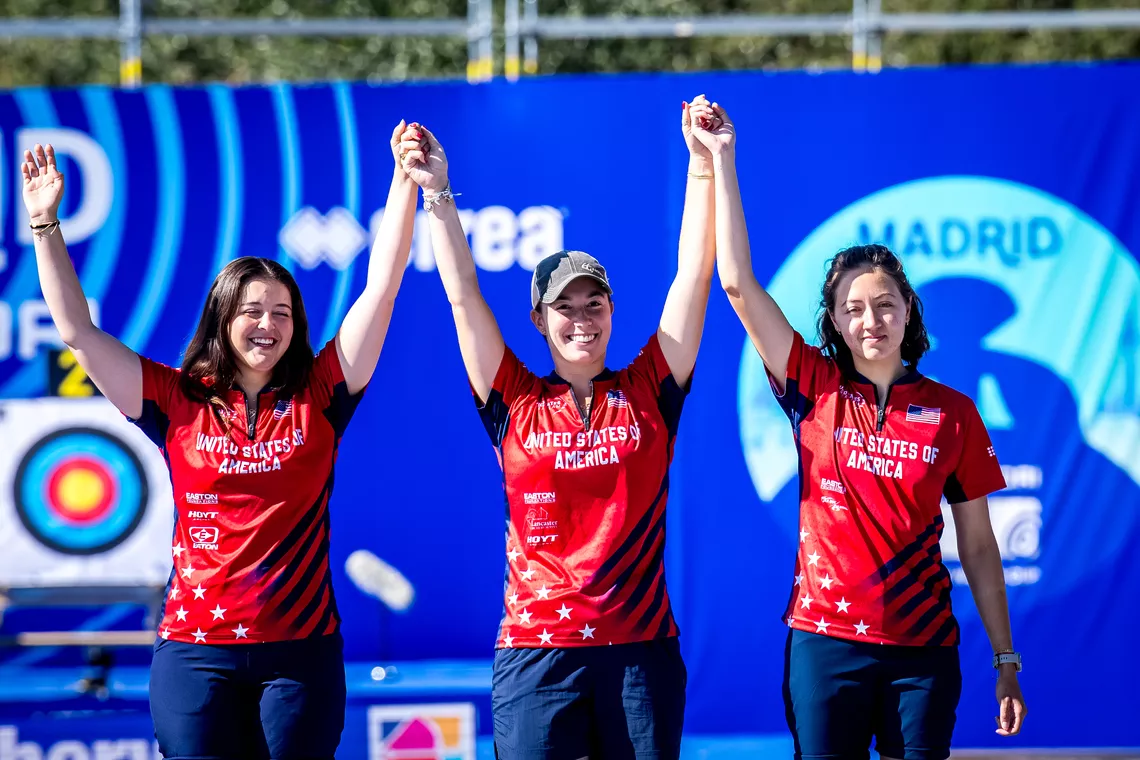
There was the moment when the USA women beat Korea at the Hyundai Archery World Cup stage in Antalya – at the 20th attempt – and went on to gold. Also silver in Central Florida. Then mixed team gold in Madrid, again beating Korea. All building on strong results in Paris.
“I think we are working in a good way and the results are starting to speak for themselves,” said Cuesta. “The women’s team went seven years without a medal, and they’ve taken three this year. But of course one of the most important things is also to convince people that they can do it.”
The USA men’s team against Korea carries serious Olympic resonance, dating back to Atlanta 1996, when the USA won the last American archery gold medal at a Games.
They won again against Korea in the London 2012 semifinal, on their way to silver. The same matchup produced perhaps the greatest recurve men’s final of all in Rio 2016 – although Korea took gold that time.
“Of course, the goal here is to win the world championship, like in every tournament,” said Cuesta. “But the best goal for us is to try to control what we can control. If we do that, we have more chance to win.”
The USA remains the second-most decorated Olympic archery nation behind Korea, and was the dominant force internationally in the 1970s and 1980s, an era that arguably ended with Justin Huish‘s remarkable double gold in Atlanta.
With LA28 approaching, can the USA dominate again as it did in the days of Darrell Pace and Rick McKinney?
“Really, one of the reasons I’m here in the United States is that I want to be the best coach in the world,” declared Cuesta. “If I’m to be the best coach, I want as many medals as I can. Right now Korea is dominating, and we need to beat them.”
“In my opinion, the only country that has everything to beat them is the USA. This is why I’m here – and I think between the athletes, USA Archery, the other coaches and me, it’s the best combination to do it again.”


Morelia 2025: Record continental pour Polish
Paralympiques: Stutzman termine par l’or

JO 2024: Médaille historique pour Barbelin