80,000 years and counting: Discovery pushes back archery’s origins

New research suggests archery may be significantly older than previously believed.
Archaeologists studying tiny stone projectile points discovered in a rock shelter at Obi-Rakhmat in Uzbekistan say the artefacts could represent the earliest evidence of bow-and-arrow technology, dating back around 80,000 years.
If confirmed, the discovery would push the origins of archery back by several thousand years.
Until now, the earliest widely accepted evidence of archery dated back around 70,000 years, based on arrow points discovered at Pinnacle Point in South Africa.
Almost all evidence for the origins of the bow and arrow comes from arrowheads made of stone – or sometimes bone. Bows themselves were usually made from wood, which rarely survives over long periods of time. The oldest complete bow ever discovered dates from around 10,000 years ago. Found in Denmark in the 20th century, it was preserved almost perfectly after being buried in peat.
Stone arrowheads, however, can survive indefinitely. The challenge for archaeologists is determining whether such points were used on arrow shafts rather than as spearheads or other types of tools.

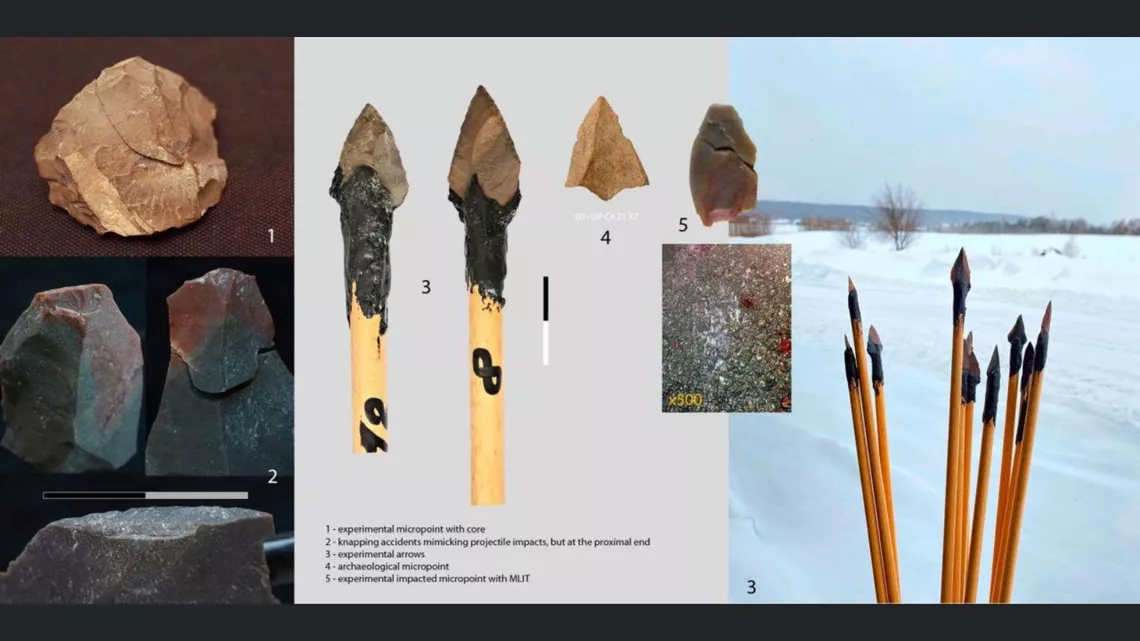
The artefacts were reevaluated in 2025 at the dramatic Obi-Rakhmat site in northeastern Uzbekistan by an international team of researchers. They consist of small, triangular stone projectile points that were initially overlooked because of their diminutive size.
Measuring just 1.5 to 2.4 centimetres wide and weighing only a few grams, these points are far too light and fragile to have served as spearheads or cutting implements. Instead, microscopic analysis of wear and fracture patterns on the stone reveals impact marks consistent with high-velocity projectiles – the kind only achievable with a bow.
Replicas of the points made from the same material were hafted onto arrow shafts and shot from a bow in order to calibrate and better understand how the raw material was used. This method of experimental archaeology has been used before to gain deeper insight into ancient archery.
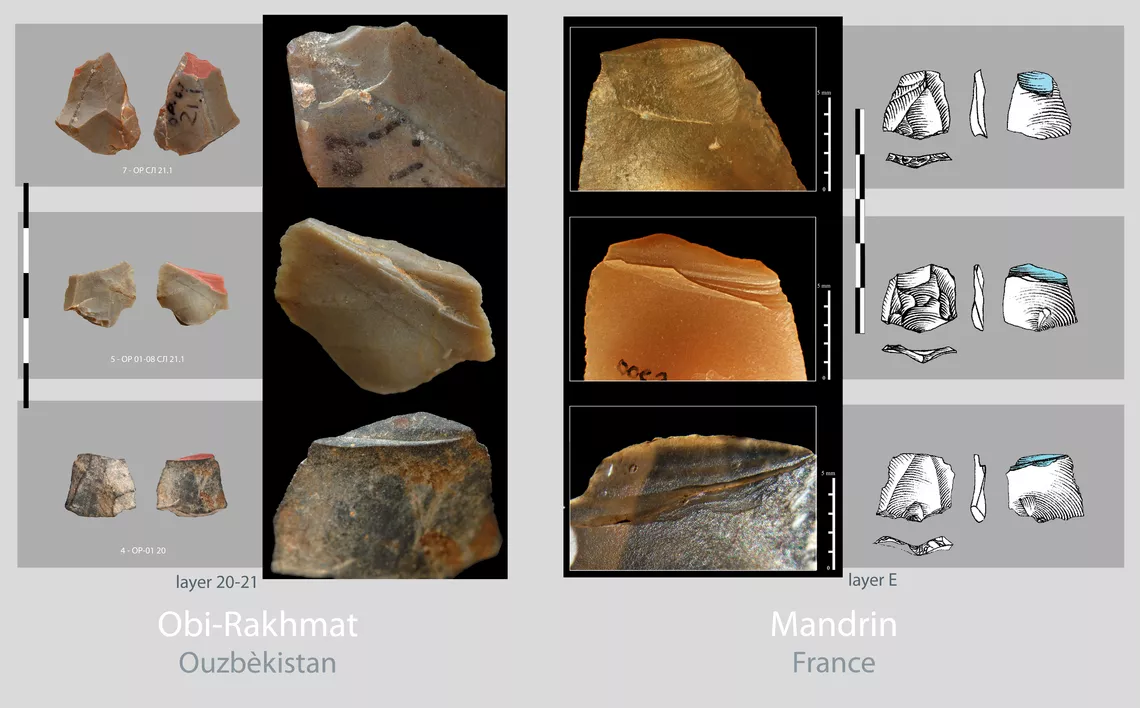
The points closely resemble those found almost 25,000 years later at a site called Mandrin in what is now France. These artefacts were brought there by modern humans, and research published in 2023 showed that archery was already well established in Europe.
Previously, it was thought that these humans had arrived directly from Africa as part of one of several “Out of Africa” expansions. Now, it is considered possible that some groups travelled via Asia instead.
Eighty thousand years ago, Central Asia was a crossroads of human evolution. At that time, Neanderthals were the dominant species in the region, but bows and arrows and other lightweight tools are almost exclusively associated with Homo sapiens, or modern humans.
Hugues Plisson, one of the researchers and an archaeologist at the University of Bordeaux, explained:
“There were multiple waves of Homo sapiens expansion across Europe and Asia, but few left traces in our genetic heritage. The oldest are dead branches, which suggests that adaptation to new environments was not easy.”
“It is possible that the bow and arrow gave an adaptive advantage by broadening the range of possible game and therefore exploitable environments. It also provided greater safety for hunters due to the shooting distance. The energetic cost was also lower than in close-range hunting strategies.”
While Neanderthals were known for their physical strength and heavy spears, this discovery suggests either that they were more technologically advanced than previously thought, or that early modern humans reached Central Asia and introduced long-range hunting much earlier than current history suggests.
“Based on current data, the only Neanderthal weapons known to exist are a few wooden spears, throwing sticks and large lithic spearheads,” added Plisson. “As for why Neanderthals did not develop bow-and-arrow technology, the answer is probably cognitive.”
“For example, in the evolution of Homo sapiens, we see an increase in blood flow to the brain over time, and therefore an increase in brain capacity, which was probably stimulated by the social interactions inherent in demography. Environmental resources – available materials – and climate also certainly played a role in the invention of the bow and arrow.”
“The history of technology shows that inventions always arise in contexts where natural conditions are favourable. Human intelligence lies in knowing how to break free from these optimal natural conditions.”

Until now, the earliest confirmed evidence of archery came from South Africa and Ethiopia, dating back about 70,000 years. If the 80,000-year date for the Uzbekistan find holds, it could shift the epicentre of this technological leap from Africa to Central Asia.
The ability to hunt from a distance would have given ancient people a major survival advantage, allowing them to take down fast-moving prey like wild goats and deer while avoiding dangerous horns or hooves.
Of course, the technology likely evolved over many millennia, and with this new data it is entirely possible that even older evidence will be discovered.
“These tiny points represent a major milestone in human ingenuity,” the research team said. “They show that our ancestors were solving complex engineering problems tens of thousands of years before the dawn of civilisation.”
“It was a time of significant change,” added Plisson. “Now that we have drawn attention to the unretouched micro-points from Obi-Rakhmat and their corresponding cores, it is likely they will be searched for at other sites – and that older examples may yet be discovered.”
The story is still developing. A brand-new discovery from South Africa suggests that advanced techniques such as poison arrowheads were already being used during the Pleistocene, around 60,000 years ago.
For now, the discovery confirms that the story of human migration across Eurasia was far more complex – and far more technologically advanced – than we ever imagined.
With thanks to Hugues Plisson. Images courtesy of The Conversation.


L’archère sur l’affiche des Jeux de 1972
World Archery fête son 90e anniversaire