Five iconic moments that defined mixed team archery’s World Cup era

For most of archery’s modern history, medals were won alone or in threes. Then came an idea that felt at once simple and radical: take a nation’s best man and woman, put them on the line together and let fate decide the rest.
The mixed team event made its World Cup debut in 2009 as an experiment. It was relaxed, even playful at first – as Italy’s Natalia Valeeva later said, “very funny and relax!” – but it quickly proved something more enduring.
Mixed team archery demanded rhythm, trust and shared nerves, compressing the sport’s quiet intensity into four-arrow bursts. As the format matured, it found new expression in the set system for recurve and later tested an 11-ring scoring format.
As the Archery World Cup approaches its 20th anniversary in 2026 and March builds momentum toward the new season, the format stands as one of the circuit’s defining innovations.
What follows are five Archery World Cup moments that chart how the format grew from novelty to necessity – and, ultimately, to Olympic relevance.
1. Santo Domingo 2009: Denmark and Italy make history
The first stage of the 2009 Archery World Cup in Santo Domingo carried a quiet sense of curiosity. The top-ranked male and female archers from each nation were paired together in a new experimental round.
At the time, no one quite knew what it would become.
In recurve, Italy’s experienced duo of Ilario Di Buò and Natalia Valeeva claimed the first mixed team gold medal ever awarded at a World Cup stage. In compound, Denmark’s Martin Damsbo and Camilla Soemod did the same.
What began as a trial instantly felt legitimate. Italy would go on to win again in Porec, while Denmark doubled down in Shanghai and later took the Final on home soil in Copenhagen.
Valeeva’s reflection captured the tone of those early days: different from individual archery’s grind, but no less compelling. Mixed team archery had arrived – lighter in mood, perhaps, but heavy with possibility.
2. Shanghai 2014: Team USA and the arrival of the set system
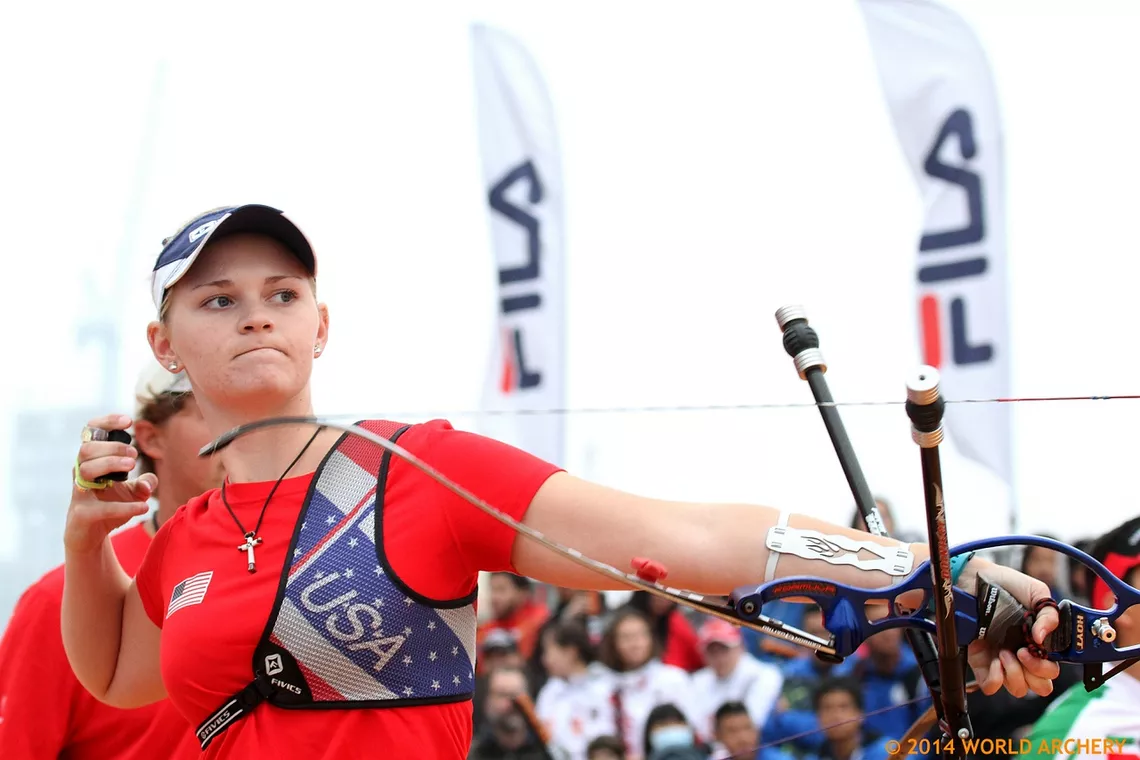
By 2014, the mixed team format was evolving. At the first stage in Shanghai, the recurve mixed team final was decided under the now-familiar set system: four arrows per set, two per athlete, first to five set points wins. The change sharpened the contest, creating natural crescendos every few minutes.
The USA pairing of rookie Mackenzie Brown and Brady Ellison, who already had two World Cup titles under his belt, defeated Mexico’s formidable duo of Aida Roman and Juan Rene Serrano Gutierrez in a composed performance. Brown, just 19, later said she felt little nerves in her first World Cup final – a testament to the partnership dynamic.
With the set system, momentum could flip quickly; confidence and cohesion mattered as much as form.
The gold in Shanghai marked more than a podium finish. It confirmed mixed team as a fully realised discipline, complete with its own identity and unmistakable drama.
3. Medellin 2022: Brazil proves Korea is beatable
Korea’s dominance in recurve is beyond dispute – the nation’s women claimed a 10th consecutive Olympic team gold in Paris – and their mixed team competitors carry the same aura. Which is why Brazil’s bronze-medal win at the fourth stage of the 2022 World Cup in Medellin felt so significant.
Ana Luiza Sliachticas Caetano, just 19, and in her third World Cup appearance, teamed with veteran Marcus D’Almeida to defeat Olympic championsAn San and Je Deok Kim, 6-2. Even a perfect 40 from Korea in the third set could not swing the match.
“Korea is difficult, but it is not impossible,” D’Almeida said afterward, smiling toward his teammate.
It was a reminder that mixed team compresses pressure – and that belief, shared across the shooting line, can topple even the sport’s most established powers.
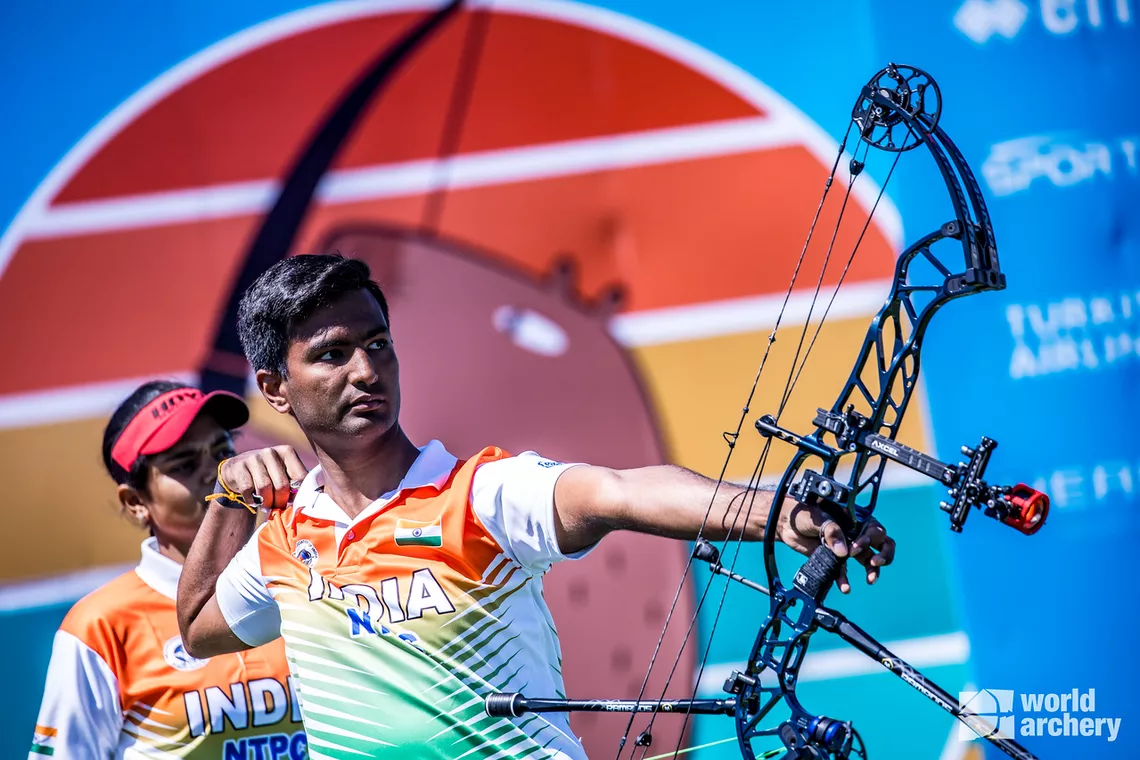
4. Central Florida 2025: India seizes the LA28 moment
In Central Florida in 2025, the compound mixed team competition carried new weight. Just days earlier, compound mixed team had been confirmed for debut at the LA28 Olympic Games – the first time since 1972 that a new bowstyle would be added to the Olympic programme.
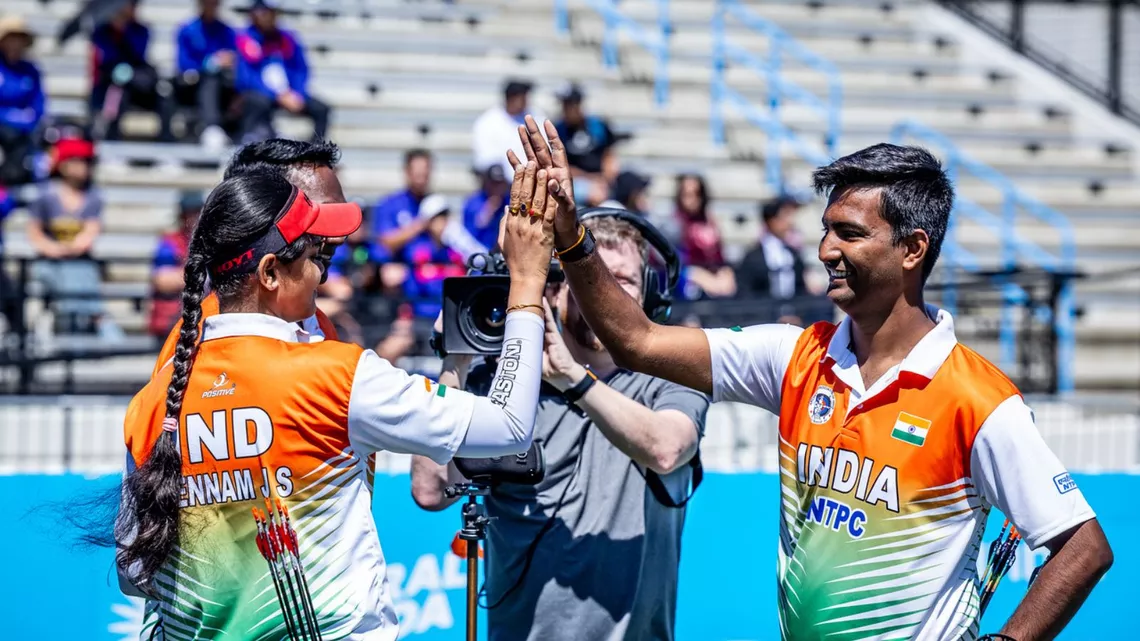
India’s Jyothi Surekha Vennam and Rishabh Yadavrose to the occasion in the opening stage of the World Cup season. In a tense four-end final, India edged Chinese Taipei’s Chen Chieh-Lun and Huang I-Jou, 153-151, holding their nerve as the stakes for the discipline shifted overnight. Seeded fifth, they navigated a demanding bracket – beating Spain, Denmark and Slovenia – before delivering when it mattered most.
The victory was a stage win, yes, but also a starting line. For compound archers worldwide, LA28 was no longer an abstraction. It was coming – and India had claimed early momentum.
5. Antalya 2025: Estonia, Türkiye and the 11-ring
The third stage of the 2025 World Cup in Antalya was a test event in more ways than one. Alongside a shortened qualification round and condensed schedule, the World Cup trialled a significant change: turning the X-ring into an 11-ring during competition.
In the bronze medal match, Estonia’s Meeri-Marita Paas and Robin Jaatma faced Türkiye’s Emircan Haney and Hazal Burun. The margin was razor-thin. Estonia needed an 11 with the final arrow.
An 11 was needed. An 11 was delivered.
Jaatma’s final shot landed in the newly elevated ring, sealing a 159-158 victory and Estonia’s medal. It was a perfect encapsulation of mixed team’s evolution: innovation meeting execution, format meeting fortitude.
As scoring margins tighten at the top of compound archery, the 11-ring may prove decisive. That day in Antalya, it already was.



Puebla remplacera la Floride en 2026
Des débuts prometteurs pour Er’rahmouni
Huit équipes classiques à LA28
Shanghai 2025: Comment suivre

Guide de la Coupe du Monde de tir à l’arc
L’équipe de France pour le début de saison