Kaufhold and Ellison: The partnership behind a Paris 2024 mixed team bronze

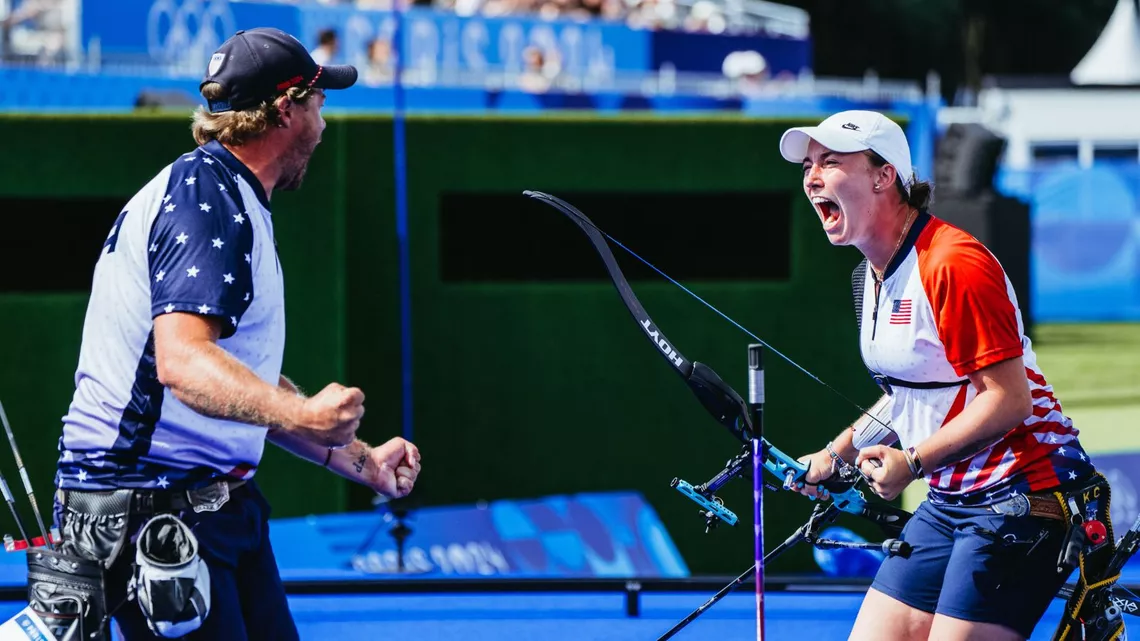
As part of World Archery’s mixed team campaign and ahead of the 2026 Hyundai Archery World Cup season – which marks the circuit’s 20th anniversary – the spotlight is on the partnerships that define the discipline.
Few have been as consistent as Casey Kaufhold and Brady Ellison.
The USA is the most successful mixed team nation at the World Cup across stages and final – across both recurve and compound.
At the Paris 2024 Olympic Games, World Archery named the USA’s bronze medal its favourite mixed team moment of the Games.
It was more than a gritty and entertaining performance in Paris. It was also a redemption story for Kaufhold, after the fourth seed was knocked out of the individual competition early – while it delivered Ellison a fourth Olympic medal, the most any American archer had ever collected, and not his last that week.
For this year’s Mixed Team March initiative, we caught up with Kaufhold as she prepared for The Vegas Shoot.
This summer will mark the midway point between Paris and the LA28 Olympic Games, where – with the debut of compound competition – mixed team will become a more prominent part of the schedule than ever before.
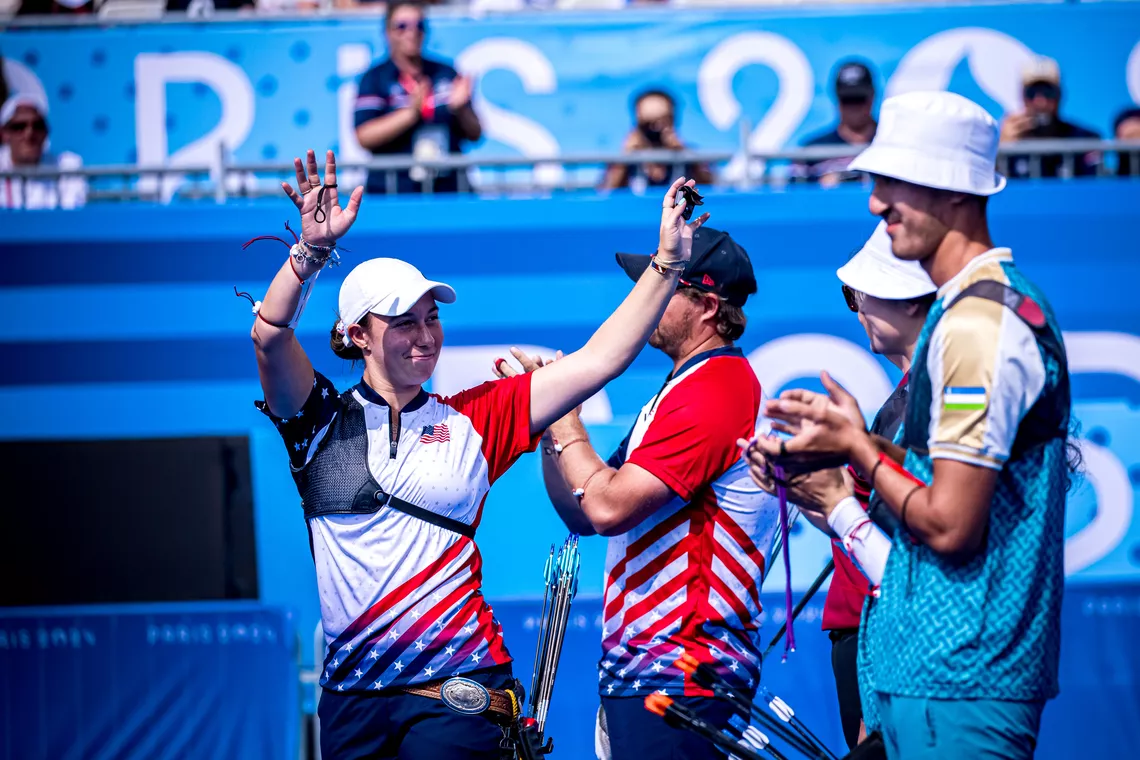
Kaufhold and Ellison have been working together as a mixed team for several years, including winning a World Cup stage in Paris in 2022.
That kind of connection is often a key factor in mixed team success – part of the broader calculation behind how teams are selected.
But the immediate build-up to the Games was not auspicious.
“We were qualifying well, we were shooting well, we just weren’t winning matches,” she said. “A lot of those situations where it’s like: you shot good, but it’s just not your day.”
“Through 2024, I didn’t feel we were thought of as the favourite.”
“From the outside, I didn’t feel as if there was any pressure. I honestly felt more pressure on my individual performance than anything. Brady and I had so many conversations at those World Cups when we weren’t podiuming, it was kind of: ‘the time’s not right yet, we’re waiting to peak in Paris’.”
“From the outside, I didn’t feel as if there was any pressure. I honestly felt more pressure on my individual performance than anything. Brady and I had so many conversations at those World Cups when we weren’t podiuming – it was kind of: ‘the time’s not right yet, we’re waiting to peak in Paris’.”
“We went through three World Cups with nothing. But then we got to Paris and we both qualified so well. I was like, ‘Yeah, this is the time.’”
Kaufhold qualified fourth individually with 672 points, behind China’s Yang Xiaolei and Korea’s Lim Sihyeon and Nam Suhyeon.
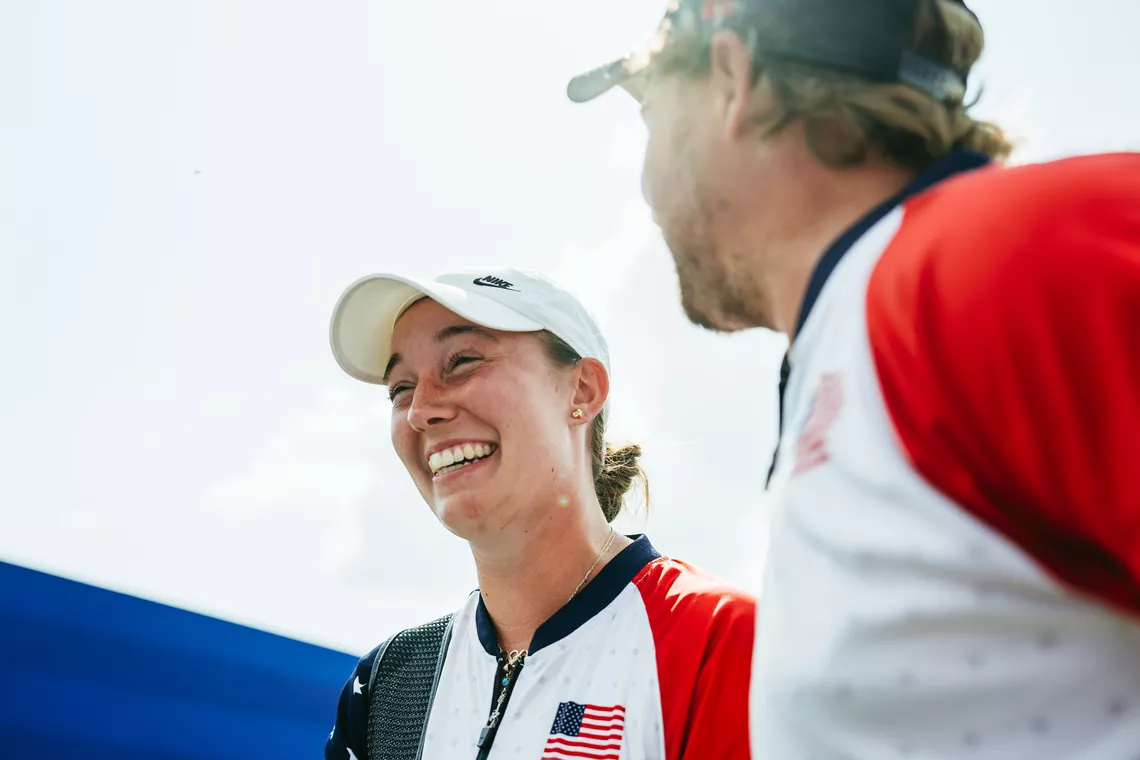
But disaster struck the day before the mixed team event, when she was eliminated by Chinese Taipei’s Lei Chien-Ying.
“I’m such a believer that everything happens for a reason,” said Kaufhold. “I took a lot of lessons from that and applied them to the next day, which was mixed team, and we walked away with a medal.”
“Who’s to say that if I had done a little better, but didn’t have those learning lessons, mixed team would have turned out the same? You don’t know.”
“It just wasn’t my time yet. I had a lot of conversations with my coach Heather [Pfeil] and with Brady, and with coach Chris Webster. I was so upset, but they were all like, ‘You’re not done yet. You have a great chance to bring home a medal tomorrow.’”
As third seeds, the USA pushed aside Uzbekistan in the first round, 6-0.
“I remember that first match against Uzbekistan. I felt like I could not miss. I don’t know honestly how many tens I shot, but it felt like a ton. I just felt so solid.”
The next match was a sterner test. Japan shot a 40 in the second set, but Kaufhold and Ellison held firm to come through 5-3 and reach the semifinal against Germany.
“I don’t believe we left the yellow the whole time until the wind switched up on us a little bit in that semi,” she said. “We had some eights there – as much as you try to be perfect, it was just one of those things. We both missed a bit of breeze and hit the same spot, low right eight.”
“Germany figured it out and we didn’t. They deserved to go on to the gold, and we were still happy to go for bronze.”
“I wasn’t even really upset that we weren’t going for the gold medal. We still had an opportunity to compete for a medal, so we were going to go win it, no matter what colour it was.”
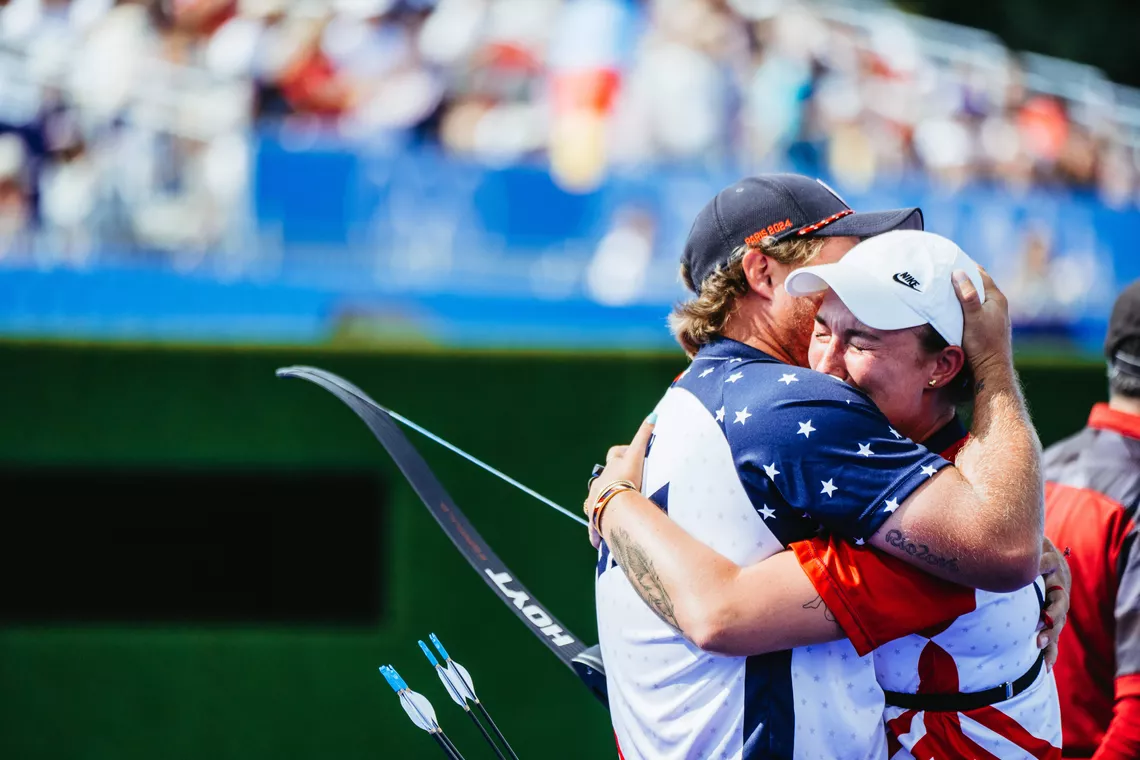
Waiting for a final at an Olympic Games is not a glamorous affair. Athletes are herded into a call room with little more than a few plastic chairs and told to wait.
In Paris, it was a gloomy tent just behind the main stage, but the pair had a well-rehearsed routine to keep nerves at bay.
“There is nothing really serious going on until we step on the stage. When we step on the stage, of course it’s business, but in that tent behind the scenes, we’re cracking jokes, drinking Gatorade, watching the match before us and talking about whatever funny things we see in the crowd – just trying to keep the atmosphere light, because that’s what we thrive under.”
“There was a moment where Brady had to talk me down. When we beat Japan and I knew we were into the semis, I was so excited.”
“He was like, ‘I get it, this is exciting, but you’ve got to stay at that same level. Once we’re done, we can celebrate as much as we want – but right now we need to keep that level of intensity and not get too excited.’”
It was time. The bronze medal match against India began, and the USA edged the first set 38-37.
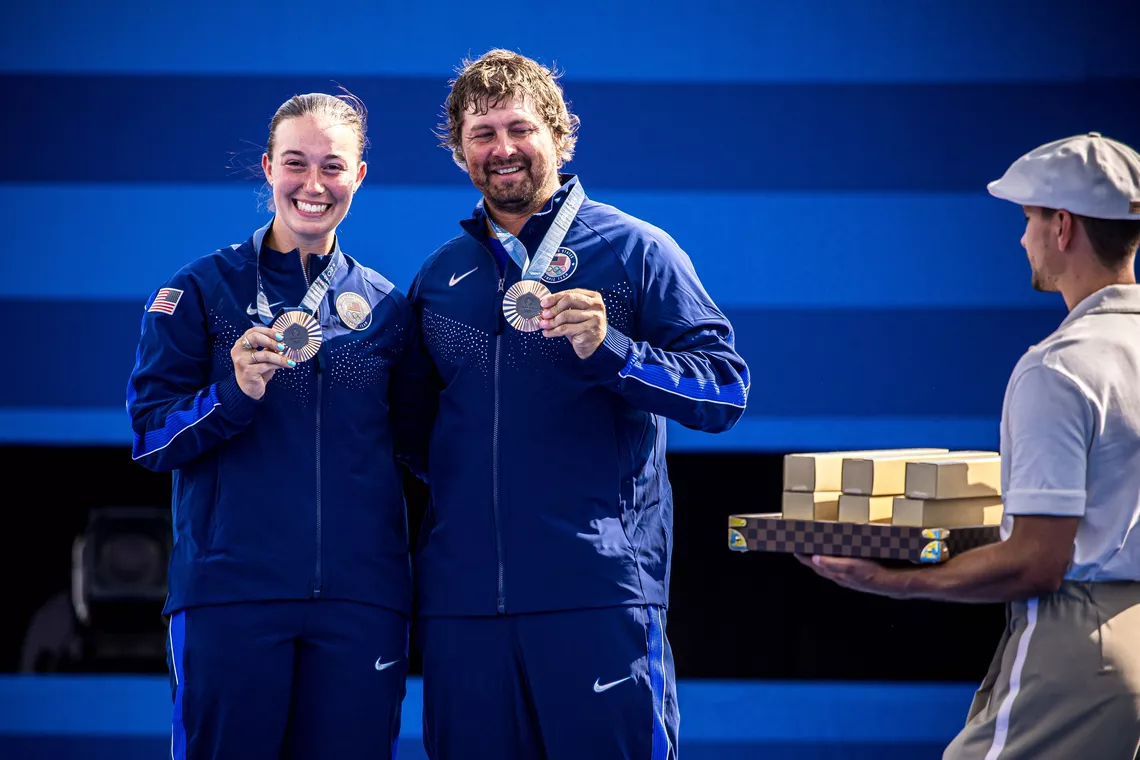
Mixed team communication is vital. What did Brady tell you on the stage? “He tells me a lot like, like, "remember your breathing", "good timing", "just be comfortable", you know, "shoot your shot", "nothing special".
The communication was not all one-way. “When I get up there and put a shot in the middle that feels good but hits a right nine, I’ll say, ‘Okay, that one drifted a ring.’ It’s just so we’re on the same page.”
With a headwind picking up, Kaufhold and Ellison knew they had to execute strongly.
“I want to shoot every arrow as if the other team has shot perfect the whole time. When I went back and watched the match, I was like, ‘Oh wow, we had quite a lead going into that last set.’ But in the moment, I didn’t even think about it. I just had to shoot one more good arrow.”
The good arrows came. The USA won 3-1, with Kaufhold closing out the match with a nine.
“I don’t remember going as crazy as I did,” she smiled, remembering the emotions that poured out of her. “Anytime I watch it, it makes me tear up.”
“Relief is the biggest emotion. When you put your whole life into something and you see it pay off – hundreds of thousands of arrows, so many hours, all the travel, all the time away from home – and it finally comes together.”
“But I was so grateful to see that Brady was as equally as excited as I was.”
The next few hours were a whirlwind of celebration, media duties and – for Kaufhold – the less glamorous experience of random drug testing.
“We finished the match around 2.30pm, but I didn’t get to see my family until 7pm. All I wanted to do was see them. When we finally met, I don’t think we even exchanged words. We just cried.”
“To have them there, part of the experience of me winning my first Olympic medal, was very special. Of all the things I did in Paris, my favourite memory was getting to see them afterwards.”
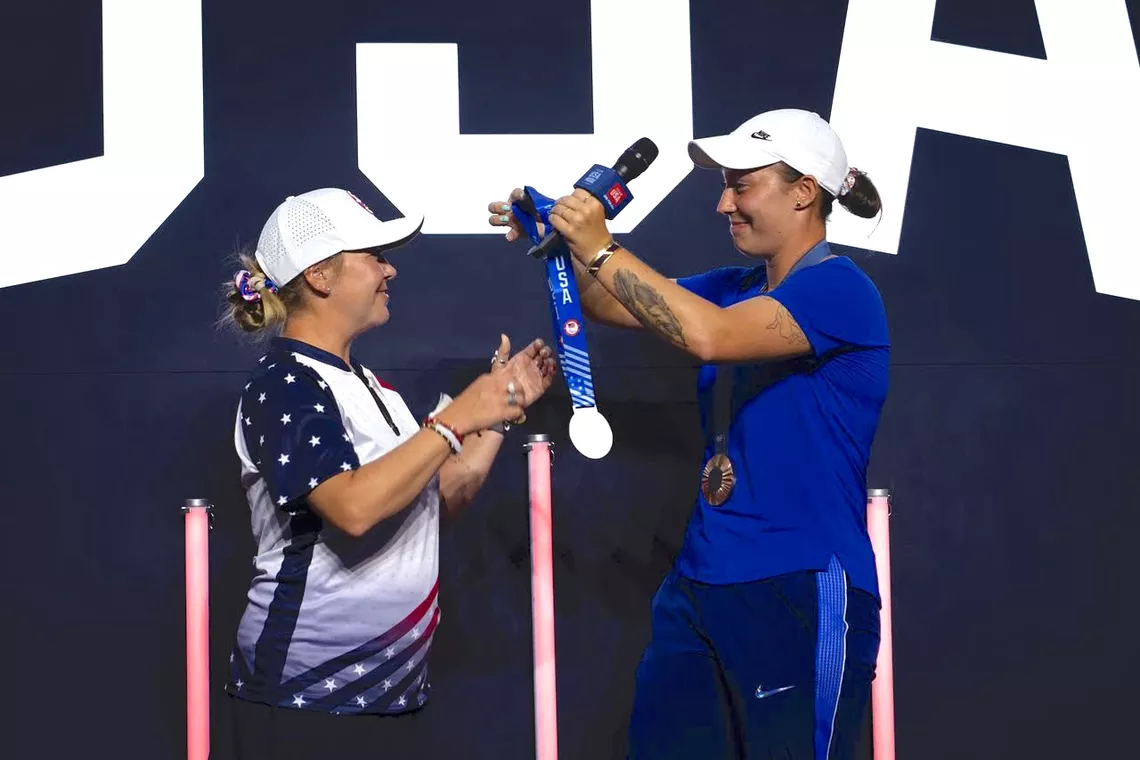
Like many nations, the USA hosted athletes at a team base during the Games. Kaufhold and Ellison attended a ceremony at USA House, where medal winners take part in a unique tradition: awarding the Order of Ikkos to someone who has supported their career.
Kaufhold presented hers to coach Heather Pfeil, while Ellison honoured then head coach Chris Webster.
“I was very honoured to award that to Heather. She’s worked with me since I was 10 years old.”
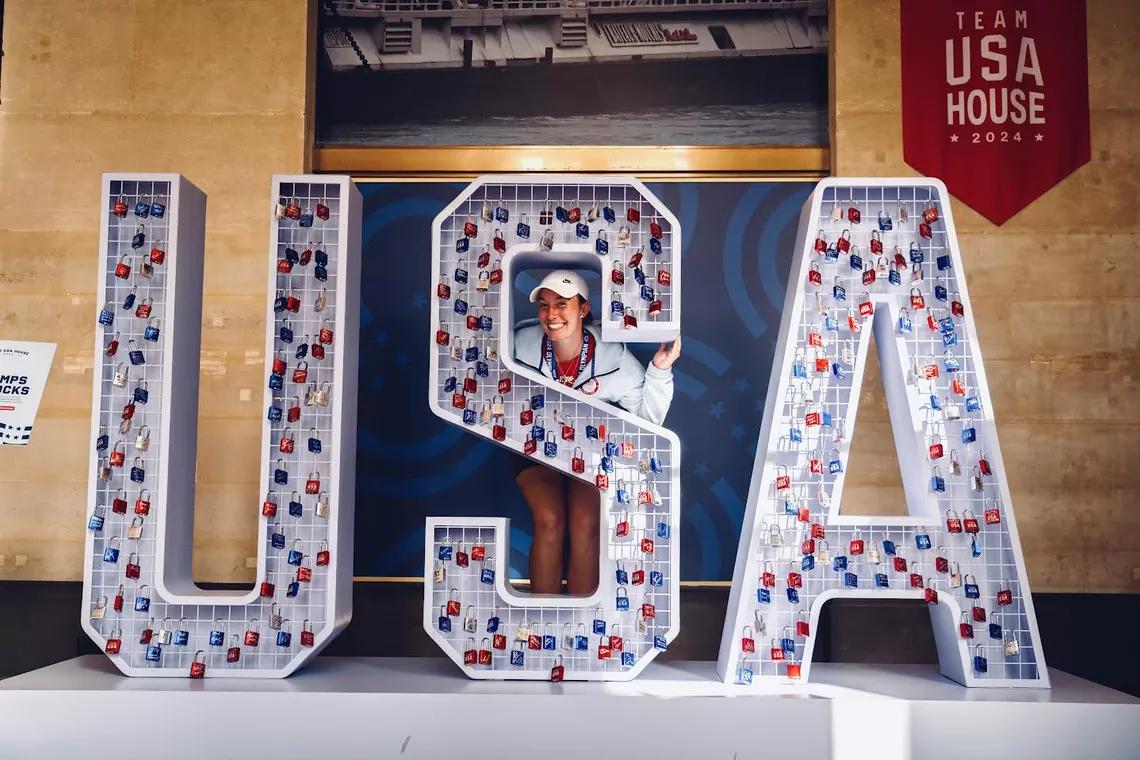
With LA28 on the horizon, Kaufhold is already looking ahead.
“Being able to shoot in your home country at the Olympics is a very special thing. When I talk to Justin Huish about Atlanta, he says it was the coolest thing – winning a medal on home soil. I’m really excited about that feeling.”
“I wouldn’t say I have expectations, but I do believe everything happens for a reason. Could Brady and I have won gold in Paris? Probably. Would it be even cooler to win gold in LA? Yes, definitely.”
Expectations may be measured, but Kaufhold’s focus is clear.
“I use every tournament – indoor, outdoor, field, 3D – whether it’s just for fun or a big competition, as preparation for the Olympic Games. Any time I step on the line, I’m trying new things, testing equipment.”
“All of those are steps toward the Olympics. In my mind, that’s why I do this.”
Last two images courtesy of Casey Kaufhold.


Top 5: Les meilleurs matchs en double mixte
L’épreuve du double mixte à Tokyo