Indian traditional bow gifted as coaches complete level 2 course in Lausanne
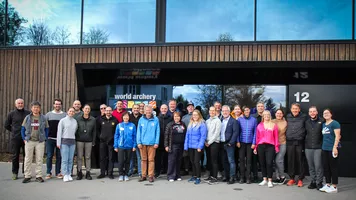
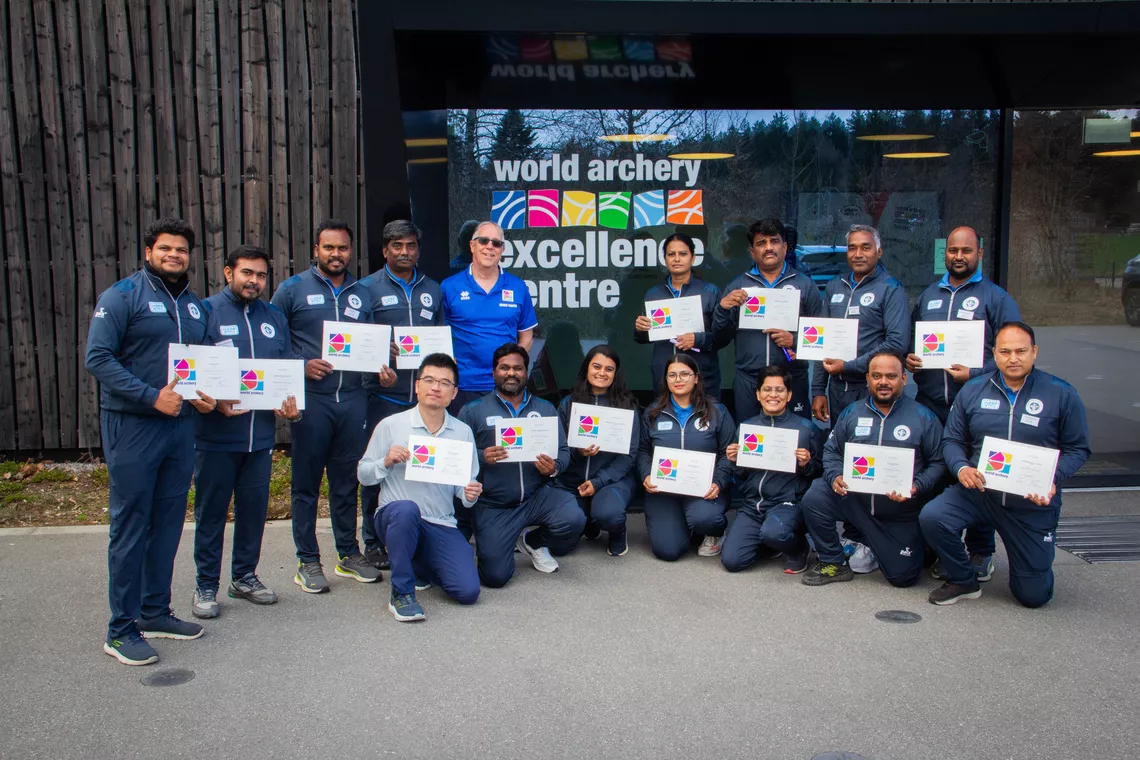
The World Archery Excellence Centrein Lausanne hosted a group of coaches as part of a level 2 coaching course from 23 to 27 March 2026.
Fifteen participants (four women and 11 men), including 14 from India and one from Chinese Taipei, successfully completed the programme. The course was led by Tim Swane (Great Britain), supported by Bernardo Oliveira (Brazil).
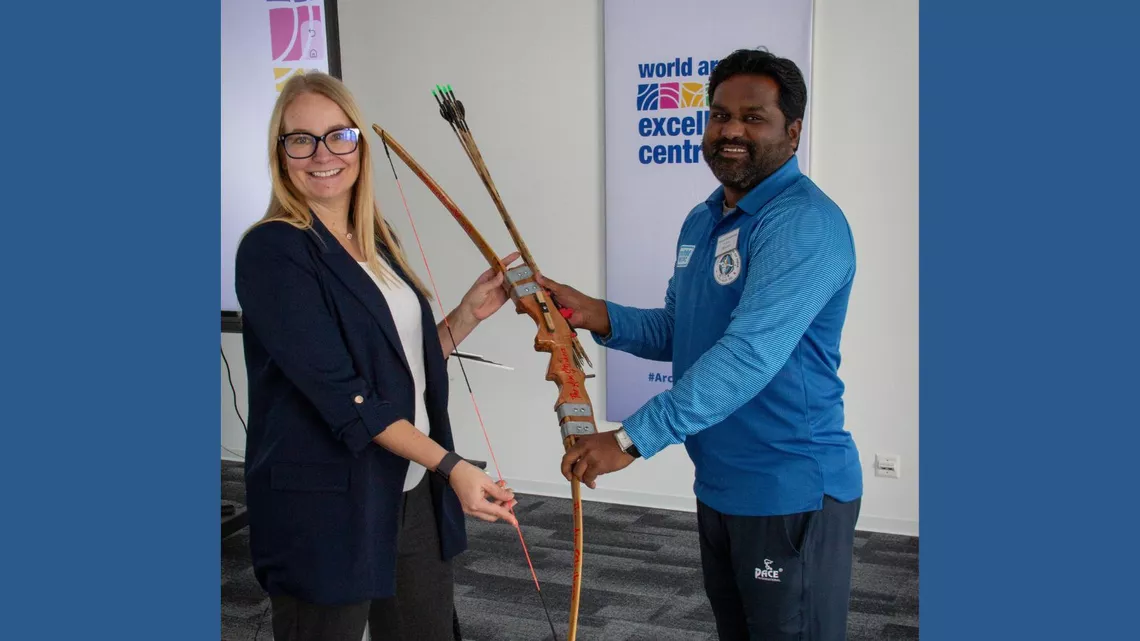
During the session, delegates presented Siret Luik, World Archery head of education, with a traditional Indian bow. Crafted by Ganesh Vishwakarma, one of the participating coaches, who also successfully completed the course, it will now be displayed at the Excellence Centre.
“I am happy to add a bamboo bow from India to the display in the World Archery Excellence Centre,” said Luik. “We already have a collection of ancient bows and arrows from Peru, previously gifted by one of our members.”
The traditional Indian bow plays a central role in grassroots archery development in India. While it performs similarly to a recurve bow, it can be produced at a significantly lower cost, making the sport more accessible.
“We cannot deny that high-level archery equipment can be expensive, especially when it needs to be imported,” said Luik. “This bow is an excellent example that, in a lack of resources, we need to be more creative – a symbol of seeing a solution instead of a problem.”
She added that bamboo bows contribute significantly to grassroots development and the popularisation of archery in India.
“At a coaching level, these bows are a great way to teach good recurve technique at a really affordable price,” said Swane. “They behave like a high-performance recurve but allow for much greater participation of children where families are on a tight budget.”
At any given time, approximately 100,000 archers across India train using this equipment. Some continue to use it throughout their careers, while others transition to standard recurve equipment as they progress.
The bow features a wooden riser, typically machined from teak, paired with bamboo limbs. These limbs are produced in a range of draw weights and can be replaced as the archer develops strength.
Arrows are manufactured from a specific type of bamboo grown in northwest India, known for its longer segments, which allow for straight and consistent arrow shafts. Bamboo is also used in the stabilisation system.
A full set of equipment – including bow, arrows, bow bag, stabiliser, quiver, armguard, sight and finger tab – can be assembled for approximately USD 55. All components are produced locally, supporting both affordability and accessibility.
Competitions using the Indian bow follow standard formats. Junior athletes shoot at 30 and 20 metres, completing 12 ends of three arrows at each distance for a total of 72 arrows.
Senior athletes shoot at 50 and 30 metres under the same format. Despite the simplicity of the equipment, competition standards are high and participation levels remain strong.
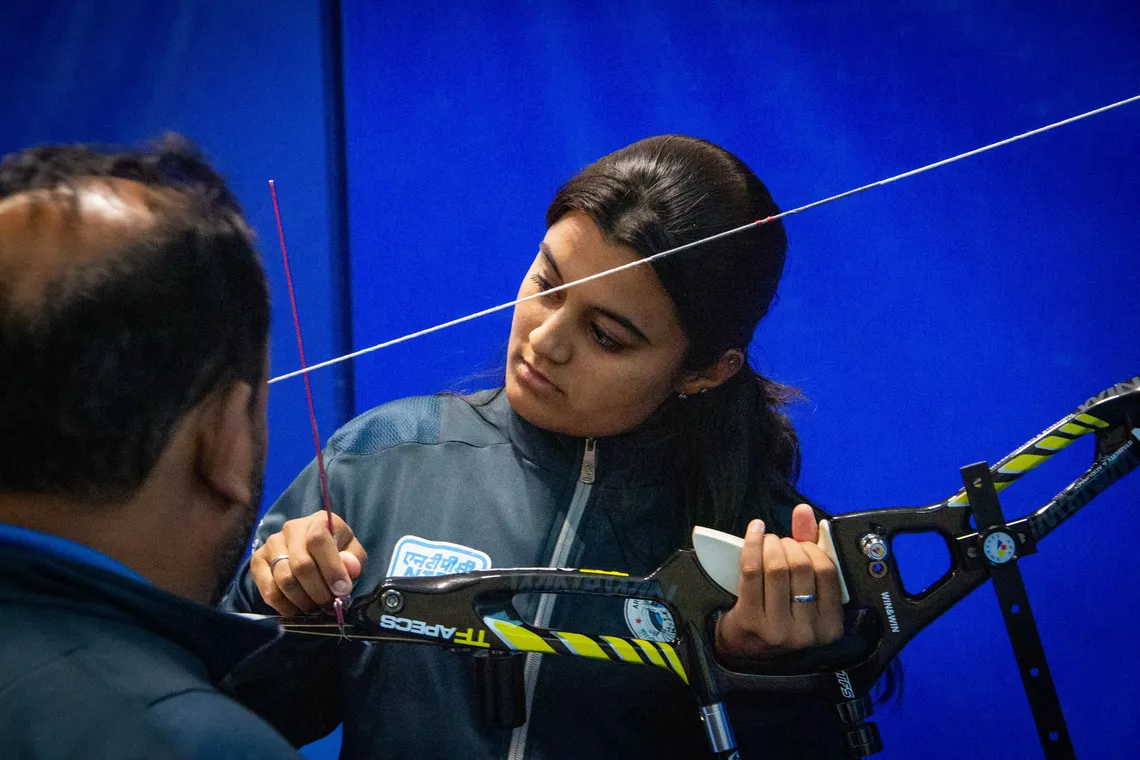
The intermediate-level course held at the Excellence Centre focused on developing coaching competencies in athlete progression, technical analysis and training planning.
It also covered equipment optimisation, including recurve and barebow setup and tuning, alongside key technical elements such as pre-draw, expansion, balance and breathing.
Delivery combined theory and practice through observation, video analysis and practical coaching assessments, with additional modules on athlete psychology, nutrition, strength and conditioning, and preparing archers for competition.
The level 2 course followed a level 1 session delivered to another group earlier in March, as part of a structured coach development pathway. A level 3 course is planned as the next step, continuing to build coaching expertise within the national system.
Opportunities to take part in coaching courses at the Excellence Centre are available throughout the year, with registration open via the Centre’s website.


L’heure de vérité pour Monsieur Oh
Wilde nommé entraîneur poulies en Corée