
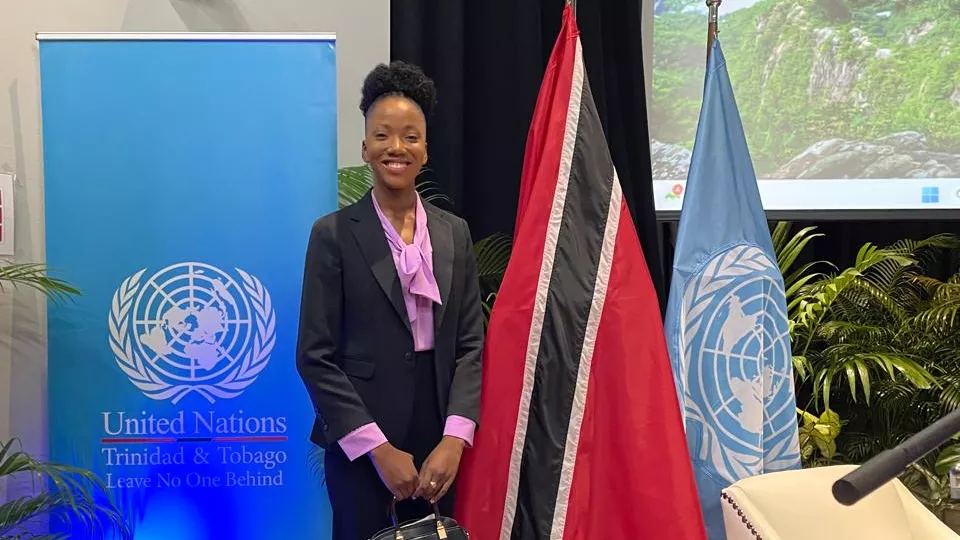
No matter how many times people mention it, Anthurium Lewis has never lost sight of how old she is.
The 17-year-old archer, coach, non-profit leader and child rights ambassador has been hearing about it since she was 14, when she founded Fruits For Tomorrow to plant native fruit trees and tackle food insecurity on her home island of Tobago.
“When I talk to adults and they bring up my age, I think there’s almost a level of comparison that they start doing in their heads,” the six-time Trinidad and Tobago archery champion said last month while preparing for the Afro-Latin-Caribbean Youth Congress in Panama, where delegates drafted a declaration focused on youth empowerment and regional collaboration.
“It’s been really interesting to see people realise that age is not a barrier to the things that you can accomplish.”
Even at a young age, Lewis saw what needed fixing. Native fruit trees were disappearing across Trinidad and Tobago, while too many of her classmates came to school without snacks or lunch.
While many of her classmates were content to let adults take the lead, Lewis wanted to be part of the solution herself. She had not yet learned to temper her expectations. The same determination that carried her to her first archery titles told her she could make a difference.
“My first gold medal was a big eye-opener because I realised I can do this, and that if I keep pushing, there are no limits to what I can reach,” Lewis said. “There are no boundaries that I can’t cross. Because when you put your mind to it, you can do anything.”
Her work with Fruits For Tomorrow earned Lewis a place among the UN’s Young Leaders for the Sustainable Development Goals in 2025, a distinction that attracted more than 33,000 applications from over 150 countries.
Lewis, who also coaches archers up to three times her age, said her sporting background has helped her overcome obstacles in pursuit of her goals. While competing at a high level could easily crowd out everything else, she believes her different roles reinforce one another.
“I think they all kind of complement each other,” she said. “Interacting with people of varying ages, both big and small, helps me develop those social skills. When I’m ready to deal with my foundation and go out and meet people and build community with others, I’m able to be a lot more compassionate and understand people or situations and actually reach them where they are.”
She admits she sometimes has to “flip a switch”, depending on who she is speaking to.
“If you were to ask a close friend about my personality, as compared to someone who I coach professionally, or a government official who I have a meeting with, they would probably describe two different people,” she said.
“There’s a certain posture, or a certain stature, that you have to adopt so that people actually listen to you and take you seriously.”
That same determination carries over to her advocacy work. Rather than scaling back projects when resources are limited, Lewis focuses on finding a way to make them happen.
“No matter the situation, I will not stop until I get the resources that I need to do the projects that I need to do, because I know my community deserves it,” she said.
“It’s the same mindset of pushing through challenges in archery and not giving up. Because once you change your mentality, you can do anything.”
Connecting with children, Lewis said, comes naturally. Fruits For Tomorrow has grown well beyond that first overgrown garden, reaching classrooms, community groups and churches, where she distributes seedlings of sapodilla, soursop, pomerac, breadfruit, custard apple, shaddock and primrose, encouraging children to plant them themselves.
She regularly visits schools to hand out native fruit trees. Lewis recalled one in particular where an abandoned garden – part of an old agricultural programme the school had let lapse years earlier – had become overgrown.
When she returned two months later, the garden had been cleared, the trees were thriving and the pupils were proudly tending to the plants.
She wants other young people to have the same opportunity to make a difference that she has had.
“Why not now? Why not me? Those are questions I ask myself all the time. Why wait for it to be someone else 10 or 15 years down the line when climate change is already affecting us? So why should I wait?”
Rather than waiting for someone else to act years down the line, Lewis believes young people should take the initiative now, particularly as climate change is already affecting communities around the world.
In July, Lewis heads to UN headquarters for a week of meetings, including one focused on sport and mental health. She hopes to find an opportunity to talk about archery specifically and bring some attention back to the sport that started it.
“There’s a saying: if you always wait until you’re ready, it will never get done,” she said.
“I try to do whatever I can right now, because you don’t know what’s promised. I use every day to make some type of impact on this world.
“I think even one drip in the bucket can make an impact if everyone around the world continues to add their own drips, because together they can fill the bucket.”


La révélation Alicia Baumert
Des débuts prometteurs pour Er’rahmouni
Caroline Lopez, la maturité à 20 ans
Schwarz, l’amitié franco-allemande

Acha, le plus Français des Espagnols