From Singapore 2010 to Dakar 2026: Alice Ingley’s full-circle moment

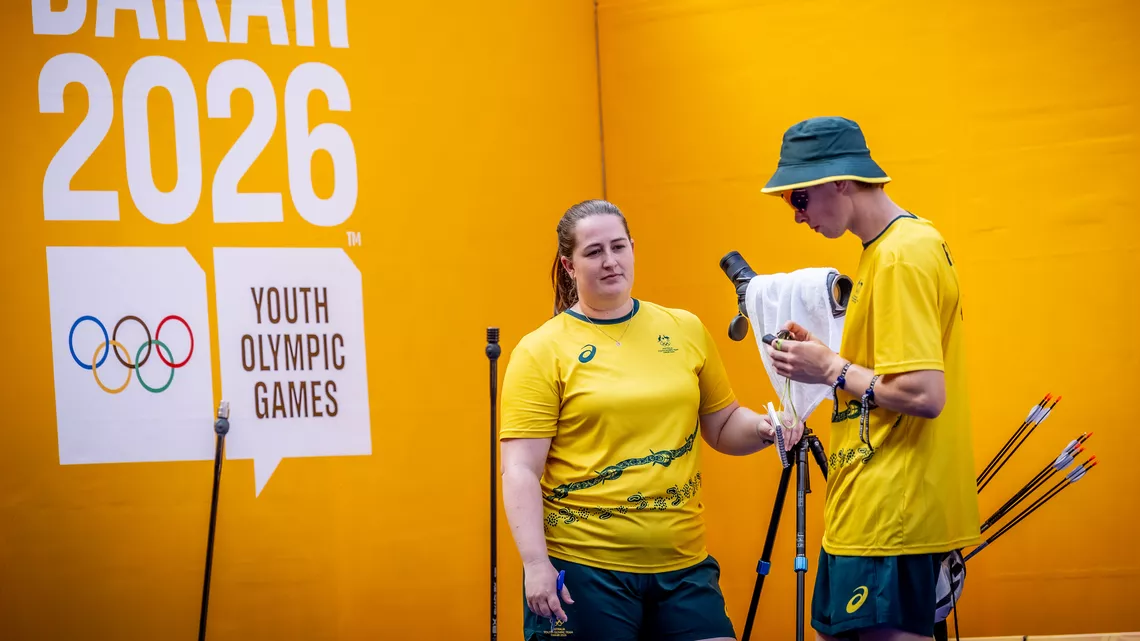
“Being in a stadium with that presence, with a lot of crowds coming in, it felt like it got bigger for sure,” was Alice Ingley’s response when asked to compare the Dakar 2026 Youth Olympic Games to Singapore 2010.
The Australian competed 16 years ago at the first Youth Olympic Games – back when the recurve archery categories were up to under-21 level, rather than under-18 – which became a key part of her journey to becoming a senior Olympian at Rio 2016 and Tokyo 2020.
At the same event nearly two decades later, one thing that stood out to Ingley was the sheer growth of archery within the Olympic movement in terms of magnitude and popularity.
In Singapore, there were only a few temporary stands built around Kallang Field – a sports field just outside the island nation’s national stadium – whereas in Dakar, ranking rounds and matches took place inside the 50,000-seat Abdoulaye Wade Stadium in Senegal’s capital.
Schoolchildren, general fans and archers’ families busily filled the open sections during qualifications and matches, something unheard of in archery, which Ingley herself called “quite weird”.
Standing on the shooting line there as a 33-year-old, however, it wasn’t this growth that hit Ingley, but the full-circle moment she found herself in.
The first Youth Olympic Games was her maiden appearance on the international scene, and now the latest edition was the biggest event she had attended in her newfound role in Australian archery, as a coach.
“I think definitely walking out there and having a similar feel, I suppose, it hit me in a way that I didn’t expect,” said Ingley, who finished ninth individually and fifth in the mixed team event in Singapore.
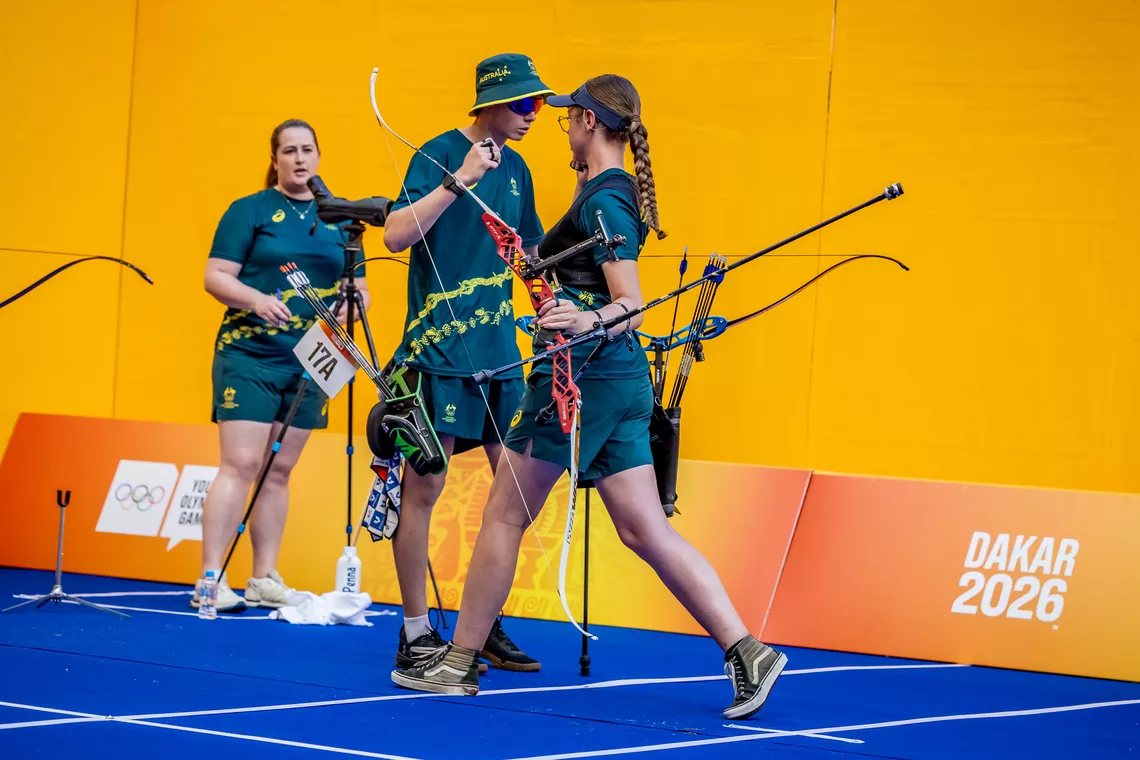
“It wasn’t in an emotional way. It was more just that full-circle feeling, and it did make me reflect on how I can help them because if I had that for my coach in the Youth Olympics before, and knowing I can help them go on to the Olympics, I can help their career, knowing what I know now.”
“It made me want to give them as much as I can so that I can see them achieve all their dreams moving forward. So, not emotionally, but it definitely hit me.”
There is a great, humorous irony that Ingley recognises in passing on her knowledge to the next generation of Australian archers, who in Dakar were Brock Penna and Ellen Martini.
Working as a manual labourer for a freight company during her shooting days, Ingley had no experience of teaching anyone when she retired from the sport following Tokyo – due to the sheer cost of archery – nor did she have any intention of doing so at any point.
In fact, the Perth-based Ingley would laugh off the notion whenever teammates at her club or anyone else suggested she had the natural skillset to be a good coach.
“I think I was never wanting to teach or stand in front of crowds or things like that. It was always something I just never wanted to do, and so when people would bring it up, I was like, ‘No, it’s not going to happen.’”
“But when I went into coaching, it was more to give back to the sport that had basically given me a lot and all the opportunities that came with it, so I kind of just fell into a coaching role.”
In other words, old habits never die, and the itch to come back was insatiable for Ingley.
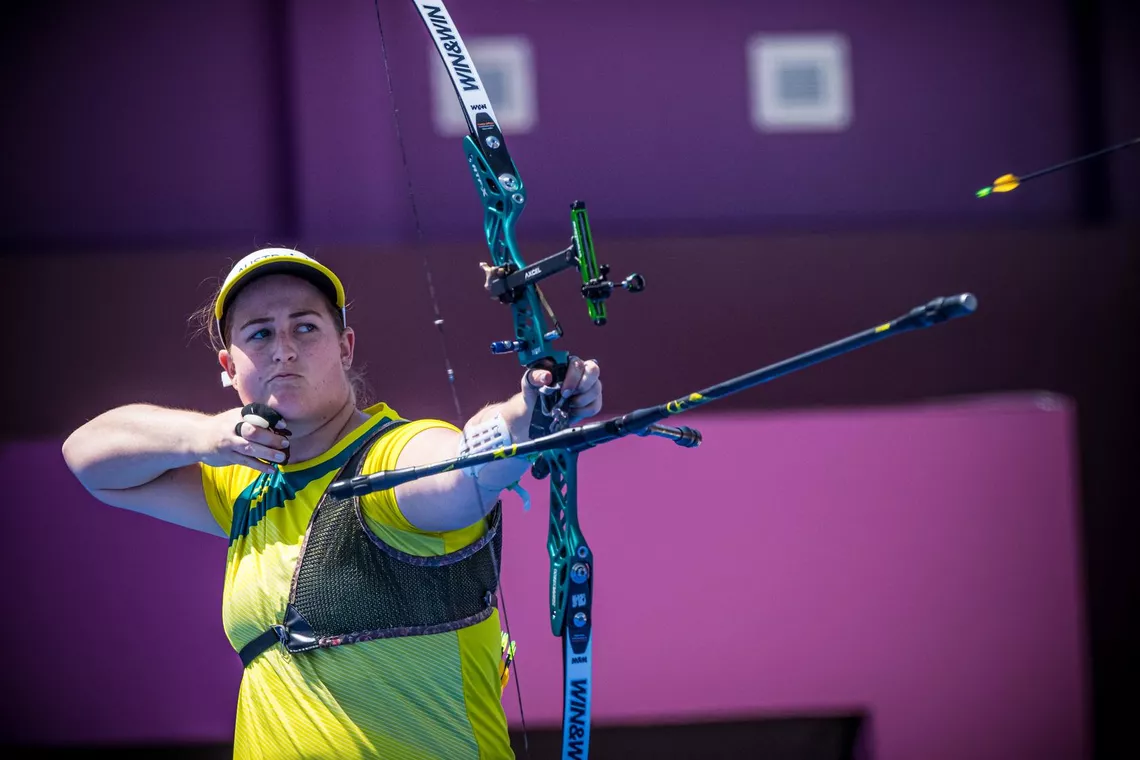
Turning her back on an athletic career in which she travelled the globe as a youth and then an adult was so painful that she even forced herself not to shoot a recurve bow, a restriction she has imposed on herself since 2021 and still sticks by.
Only recently has she started shooting again with a compound bow as a “social hobby” and to improve her understanding of the bow now that she coaches Australia’s best in the modern bow category.
Recurve, on the other hand, really is still an all-or-nothing mentality for her, and when asked whether she has ever thought about returning – let’s not forget Ingley is only 33 – a firm no remains her answer.
“I never let myself get to that point,” she succinctly responded. “I’ve probably got to rein myself in if I go too far with compound, but I just can’t go into that recurve space without tipping back into that.”
The coaching role that Ingley did fall into happened to be almost the perfect role at the perfect time.
After a period in which she wanted to reinvolve herself in the sport but wasn’t sure how, she successfully became assistant coach to the legendary Simon Fairweather – Australia’s sole Olympic gold medallist in archery – who returned as head coach of the Australian national team following his 2011-2013 stint.
It also coincided with the announcement in early 2025 that the Australian Institute of Sport in Canberra would now house a brand-new centralised performance centre – Archery Australia’s Centre of Excellence.
Having previously travelled to Canberra to train at the Institute’s old centre before it closed in 2013 – and was subsequently converted into a football centre – it is once again Ingley’s second home.
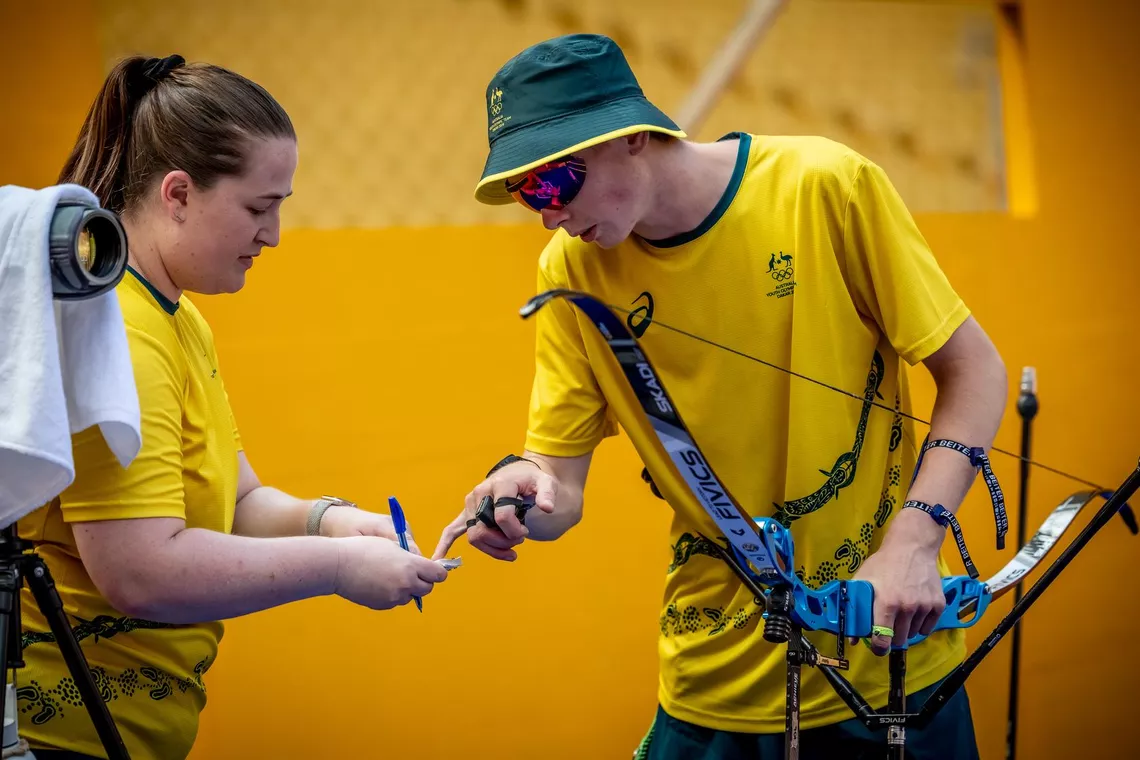
As well as being assistant to Fairweather with the seniors, Ingley is the main coach for the youth team and, just like her 50-hour trip to Dakar, can expect to go on some longer trips next year for the World Cups and World Championships.
As well as assisting Fairweather with the senior team, Ingley is the main coach for the youth team and, just like her 50-hour trip to Dakar, can expect to go on some longer trips next year for the World Cups and World Championships.
The return to the competitive cycle is what she wanted, and Dakar was not only a full-circle moment for Alice Ingley as a former athlete but an emblem of the next phase in her career.
“I knew what I was seeking and what I was looking for,” she concluded. “I think when I thought of teaching, it was always, ‘No, it’s something I can’t teach, I don't know anything about that.’”
“But at least within archery, I’ve grown up in it and I understand it, and I’m able to give that knowledge and experience back as well.”


L’heure de vérité pour Monsieur Oh

Wilde nommé entraîneur poulies en Corée