This content is archived and as has not been processed. It may contain unformatted text or images, broken links or out-of-date information.
Information No. 10 from FITA Judges and Coaches Committees Lausanne – 22 February 2011 Information to Coaches In 2009 there were many competitions where archers were either confused or just did not know the rules or regulations currently in place. This resulted in many delays being encountered during competitions which caused frustration to the competitors and organisers alike. Because of this the FITA Judges and Coaches Committees have agreed it would be useful to introduce some "drops" on issues concerning coaches, procedures and rules, and make judges procedures understandable to them, and not least, so the coaches know what to expect from the judges. Ken BEARMAN, FITA Coaches Committee Chairman We hereby intend to start a series of small inputs in order to be helpful to coaches and enhance their knowledge on rules and procedures to avoid extraordinary stress on their archers. We are of course also open to questions that might be asked. Morten B. WILMANN, FITA Judges Committee Chairman The 3-metre line On rare occasions an archer drops an arrow (due to a nock breakage or some other reason), or shoots an arrow into the 3metre area in front of the shooting line when in the process of letting down, etc. Judges sometimes observe archers in this situation looking bewildered, not knowing what to do and turn to their coach, or a judge, for advice—and the time is ticking by. Let us take a closer look into this question. As archers and coaches know, an arrow within this area is considered as not having been shot (with exceptions of rebound arrows). Let us clarify this situation: if the rear part of the arrow is within the 3-metre area the arrow is deemed not to be shot. In other words the arrow does not need to lie on the ground, see the picture below. 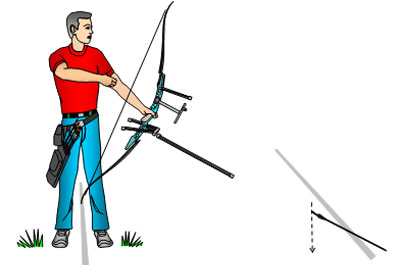 This arrow would be deemed to be inside the 3-metre area. If the above situation occurs during the Qualification Round (or a single round event): The archer has two options: a) If the archer feels confident that no other equipment failure has occurred, and is sure a part of the arrow shaft is within the 3-metre area, the smoothest action is just to shoot another arrow, however they must not step forward in front of the shooting line to pick up any arrow. b) But if the archer knows they will have a time problem, or do not have another arrow at hand to shoot, or is unsure if the arrow is within the area or not, they may take a step back and call a judge, explaining the situation. The judge will then handle the incident as an equipment failure, and at the expiry of that end, the other archers will be held back and the situation will be handled. The archer will have their 40 seconds per arrow to shoot any un-shot arrows of that end before all archers are permitted to go forward to the targets for general scoring. During match play: As archers and coaches know, during a match the time will not be stopped for equipment failures or similar situations. If an arrow falls inside the 3-metre area (for whatever reason), the archer could just have to shoot another arrow within the time allowed, which means that the archer should always have an extra arrow in their quiver. The archer must decide if the arrow is inside or outside the 3-metre area, if there is doubt they should shoot another arrow. If the arrow is inside the 3-metre area, then they would have shot the required number of arrows. If the arrow is outside the 3-metre area it is classed as a miss and the archer will then score the lower six of the seven arrows shot (normally not a big difference between the scores of the arrows in the target). Coaches should ensure that all their archers know what to do and how to react quickly, if an arrow falls or is shot into the 3-metre area. To avoid disputes, coaches should advise their archers that they must not remove any arrow from the 3-metre area before a judge has confirmed its location, particularly if it is a doubtful one. World Archery Communication




Features