This content is archived and as has not been processed. It may contain unformatted text or images, broken links or out-of-date information.
Archive
Largest Universiade concludes as Korea tops archery medals table
Lausanne

Real name:
Largest-ever Universiade concludes as Korea tops archery medals table
Lausanne – 25 August 2011
The 26th Summer Universiade came to an end on 23 August 2011 in Shenzhen, China, concluding the 11-day competition among university athletes. The games were the largest ever, involving a record of 10,603 participants, with 7,132 athletes and 3,471 officials from 151 countries and regions. It also provided the most sports, 24, for 306 events and 949 medals. A total of 14 Universiade records were broken, seven in swimming, six in track cycling and one in archery. The archery competition was held from 14-18 August.
The archery official practice took place on Sunday, 14 August and the competition started the day after. The Olympic team champion IM Dong-Hyun (KOR) and many other great archery names from 34 countries competed in the recurve and compound divisions in individual, team and mixed team events for a total of 30 medals (10 gold, 10 silver and 10 bronze).
On the first day of competition, the recurve mixed team of Korea, represented by KI Bo Bae and KIM Bubmin, set a new Universiade record with 1348 points in the qualification round (previous was 1341).
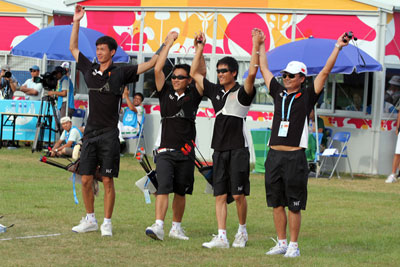 Recurve Men
Several Olympic medallists competed in this category. The most famous was the double Olympic team champion (2004 and 2008) from Korea IM Dong-Hyun. After qualification, however, the No. 1 seed was his fellow countryman KIM Bubmin. Seeded No. 2 was Juan Rene SERRANO (MEX), who finished 4th at Beijing Games. IM was No. 3 and another Korean, the newly-crowned world champion from Turin in July KIM Woojin, was No. 4.
The top 4 seeded athletes all reached the semifinals where the two KIMs faced each other. After a tense match (4-4 after four sets), the new world champion KIM Woojin finally had the last word at 6-4. He was joined to shoot for gold by his teammate IM Dong-Hyun, who defeated SERRANO 6-2.
In the gold final, IM proved superior and easily clinched victory 7-1. Shooting for bronze, the only athlete left to try and prevent an all-Korean podium, the Mexican SERRANO, gave the illusion of being able to win in the first set only. Leading 2-0, he then lost the following three sets to let the bronze medal go to KIM Bubmin (6-2).
In the team event, upset came from the early defeat of the No. 1 team Korea against Japan in quarterfinals. Then, the Japanese then went through Chinese Taipei (No. 4) in semifinals, but finally lost to China photo (No. 7) for the gold medal. The No. 2 seeded team, Mexico, also suffered an early upset, in the 1/8 elimination round against Kazakhstan (No. 15). Seeded No. 3, team Italy was kicked out of the competition in quarterfinals, losing to France who finally clinched bronze over Chinese Taipei.
Recurve Men
Several Olympic medallists competed in this category. The most famous was the double Olympic team champion (2004 and 2008) from Korea IM Dong-Hyun. After qualification, however, the No. 1 seed was his fellow countryman KIM Bubmin. Seeded No. 2 was Juan Rene SERRANO (MEX), who finished 4th at Beijing Games. IM was No. 3 and another Korean, the newly-crowned world champion from Turin in July KIM Woojin, was No. 4.
The top 4 seeded athletes all reached the semifinals where the two KIMs faced each other. After a tense match (4-4 after four sets), the new world champion KIM Woojin finally had the last word at 6-4. He was joined to shoot for gold by his teammate IM Dong-Hyun, who defeated SERRANO 6-2.
In the gold final, IM proved superior and easily clinched victory 7-1. Shooting for bronze, the only athlete left to try and prevent an all-Korean podium, the Mexican SERRANO, gave the illusion of being able to win in the first set only. Leading 2-0, he then lost the following three sets to let the bronze medal go to KIM Bubmin (6-2).
In the team event, upset came from the early defeat of the No. 1 team Korea against Japan in quarterfinals. Then, the Japanese then went through Chinese Taipei (No. 4) in semifinals, but finally lost to China photo (No. 7) for the gold medal. The No. 2 seeded team, Mexico, also suffered an early upset, in the 1/8 elimination round against Kazakhstan (No. 15). Seeded No. 3, team Italy was kicked out of the competition in quarterfinals, losing to France who finally clinched bronze over Chinese Taipei.
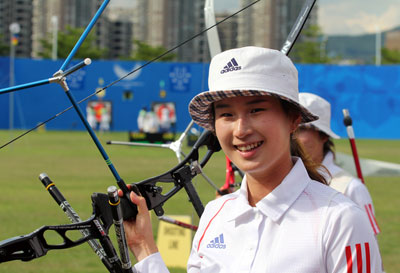 Recurve Women
The big favourites in this category were the three Koreans HAN Gyeonghee, JUNG Dasomi and KI Bo Bae photo, who won several World Cup medals and the team bronze medal together at the world championships in July. And without surprise they topped the qualification round, with KI No. 1, JUNG No. 2 and HAN No. 3. Seeded No. 4 was Kaori KAWANAKA (JPN) and No. 5 was LE Chieh-Ying (TPE).
These two faced each other in quarterfinals for a victory by the lady from Chinese Taipei, 6-4. But LE was then defeated 4-6 by top-seeded KI in semifinals. The No. 11 athlete CHO Peichin (TPE) upset the No. 3 HAN in quarterfinals by 6-5, 10-8 in the tie-break. However, in the following match she was defeated 2-6 by the No. 2 JUNG.
The gold final was therefore an all-Korean match between KI and JUNG, while the bronze final was an all-Chinese Taipei duel featuring CHOI and LE. Leading 4-0 after two sets, KI let her teammate come back into the match shooting only 26 and 27 points in the third and fourth sets. With strong sets of 30 and 29, JUNG tied up the match at 4-4. However, KI regained her self-control in the final set to score 29 points (versus 27 for JUNG) and clinch victory, 6-4. The match for bronze was straightforward in favour of CHO, who beat her fellow countrywoman LE by 6-0.
Unlike their male counterparts, the top-seeded Korean ladies also clinched gold in the team event. In the gold final, they beat the No. 3 seeded team of Ukraine. The bronze medal was taken by Chinese Taipei (No. 2) who defeated Japan (No. 5).
Recurve Mixed Team
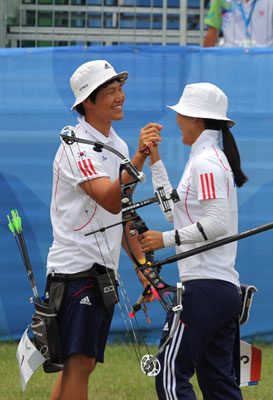
On the first day of competition, the recurve mixed team of Korea, KI Bo Bae/KIM Bubmin, set a new Universiade record with 1348 points in the qualification round (previous was 1341). The No. 1 double then went on all the way to clinch the gold medal against TIEN Kang/YUAN Shu Chi (TPE/3). Bronze was for Dmytro HRACHOV/Nina MYLCHENKO (UKR/4) who defeated Jessica TOMASI/Alberto ZAGAMI (ITA/7).
Recurve Women
The big favourites in this category were the three Koreans HAN Gyeonghee, JUNG Dasomi and KI Bo Bae photo, who won several World Cup medals and the team bronze medal together at the world championships in July. And without surprise they topped the qualification round, with KI No. 1, JUNG No. 2 and HAN No. 3. Seeded No. 4 was Kaori KAWANAKA (JPN) and No. 5 was LE Chieh-Ying (TPE).
These two faced each other in quarterfinals for a victory by the lady from Chinese Taipei, 6-4. But LE was then defeated 4-6 by top-seeded KI in semifinals. The No. 11 athlete CHO Peichin (TPE) upset the No. 3 HAN in quarterfinals by 6-5, 10-8 in the tie-break. However, in the following match she was defeated 2-6 by the No. 2 JUNG.
The gold final was therefore an all-Korean match between KI and JUNG, while the bronze final was an all-Chinese Taipei duel featuring CHOI and LE. Leading 4-0 after two sets, KI let her teammate come back into the match shooting only 26 and 27 points in the third and fourth sets. With strong sets of 30 and 29, JUNG tied up the match at 4-4. However, KI regained her self-control in the final set to score 29 points (versus 27 for JUNG) and clinch victory, 6-4. The match for bronze was straightforward in favour of CHO, who beat her fellow countrywoman LE by 6-0.
Unlike their male counterparts, the top-seeded Korean ladies also clinched gold in the team event. In the gold final, they beat the No. 3 seeded team of Ukraine. The bronze medal was taken by Chinese Taipei (No. 2) who defeated Japan (No. 5).
Recurve Mixed Team
On the first day of competition, the recurve mixed team of Korea, KI Bo Bae/KIM Bubmin, set a new Universiade record with 1348 points in the qualification round (previous was 1341). The No. 1 double then went on all the way to clinch the gold medal against TIEN Kang/YUAN Shu Chi (TPE/3). Bronze was for Dmytro HRACHOV/Nina MYLCHENKO (UKR/4) who defeated Jessica TOMASI/Alberto ZAGAMI (ITA/7).
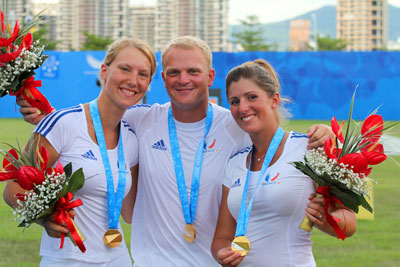 Compound Men
Some young but talented athletes competed for the compound men's medals such as Simon ROUSSEAU (CAN), team bronze medallist at the 2011 World Championships, and the Russians Alexander DAMBAEV and Denis SEGIN, European team champions in 2010. They were challenged by the 2006 European champion Sebastien BRASSEUR (FRA) as well as strong teams from the USA and Iran.
The No. 1 seeded athlete in this category, MIN Lihong (KOR) was defeated by BRASSEUR (No. 9), 140-138 in quarterfinals. However, the Frenchman conceded defeat in semifinals after a shoot-off against Alexander DAMBAEV (RUS/20). The Russian then went on to clinch the gold medal over CHOI Yong Hee (KOR/3). The No. 2 Zachary PLANNICK (USA) was kicked out in 1/8 elimination by Claudio CAPOVILLA (ITA/15), while the No. 4 Abhishek VERMA (IND) also suffered an upset in the same round against the future winner. The bronze medal was clinched by BRASSEUR, who beat CAPOVILLA.
In the team event, France photo (No. 6) added another medal, clinching gold against Mexico (No. 5), after defeating the No. 3 and No. 2 teams, Italy and USA, in quarter and semifinals, respectively. It is noteworthy the French team was made up of one male (BRASSEUR) and two female archers (Joanna CHESSE and Pascale LEBECQUE). Losing to the Mexicans in semifinals, the No. 1 team Korea then bowed for the second time in a row, losing to USA (No. 2) in the bronze medal match.
Compound Women
Top-seeded after qualifications, Joanna CHESSE (FRA) was defeated 140-141 in quarterfinals by Polina NIKITINA (RUS/24). The Russian then went on beating the 2010 European champion Viktoria BALZHANOVA (RUS/5), 136-116 in semifinals, and the 2008 junior world champion Kendal NICELY (USA/10), after a tie-break (140-140/10-9), to win the Universiade title.
While the No. 2 Anastasia ANASTASIO (ITA) suffered an early defeat, 135-136 in 1/16 elimination against Catheline DESSOY (BEL/31), the No. 3 SEO Jung Hee (KOR) reached the semifinals where she lost to NICELY. In the bronze medal match, BALZHANOVA proved stronger that the Korean for victory 140-137.
In the team event, the No. 1 trio from Korea did not shake, winning the gold medal over Russia (No. 2). The bronze medal was logically clinched by the No. 3 team, India, who beat Mexico (5).
Compound Men
Some young but talented athletes competed for the compound men's medals such as Simon ROUSSEAU (CAN), team bronze medallist at the 2011 World Championships, and the Russians Alexander DAMBAEV and Denis SEGIN, European team champions in 2010. They were challenged by the 2006 European champion Sebastien BRASSEUR (FRA) as well as strong teams from the USA and Iran.
The No. 1 seeded athlete in this category, MIN Lihong (KOR) was defeated by BRASSEUR (No. 9), 140-138 in quarterfinals. However, the Frenchman conceded defeat in semifinals after a shoot-off against Alexander DAMBAEV (RUS/20). The Russian then went on to clinch the gold medal over CHOI Yong Hee (KOR/3). The No. 2 Zachary PLANNICK (USA) was kicked out in 1/8 elimination by Claudio CAPOVILLA (ITA/15), while the No. 4 Abhishek VERMA (IND) also suffered an upset in the same round against the future winner. The bronze medal was clinched by BRASSEUR, who beat CAPOVILLA.
In the team event, France photo (No. 6) added another medal, clinching gold against Mexico (No. 5), after defeating the No. 3 and No. 2 teams, Italy and USA, in quarter and semifinals, respectively. It is noteworthy the French team was made up of one male (BRASSEUR) and two female archers (Joanna CHESSE and Pascale LEBECQUE). Losing to the Mexicans in semifinals, the No. 1 team Korea then bowed for the second time in a row, losing to USA (No. 2) in the bronze medal match.
Compound Women
Top-seeded after qualifications, Joanna CHESSE (FRA) was defeated 140-141 in quarterfinals by Polina NIKITINA (RUS/24). The Russian then went on beating the 2010 European champion Viktoria BALZHANOVA (RUS/5), 136-116 in semifinals, and the 2008 junior world champion Kendal NICELY (USA/10), after a tie-break (140-140/10-9), to win the Universiade title.
While the No. 2 Anastasia ANASTASIO (ITA) suffered an early defeat, 135-136 in 1/16 elimination against Catheline DESSOY (BEL/31), the No. 3 SEO Jung Hee (KOR) reached the semifinals where she lost to NICELY. In the bronze medal match, BALZHANOVA proved stronger that the Korean for victory 140-137.
In the team event, the No. 1 trio from Korea did not shake, winning the gold medal over Russia (No. 2). The bronze medal was logically clinched by the No. 3 team, India, who beat Mexico (5).
 Compound Mixed Team
The Korean double MIN Lihong/SEO Jung Hee photo (No. 1) offered another gold medal to their country in the compound mixed team event after a final victory over Kendal NICELY/Zachary PLANNICK (USA/2). The No. 2 and No. 3 mixed teams, Russia and France, were defeated in quarterfinals by the No. 6 and No. 5 doubles, Iran and Italy, respectively. These two finally met in the bronze medal match for an Italian victory.
Largest-ever Universiade
China topped the gold medal list with a record of 75, followed by Russia, 43, and South Korea, 27. China's haul broke the record of 69 gold medals set by the former Soviet Union delegation 38 years ago. The Chinese delegation also won the highest number of medals in Universiade history, 145, followed by Russia, 131, and Japan, 87. In archery, Korea topped the medal list with 10 medals out of 30 (6 gold-3 silver-1 bronze), followed by Russia, 4 (2-1-1), and France, 3 (1-0-2).
Some 1.27 million citizens worked as volunteers for the games, whether in the venues, in the Athletes Village or on the streets. Owners of more than 430,000 vehicles voluntarily suspended their cars during the Universiade. It was the first time that the number of participants passed the 10,000 mark at a Universiade, and the Shenzhen edition was hailed as "the best ever" by Claude-Louis GALLIEN, newly-elected President of the International University Sports Federation (FISU).
For the first time in Universiade history, FISU, the governing body of international university sport, offered live streaming on its TV website www.fisu.tv, showing a selection of events of the sports programme and highlights from all 24 sports on the programme.
All results, news and photos are available on www.worldarchery.org and www.sz2011.org/Universiade/.
World Archery Communication
Compound Mixed Team
The Korean double MIN Lihong/SEO Jung Hee photo (No. 1) offered another gold medal to their country in the compound mixed team event after a final victory over Kendal NICELY/Zachary PLANNICK (USA/2). The No. 2 and No. 3 mixed teams, Russia and France, were defeated in quarterfinals by the No. 6 and No. 5 doubles, Iran and Italy, respectively. These two finally met in the bronze medal match for an Italian victory.
Largest-ever Universiade
China topped the gold medal list with a record of 75, followed by Russia, 43, and South Korea, 27. China's haul broke the record of 69 gold medals set by the former Soviet Union delegation 38 years ago. The Chinese delegation also won the highest number of medals in Universiade history, 145, followed by Russia, 131, and Japan, 87. In archery, Korea topped the medal list with 10 medals out of 30 (6 gold-3 silver-1 bronze), followed by Russia, 4 (2-1-1), and France, 3 (1-0-2).
Some 1.27 million citizens worked as volunteers for the games, whether in the venues, in the Athletes Village or on the streets. Owners of more than 430,000 vehicles voluntarily suspended their cars during the Universiade. It was the first time that the number of participants passed the 10,000 mark at a Universiade, and the Shenzhen edition was hailed as "the best ever" by Claude-Louis GALLIEN, newly-elected President of the International University Sports Federation (FISU).
For the first time in Universiade history, FISU, the governing body of international university sport, offered live streaming on its TV website www.fisu.tv, showing a selection of events of the sports programme and highlights from all 24 sports on the programme.
All results, news and photos are available on www.worldarchery.org and www.sz2011.org/Universiade/.
World Archery Communication
Recurve Men
Several Olympic medallists competed in this category. The most famous was the double Olympic team champion (2004 and 2008) from Korea IM Dong-Hyun. After qualification, however, the No. 1 seed was his fellow countryman KIM Bubmin. Seeded No. 2 was Juan Rene SERRANO (MEX), who finished 4th at Beijing Games. IM was No. 3 and another Korean, the newly-crowned world champion from Turin in July KIM Woojin, was No. 4.
The top 4 seeded athletes all reached the semifinals where the two KIMs faced each other. After a tense match (4-4 after four sets), the new world champion KIM Woojin finally had the last word at 6-4. He was joined to shoot for gold by his teammate IM Dong-Hyun, who defeated SERRANO 6-2.
In the gold final, IM proved superior and easily clinched victory 7-1. Shooting for bronze, the only athlete left to try and prevent an all-Korean podium, the Mexican SERRANO, gave the illusion of being able to win in the first set only. Leading 2-0, he then lost the following three sets to let the bronze medal go to KIM Bubmin (6-2).
In the team event, upset came from the early defeat of the No. 1 team Korea against Japan in quarterfinals. Then, the Japanese then went through Chinese Taipei (No. 4) in semifinals, but finally lost to China photo (No. 7) for the gold medal. The No. 2 seeded team, Mexico, also suffered an early upset, in the 1/8 elimination round against Kazakhstan (No. 15). Seeded No. 3, team Italy was kicked out of the competition in quarterfinals, losing to France who finally clinched bronze over Chinese Taipei.
Recurve Women
The big favourites in this category were the three Koreans HAN Gyeonghee, JUNG Dasomi and KI Bo Bae photo, who won several World Cup medals and the team bronze medal together at the world championships in July. And without surprise they topped the qualification round, with KI No. 1, JUNG No. 2 and HAN No. 3. Seeded No. 4 was Kaori KAWANAKA (JPN) and No. 5 was LE Chieh-Ying (TPE).
These two faced each other in quarterfinals for a victory by the lady from Chinese Taipei, 6-4. But LE was then defeated 4-6 by top-seeded KI in semifinals. The No. 11 athlete CHO Peichin (TPE) upset the No. 3 HAN in quarterfinals by 6-5, 10-8 in the tie-break. However, in the following match she was defeated 2-6 by the No. 2 JUNG.
The gold final was therefore an all-Korean match between KI and JUNG, while the bronze final was an all-Chinese Taipei duel featuring CHOI and LE. Leading 4-0 after two sets, KI let her teammate come back into the match shooting only 26 and 27 points in the third and fourth sets. With strong sets of 30 and 29, JUNG tied up the match at 4-4. However, KI regained her self-control in the final set to score 29 points (versus 27 for JUNG) and clinch victory, 6-4. The match for bronze was straightforward in favour of CHO, who beat her fellow countrywoman LE by 6-0.
Unlike their male counterparts, the top-seeded Korean ladies also clinched gold in the team event. In the gold final, they beat the No. 3 seeded team of Ukraine. The bronze medal was taken by Chinese Taipei (No. 2) who defeated Japan (No. 5).
Recurve Mixed Team
On the first day of competition, the recurve mixed team of Korea, KI Bo Bae/KIM Bubmin, set a new Universiade record with 1348 points in the qualification round (previous was 1341). The No. 1 double then went on all the way to clinch the gold medal against TIEN Kang/YUAN Shu Chi (TPE/3). Bronze was for Dmytro HRACHOV/Nina MYLCHENKO (UKR/4) who defeated Jessica TOMASI/Alberto ZAGAMI (ITA/7).
Compound Men
Some young but talented athletes competed for the compound men's medals such as Simon ROUSSEAU (CAN), team bronze medallist at the 2011 World Championships, and the Russians Alexander DAMBAEV and Denis SEGIN, European team champions in 2010. They were challenged by the 2006 European champion Sebastien BRASSEUR (FRA) as well as strong teams from the USA and Iran.
The No. 1 seeded athlete in this category, MIN Lihong (KOR) was defeated by BRASSEUR (No. 9), 140-138 in quarterfinals. However, the Frenchman conceded defeat in semifinals after a shoot-off against Alexander DAMBAEV (RUS/20). The Russian then went on to clinch the gold medal over CHOI Yong Hee (KOR/3). The No. 2 Zachary PLANNICK (USA) was kicked out in 1/8 elimination by Claudio CAPOVILLA (ITA/15), while the No. 4 Abhishek VERMA (IND) also suffered an upset in the same round against the future winner. The bronze medal was clinched by BRASSEUR, who beat CAPOVILLA.
In the team event, France photo (No. 6) added another medal, clinching gold against Mexico (No. 5), after defeating the No. 3 and No. 2 teams, Italy and USA, in quarter and semifinals, respectively. It is noteworthy the French team was made up of one male (BRASSEUR) and two female archers (Joanna CHESSE and Pascale LEBECQUE). Losing to the Mexicans in semifinals, the No. 1 team Korea then bowed for the second time in a row, losing to USA (No. 2) in the bronze medal match.
Compound Women
Top-seeded after qualifications, Joanna CHESSE (FRA) was defeated 140-141 in quarterfinals by Polina NIKITINA (RUS/24). The Russian then went on beating the 2010 European champion Viktoria BALZHANOVA (RUS/5), 136-116 in semifinals, and the 2008 junior world champion Kendal NICELY (USA/10), after a tie-break (140-140/10-9), to win the Universiade title.
While the No. 2 Anastasia ANASTASIO (ITA) suffered an early defeat, 135-136 in 1/16 elimination against Catheline DESSOY (BEL/31), the No. 3 SEO Jung Hee (KOR) reached the semifinals where she lost to NICELY. In the bronze medal match, BALZHANOVA proved stronger that the Korean for victory 140-137.
In the team event, the No. 1 trio from Korea did not shake, winning the gold medal over Russia (No. 2). The bronze medal was logically clinched by the No. 3 team, India, who beat Mexico (5).
Compound Mixed Team
The Korean double MIN Lihong/SEO Jung Hee photo (No. 1) offered another gold medal to their country in the compound mixed team event after a final victory over Kendal NICELY/Zachary PLANNICK (USA/2). The No. 2 and No. 3 mixed teams, Russia and France, were defeated in quarterfinals by the No. 6 and No. 5 doubles, Iran and Italy, respectively. These two finally met in the bronze medal match for an Italian victory.
Largest-ever Universiade
China topped the gold medal list with a record of 75, followed by Russia, 43, and South Korea, 27. China's haul broke the record of 69 gold medals set by the former Soviet Union delegation 38 years ago. The Chinese delegation also won the highest number of medals in Universiade history, 145, followed by Russia, 131, and Japan, 87. In archery, Korea topped the medal list with 10 medals out of 30 (6 gold-3 silver-1 bronze), followed by Russia, 4 (2-1-1), and France, 3 (1-0-2).
Some 1.27 million citizens worked as volunteers for the games, whether in the venues, in the Athletes Village or on the streets. Owners of more than 430,000 vehicles voluntarily suspended their cars during the Universiade. It was the first time that the number of participants passed the 10,000 mark at a Universiade, and the Shenzhen edition was hailed as "the best ever" by Claude-Louis GALLIEN, newly-elected President of the International University Sports Federation (FISU).
For the first time in Universiade history, FISU, the governing body of international university sport, offered live streaming on its TV website www.fisu.tv, showing a selection of events of the sports programme and highlights from all 24 sports on the programme.
All results, news and photos are available on www.worldarchery.org and www.sz2011.org/Universiade/.
World Archery Communication
Features