This content is archived and as has not been processed. It may contain unformatted text or images, broken links or out-of-date information.
Archive
3 September 2010 - Sebastien FLUTE (FRA): “I have the privilege to be a fulltime archer”
Lausanne

Real name:
Sebastien FLUTE (FRA): “I have the privilege to be a fulltime archer”
Shanghai (CHN) – 3 September 2010
An exceptional archer is shooting for France this week in Shanghai: the 1992 Olympic champion Sebastien FLUTE, who came out of retirement last year, has come back to the elite level and is competing in his first World Cup event.
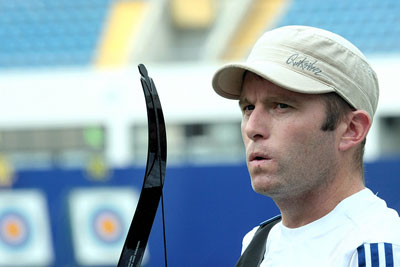 France’s Sebastien FLUTE discovered archery in 1983, aged 11, in Brest. He started his international career in 1988 as a member of the French Junior team. Four years later, having just become World Indoor Champion, Sebastien was selected to compete at the Barcelona 1992 Olympic Games, where he won the individual gold medal. Several world and European medals later, the French archer competed in the Sydney 2000 Olympic Games. He placed 8th individually and retired soon after these Games. In 2009, after nine years out of the sport, the French champion decided to make a come-back to competitive archery.
What brought you back to competitive archery, almost 20 years after you won the highest title in the world?
I decided to come back after the Beijing 2008 Olympics, where I travelled as a TV consultant for the French TV network Canal +. During those Olympics I realised how much I missed the adrenaline of the competition since I quit the sport in 2000. Apart from the adrenaline, I was also starting to miss archery and the shooting itself. After the Games I took time to reflect on a possible comeback. Was it realistic from a technical and physical perspective? I was older, the global level of archery had changed and so had the organisation of my life. To take up elite sports again would be very demanding, considering that I had a busy life outside the sport. After three of four months I decided to give it a try, even though the timing towards London 2012 would be extremely tight. I started training again on 2 February 2009, approximately six months after the Beijing Olympics.
What was your relation to archery after you retired?
I stayed completely out of the sport between 2000 and 2003. It wanted to focus on my professional career, which I had neglected from the moment I became an elite athlete. I came back in the archery world when the French Archery Federation (FFTA) organised the 2003 World Indoor Championships in Nimes and needed a TV consultant. I must admit I didn’t really miss archery at the time. I enjoyed watching and commenting it, but the thought of coming back as a competitor didn’t even cross my mind. I really came back into the archery community in 2004 when I started working for the FFTA for three years. In parallel to this in 2005 I opened a new chapter of my relation to the sport: I had the privilege to launch my own line of archery equipment, in partnership with Win and Win, among others (Win and Win is a Korean archery manufacturer). This allowed me to see the sport from a different angle.
What do you think the major evolution that happened in the archery world since you first competed is?
I think the creation of the World Cup was the major change in the sport of archery. This element made archery evolve in terms of event organisation, participating nations and media coverage. These are new factors in our sport. When I first competed we only had the European Grand Prix and the World Championships. We now have a real circuit with four annual events of a very high standard. Our World Cup can be compared to professional circuits from other sports that have existed since longer and generate bigger media interest. Archery has become a product we can sell. We just need a little more time to convince more media representatives to follow us. It is easier to find commercial partners if we can offer them five or six competitions every year, even more if you count the indoor events like the Tournament of Nimes. Last but not least, as an athlete to compete in the World Cup is a great motivation. The possibility to earn points, to advance throughout the season and compete more frequently at the highest level than in the past is a great motivational factor. I must say it’s one of the elements that played a role in my decision to come back.
What do you hope to achieve now, having already won the most important title of all?
My goal is to come back as soon as possible to the medal contenders and to qualify for London 2012. I know better than most people what it takes to win the Olympic title. My major ambition is to come back among the world’s best and to be able to fight for a good result in 2012.
How do you prepare towards this goal?
The road to London is long, even though I have already accomplished a lot in one and a half years. Since January I have the privilege to train fulltime. Between 2009 and 2010 I was combining an archery career with my professional life in an insurance brokerage firm. During one year I commuted from training between 6-9AM to work until 6PM. Every other day I had a training session in the evening, and two weekends per month I was taking part in a competition. I led a monastic life. After one year, I came to two conclusions. Firstly, I had reached a satisfying level in terms of sports performance. Secondly, I couldn’t keep up at the same pace, physically and mentally. I couldn’t reach 100% of my potential in both my job and sports career at the same time. In parallel, my line of archery equipment was starting to generate enough revenue to compensate for the eventual loss of my salary. So I chose to quit my job after the Tournament of Nimes 2010. I now shoot a minimum of 5 days a week, usually twice a day. I am enjoying my newly found freedom. I don’t have the salary of an executive anymore, but it’s the price of freedom.
How did you adapt to the changes that occurred in the world of archery since you retired? Do you train differently than in the past?
Yes, I am training differently now. I must work more on the physical plan because I’m older and it was already one of my weaknesses before. I also have reset my archery technique, which is easier to do after a long break than if you never stop practicing in ten years. I also started to work more on the mental aspect with the staff of the French Federation. It’s an aspect I had not felt the need to explore before. It all changed as I grew old and was inactive as an archer for almost 10 years. So my preparation is now more complete than before.
What are your strengths compared to your opponents?
My main advantage is that I already went through it all, I have gained experience both from my victories and my defeats. Another one of my strengths is that I know exactly why I’m making this comeback. In the last years of my career, I didn’t always know why I was continuing. I was stuck in a pattern that made me stay year after year. I don’t regret shooting until 2000, but I lacked lucidity as to why I was doing it. Now I know exactly why I’m back: I want to taste competition again and enjoy myself. I’m doing it for myself and it makes things easier and less stressful. I learned a lot from my previous experience. The media, the partners, the people that were around me had high expectations and put a lot of pressure on me. It affected me a lot when I was younger. Now the expectations from the media or the partners are coming second. If I achieve a good result they will of course take benefits from it, but above all I’m doing it for myself and not the opposite. It was not always the case in the past, and in my last seasons before I quit I wasn’t enjoying myself as I do today.
Could you share with us your Olympic experience?
My Olympic experience is multiple because I went to three Olympic Games: three times as a competitor and twice as a TV consultant. As an athlete the first time I won the gold medal, the second I failed completely and the third time I placed 8th. So I had each time a very different experience. The Olympics are the biggest sports event on earth. There are unique because they take place only once every four years and we prepare for them season after season. The Olympics are like a World Championships combining all the sports disciplines. The countries develop big expectations for their sportsmen and invest a lot in them. Therefore, it’s the competition for which we receive the highest funding for our preparation.
If asked what competition they would like to win, every athlete would choose the Olympics. I like to make the following comparison: when you tell people you are a world champion, they want to know in what sport, because people rank the different disciplines on their value scale. If you say you are Olympic champion, the first thing people ask you is from what year, the question of the discipline is secondary. That’s what makes the Olympics so magic, because if you think about it, practically it’s just another archery competition, shot under the same rules and against the same opponents as any other tournament. The magic of the Olympic Games is what makes me wake up in the morning and go to the practice field.
We can easily predict what your most memorable match was…
The gold medal final in Barcelona. We always remember the best achievements, so of course Barcelona is my best memory! I also have a special place for the Sydney competition. I hadn’t been shooting well a long time before Sydney and I was only hoping for a good team result. Of course, there is no possible comparison with my memories from Barcelona.
What did the Olympic gold medal change in your life?
My life changed completely! It’s probably the same in all countries: your social status changes when from an elite athlete you become an Olympic champion. In a country like France, we have approximately 8 to 15 new Olympic champions every four years. We become a subject of focus and are recognized on the streets. It also brings media interest to our discipline. In my case, my medal allowed me to make a living out of archery during eight years, from 1992 to 2000, which was rather unique at the time, especially in France. My medal allows me to make a living out of archery again today. The Games break the barriers between the different sports, and thanks to my Olympic title I had the opportunity to meet a lot of French and foreign athletes from other sports, which is extremely rewarding. My medal also gave me the opportunity to work for the International Archery Federation (FITA) and the French Archery Federation (FFTA), the French Anti-Doping Agency.
Your medal also brought a very keen interest to archery in France.
The number of licensed archers increased greatly in the three to four years that followed my medal, by 20% in 1992 and approximately 10 to 15% in the following years. This was a considerable drive in the development of archery in my country. I don’t know if the national interest was enhanced by the surprise effect my medal had on the French media, or by the powerful TV images (my opponent and I were still tied with three arrows remaining), or by the fact that there was no concurrence from athletics on that day, and the French media had no other subject to focus on… All these factors led the two main French TV networks to broadcast my gold medal match live. This brought focus on archery and in France it is perceived as a real sport and not only as a recreational activity. The story is similar to that of badminton. People have grown to consider it as a serious, competitive sport whereas they had previously thought it was a sport you play just for fun when you’re on the beach.
What do you think of the evolution of archery these last years?
I have studied the level of archery carefully because it was one of the factors that would orientate my decision of coming back or not. The worldwide level has improved in terms of performance, but our sport has also become denser. An extremely high number of nations are now successful and achieve results that they couldn’t have hoped for 10 years ago.
What is your opinion on the new competition formats?
I think changes are good as long as you have a well-defined strategy towards a specific goal. I competed under several formats: when I started we shot 12-arrow matches, the format then changed to 18 arrows and back to 12 again, and today we have the set system. I enjoyed the change to the match system from the day it was introduced. From an archer’s perspective, I haven’t made up my mind about the set system yet. I’ll give you my opinion when I have more experience shooting in it. As a spectator, I think it makes the hierarchy more open and keeps the game alive up to the last arrows. The match can turn upside down from set to set. Under the old system you could clinch a match from the first end, which made it easier for the most consistent archers. We will have to wait and see how things go, and let the archers adapt to the new system. The changes are revolutionising compound archery more than recurve – with the Hit/Miss target and the distance reduced from 70 to 50 metres. The negative aspect in my opinion is that in bad weather conditions, there are too many Misses and it makes the competition less interesting than with the scoring system. Under the old format the scores were lower like 8 or 7, but the game was still alive. We will have to analyse the changes at the end of the season. One thing is for sure, the changes created a real difference between the two disciplines, which is precisely why they were introduced.
What do you hope for the future of archery?
I really hope that we can bring more and more media to archery and that our sport will become an important, more respected sport. We are in a circle that some would call vicious, but that I like to call virtuous. The more we develop our professional circuit, the easier it will be to find partnerships, the better we will be able to train and the more interesting the competition will be. We still need to find more money to be able to train. In other sports it’s the contrary, and you wonder whether people do it rather for the sport or the money. We will need to improve the product that we give to the media further. On the day we will have enough money, our sport will become more professional and the worldwide level will improve. We will have to educate our archers in order to not let them fall in the trap of doping or excesses, as happens in some sports, but I think we really are heading in the right direction now.
Finally, what are your passions and activities outside of archery?
I have less and less activities outside of the sport because I have always less free time. I represent the athletes at the French Antidoping Agency. We have a disciplinary role and meet for a half-day every 3 weeks in order to discuss litigious cases. Apart from that, I have a 7½ years-old daughter and I like to spend time with her. It is not always easy because I train and compete so much, and I must work on my equipment line. In the little free time that I have left, I do what I have always loved, jogging, travelling…. But I don’t see it as a sacrifice because it is the situation I have chosen.
Vanahé ANTILLE
World Archery Communication
France’s Sebastien FLUTE discovered archery in 1983, aged 11, in Brest. He started his international career in 1988 as a member of the French Junior team. Four years later, having just become World Indoor Champion, Sebastien was selected to compete at the Barcelona 1992 Olympic Games, where he won the individual gold medal. Several world and European medals later, the French archer competed in the Sydney 2000 Olympic Games. He placed 8th individually and retired soon after these Games. In 2009, after nine years out of the sport, the French champion decided to make a come-back to competitive archery.
What brought you back to competitive archery, almost 20 years after you won the highest title in the world?
I decided to come back after the Beijing 2008 Olympics, where I travelled as a TV consultant for the French TV network Canal +. During those Olympics I realised how much I missed the adrenaline of the competition since I quit the sport in 2000. Apart from the adrenaline, I was also starting to miss archery and the shooting itself. After the Games I took time to reflect on a possible comeback. Was it realistic from a technical and physical perspective? I was older, the global level of archery had changed and so had the organisation of my life. To take up elite sports again would be very demanding, considering that I had a busy life outside the sport. After three of four months I decided to give it a try, even though the timing towards London 2012 would be extremely tight. I started training again on 2 February 2009, approximately six months after the Beijing Olympics.
What was your relation to archery after you retired?
I stayed completely out of the sport between 2000 and 2003. It wanted to focus on my professional career, which I had neglected from the moment I became an elite athlete. I came back in the archery world when the French Archery Federation (FFTA) organised the 2003 World Indoor Championships in Nimes and needed a TV consultant. I must admit I didn’t really miss archery at the time. I enjoyed watching and commenting it, but the thought of coming back as a competitor didn’t even cross my mind. I really came back into the archery community in 2004 when I started working for the FFTA for three years. In parallel to this in 2005 I opened a new chapter of my relation to the sport: I had the privilege to launch my own line of archery equipment, in partnership with Win and Win, among others (Win and Win is a Korean archery manufacturer). This allowed me to see the sport from a different angle.
What do you think the major evolution that happened in the archery world since you first competed is?
I think the creation of the World Cup was the major change in the sport of archery. This element made archery evolve in terms of event organisation, participating nations and media coverage. These are new factors in our sport. When I first competed we only had the European Grand Prix and the World Championships. We now have a real circuit with four annual events of a very high standard. Our World Cup can be compared to professional circuits from other sports that have existed since longer and generate bigger media interest. Archery has become a product we can sell. We just need a little more time to convince more media representatives to follow us. It is easier to find commercial partners if we can offer them five or six competitions every year, even more if you count the indoor events like the Tournament of Nimes. Last but not least, as an athlete to compete in the World Cup is a great motivation. The possibility to earn points, to advance throughout the season and compete more frequently at the highest level than in the past is a great motivational factor. I must say it’s one of the elements that played a role in my decision to come back.
What do you hope to achieve now, having already won the most important title of all?
My goal is to come back as soon as possible to the medal contenders and to qualify for London 2012. I know better than most people what it takes to win the Olympic title. My major ambition is to come back among the world’s best and to be able to fight for a good result in 2012.
How do you prepare towards this goal?
The road to London is long, even though I have already accomplished a lot in one and a half years. Since January I have the privilege to train fulltime. Between 2009 and 2010 I was combining an archery career with my professional life in an insurance brokerage firm. During one year I commuted from training between 6-9AM to work until 6PM. Every other day I had a training session in the evening, and two weekends per month I was taking part in a competition. I led a monastic life. After one year, I came to two conclusions. Firstly, I had reached a satisfying level in terms of sports performance. Secondly, I couldn’t keep up at the same pace, physically and mentally. I couldn’t reach 100% of my potential in both my job and sports career at the same time. In parallel, my line of archery equipment was starting to generate enough revenue to compensate for the eventual loss of my salary. So I chose to quit my job after the Tournament of Nimes 2010. I now shoot a minimum of 5 days a week, usually twice a day. I am enjoying my newly found freedom. I don’t have the salary of an executive anymore, but it’s the price of freedom.
How did you adapt to the changes that occurred in the world of archery since you retired? Do you train differently than in the past?
Yes, I am training differently now. I must work more on the physical plan because I’m older and it was already one of my weaknesses before. I also have reset my archery technique, which is easier to do after a long break than if you never stop practicing in ten years. I also started to work more on the mental aspect with the staff of the French Federation. It’s an aspect I had not felt the need to explore before. It all changed as I grew old and was inactive as an archer for almost 10 years. So my preparation is now more complete than before.
What are your strengths compared to your opponents?
My main advantage is that I already went through it all, I have gained experience both from my victories and my defeats. Another one of my strengths is that I know exactly why I’m making this comeback. In the last years of my career, I didn’t always know why I was continuing. I was stuck in a pattern that made me stay year after year. I don’t regret shooting until 2000, but I lacked lucidity as to why I was doing it. Now I know exactly why I’m back: I want to taste competition again and enjoy myself. I’m doing it for myself and it makes things easier and less stressful. I learned a lot from my previous experience. The media, the partners, the people that were around me had high expectations and put a lot of pressure on me. It affected me a lot when I was younger. Now the expectations from the media or the partners are coming second. If I achieve a good result they will of course take benefits from it, but above all I’m doing it for myself and not the opposite. It was not always the case in the past, and in my last seasons before I quit I wasn’t enjoying myself as I do today.
Could you share with us your Olympic experience?
My Olympic experience is multiple because I went to three Olympic Games: three times as a competitor and twice as a TV consultant. As an athlete the first time I won the gold medal, the second I failed completely and the third time I placed 8th. So I had each time a very different experience. The Olympics are the biggest sports event on earth. There are unique because they take place only once every four years and we prepare for them season after season. The Olympics are like a World Championships combining all the sports disciplines. The countries develop big expectations for their sportsmen and invest a lot in them. Therefore, it’s the competition for which we receive the highest funding for our preparation.
If asked what competition they would like to win, every athlete would choose the Olympics. I like to make the following comparison: when you tell people you are a world champion, they want to know in what sport, because people rank the different disciplines on their value scale. If you say you are Olympic champion, the first thing people ask you is from what year, the question of the discipline is secondary. That’s what makes the Olympics so magic, because if you think about it, practically it’s just another archery competition, shot under the same rules and against the same opponents as any other tournament. The magic of the Olympic Games is what makes me wake up in the morning and go to the practice field.
We can easily predict what your most memorable match was…
The gold medal final in Barcelona. We always remember the best achievements, so of course Barcelona is my best memory! I also have a special place for the Sydney competition. I hadn’t been shooting well a long time before Sydney and I was only hoping for a good team result. Of course, there is no possible comparison with my memories from Barcelona.
What did the Olympic gold medal change in your life?
My life changed completely! It’s probably the same in all countries: your social status changes when from an elite athlete you become an Olympic champion. In a country like France, we have approximately 8 to 15 new Olympic champions every four years. We become a subject of focus and are recognized on the streets. It also brings media interest to our discipline. In my case, my medal allowed me to make a living out of archery during eight years, from 1992 to 2000, which was rather unique at the time, especially in France. My medal allows me to make a living out of archery again today. The Games break the barriers between the different sports, and thanks to my Olympic title I had the opportunity to meet a lot of French and foreign athletes from other sports, which is extremely rewarding. My medal also gave me the opportunity to work for the International Archery Federation (FITA) and the French Archery Federation (FFTA), the French Anti-Doping Agency.
Your medal also brought a very keen interest to archery in France.
The number of licensed archers increased greatly in the three to four years that followed my medal, by 20% in 1992 and approximately 10 to 15% in the following years. This was a considerable drive in the development of archery in my country. I don’t know if the national interest was enhanced by the surprise effect my medal had on the French media, or by the powerful TV images (my opponent and I were still tied with three arrows remaining), or by the fact that there was no concurrence from athletics on that day, and the French media had no other subject to focus on… All these factors led the two main French TV networks to broadcast my gold medal match live. This brought focus on archery and in France it is perceived as a real sport and not only as a recreational activity. The story is similar to that of badminton. People have grown to consider it as a serious, competitive sport whereas they had previously thought it was a sport you play just for fun when you’re on the beach.
What do you think of the evolution of archery these last years?
I have studied the level of archery carefully because it was one of the factors that would orientate my decision of coming back or not. The worldwide level has improved in terms of performance, but our sport has also become denser. An extremely high number of nations are now successful and achieve results that they couldn’t have hoped for 10 years ago.
What is your opinion on the new competition formats?
I think changes are good as long as you have a well-defined strategy towards a specific goal. I competed under several formats: when I started we shot 12-arrow matches, the format then changed to 18 arrows and back to 12 again, and today we have the set system. I enjoyed the change to the match system from the day it was introduced. From an archer’s perspective, I haven’t made up my mind about the set system yet. I’ll give you my opinion when I have more experience shooting in it. As a spectator, I think it makes the hierarchy more open and keeps the game alive up to the last arrows. The match can turn upside down from set to set. Under the old system you could clinch a match from the first end, which made it easier for the most consistent archers. We will have to wait and see how things go, and let the archers adapt to the new system. The changes are revolutionising compound archery more than recurve – with the Hit/Miss target and the distance reduced from 70 to 50 metres. The negative aspect in my opinion is that in bad weather conditions, there are too many Misses and it makes the competition less interesting than with the scoring system. Under the old format the scores were lower like 8 or 7, but the game was still alive. We will have to analyse the changes at the end of the season. One thing is for sure, the changes created a real difference between the two disciplines, which is precisely why they were introduced.
What do you hope for the future of archery?
I really hope that we can bring more and more media to archery and that our sport will become an important, more respected sport. We are in a circle that some would call vicious, but that I like to call virtuous. The more we develop our professional circuit, the easier it will be to find partnerships, the better we will be able to train and the more interesting the competition will be. We still need to find more money to be able to train. In other sports it’s the contrary, and you wonder whether people do it rather for the sport or the money. We will need to improve the product that we give to the media further. On the day we will have enough money, our sport will become more professional and the worldwide level will improve. We will have to educate our archers in order to not let them fall in the trap of doping or excesses, as happens in some sports, but I think we really are heading in the right direction now.
Finally, what are your passions and activities outside of archery?
I have less and less activities outside of the sport because I have always less free time. I represent the athletes at the French Antidoping Agency. We have a disciplinary role and meet for a half-day every 3 weeks in order to discuss litigious cases. Apart from that, I have a 7½ years-old daughter and I like to spend time with her. It is not always easy because I train and compete so much, and I must work on my equipment line. In the little free time that I have left, I do what I have always loved, jogging, travelling…. But I don’t see it as a sacrifice because it is the situation I have chosen.
Vanahé ANTILLE
World Archery Communication
France’s Sebastien FLUTE discovered archery in 1983, aged 11, in Brest. He started his international career in 1988 as a member of the French Junior team. Four years later, having just become World Indoor Champion, Sebastien was selected to compete at the Barcelona 1992 Olympic Games, where he won the individual gold medal. Several world and European medals later, the French archer competed in the Sydney 2000 Olympic Games. He placed 8th individually and retired soon after these Games. In 2009, after nine years out of the sport, the French champion decided to make a come-back to competitive archery.
What brought you back to competitive archery, almost 20 years after you won the highest title in the world?
I decided to come back after the Beijing 2008 Olympics, where I travelled as a TV consultant for the French TV network Canal +. During those Olympics I realised how much I missed the adrenaline of the competition since I quit the sport in 2000. Apart from the adrenaline, I was also starting to miss archery and the shooting itself. After the Games I took time to reflect on a possible comeback. Was it realistic from a technical and physical perspective? I was older, the global level of archery had changed and so had the organisation of my life. To take up elite sports again would be very demanding, considering that I had a busy life outside the sport. After three of four months I decided to give it a try, even though the timing towards London 2012 would be extremely tight. I started training again on 2 February 2009, approximately six months after the Beijing Olympics.
What was your relation to archery after you retired?
I stayed completely out of the sport between 2000 and 2003. It wanted to focus on my professional career, which I had neglected from the moment I became an elite athlete. I came back in the archery world when the French Archery Federation (FFTA) organised the 2003 World Indoor Championships in Nimes and needed a TV consultant. I must admit I didn’t really miss archery at the time. I enjoyed watching and commenting it, but the thought of coming back as a competitor didn’t even cross my mind. I really came back into the archery community in 2004 when I started working for the FFTA for three years. In parallel to this in 2005 I opened a new chapter of my relation to the sport: I had the privilege to launch my own line of archery equipment, in partnership with Win and Win, among others (Win and Win is a Korean archery manufacturer). This allowed me to see the sport from a different angle.
What do you think the major evolution that happened in the archery world since you first competed is?
I think the creation of the World Cup was the major change in the sport of archery. This element made archery evolve in terms of event organisation, participating nations and media coverage. These are new factors in our sport. When I first competed we only had the European Grand Prix and the World Championships. We now have a real circuit with four annual events of a very high standard. Our World Cup can be compared to professional circuits from other sports that have existed since longer and generate bigger media interest. Archery has become a product we can sell. We just need a little more time to convince more media representatives to follow us. It is easier to find commercial partners if we can offer them five or six competitions every year, even more if you count the indoor events like the Tournament of Nimes. Last but not least, as an athlete to compete in the World Cup is a great motivation. The possibility to earn points, to advance throughout the season and compete more frequently at the highest level than in the past is a great motivational factor. I must say it’s one of the elements that played a role in my decision to come back.
What do you hope to achieve now, having already won the most important title of all?
My goal is to come back as soon as possible to the medal contenders and to qualify for London 2012. I know better than most people what it takes to win the Olympic title. My major ambition is to come back among the world’s best and to be able to fight for a good result in 2012.
How do you prepare towards this goal?
The road to London is long, even though I have already accomplished a lot in one and a half years. Since January I have the privilege to train fulltime. Between 2009 and 2010 I was combining an archery career with my professional life in an insurance brokerage firm. During one year I commuted from training between 6-9AM to work until 6PM. Every other day I had a training session in the evening, and two weekends per month I was taking part in a competition. I led a monastic life. After one year, I came to two conclusions. Firstly, I had reached a satisfying level in terms of sports performance. Secondly, I couldn’t keep up at the same pace, physically and mentally. I couldn’t reach 100% of my potential in both my job and sports career at the same time. In parallel, my line of archery equipment was starting to generate enough revenue to compensate for the eventual loss of my salary. So I chose to quit my job after the Tournament of Nimes 2010. I now shoot a minimum of 5 days a week, usually twice a day. I am enjoying my newly found freedom. I don’t have the salary of an executive anymore, but it’s the price of freedom.
How did you adapt to the changes that occurred in the world of archery since you retired? Do you train differently than in the past?
Yes, I am training differently now. I must work more on the physical plan because I’m older and it was already one of my weaknesses before. I also have reset my archery technique, which is easier to do after a long break than if you never stop practicing in ten years. I also started to work more on the mental aspect with the staff of the French Federation. It’s an aspect I had not felt the need to explore before. It all changed as I grew old and was inactive as an archer for almost 10 years. So my preparation is now more complete than before.
What are your strengths compared to your opponents?
My main advantage is that I already went through it all, I have gained experience both from my victories and my defeats. Another one of my strengths is that I know exactly why I’m making this comeback. In the last years of my career, I didn’t always know why I was continuing. I was stuck in a pattern that made me stay year after year. I don’t regret shooting until 2000, but I lacked lucidity as to why I was doing it. Now I know exactly why I’m back: I want to taste competition again and enjoy myself. I’m doing it for myself and it makes things easier and less stressful. I learned a lot from my previous experience. The media, the partners, the people that were around me had high expectations and put a lot of pressure on me. It affected me a lot when I was younger. Now the expectations from the media or the partners are coming second. If I achieve a good result they will of course take benefits from it, but above all I’m doing it for myself and not the opposite. It was not always the case in the past, and in my last seasons before I quit I wasn’t enjoying myself as I do today.
Could you share with us your Olympic experience?
My Olympic experience is multiple because I went to three Olympic Games: three times as a competitor and twice as a TV consultant. As an athlete the first time I won the gold medal, the second I failed completely and the third time I placed 8th. So I had each time a very different experience. The Olympics are the biggest sports event on earth. There are unique because they take place only once every four years and we prepare for them season after season. The Olympics are like a World Championships combining all the sports disciplines. The countries develop big expectations for their sportsmen and invest a lot in them. Therefore, it’s the competition for which we receive the highest funding for our preparation.
If asked what competition they would like to win, every athlete would choose the Olympics. I like to make the following comparison: when you tell people you are a world champion, they want to know in what sport, because people rank the different disciplines on their value scale. If you say you are Olympic champion, the first thing people ask you is from what year, the question of the discipline is secondary. That’s what makes the Olympics so magic, because if you think about it, practically it’s just another archery competition, shot under the same rules and against the same opponents as any other tournament. The magic of the Olympic Games is what makes me wake up in the morning and go to the practice field.
We can easily predict what your most memorable match was…
The gold medal final in Barcelona. We always remember the best achievements, so of course Barcelona is my best memory! I also have a special place for the Sydney competition. I hadn’t been shooting well a long time before Sydney and I was only hoping for a good team result. Of course, there is no possible comparison with my memories from Barcelona.
What did the Olympic gold medal change in your life?
My life changed completely! It’s probably the same in all countries: your social status changes when from an elite athlete you become an Olympic champion. In a country like France, we have approximately 8 to 15 new Olympic champions every four years. We become a subject of focus and are recognized on the streets. It also brings media interest to our discipline. In my case, my medal allowed me to make a living out of archery during eight years, from 1992 to 2000, which was rather unique at the time, especially in France. My medal allows me to make a living out of archery again today. The Games break the barriers between the different sports, and thanks to my Olympic title I had the opportunity to meet a lot of French and foreign athletes from other sports, which is extremely rewarding. My medal also gave me the opportunity to work for the International Archery Federation (FITA) and the French Archery Federation (FFTA), the French Anti-Doping Agency.
Your medal also brought a very keen interest to archery in France.
The number of licensed archers increased greatly in the three to four years that followed my medal, by 20% in 1992 and approximately 10 to 15% in the following years. This was a considerable drive in the development of archery in my country. I don’t know if the national interest was enhanced by the surprise effect my medal had on the French media, or by the powerful TV images (my opponent and I were still tied with three arrows remaining), or by the fact that there was no concurrence from athletics on that day, and the French media had no other subject to focus on… All these factors led the two main French TV networks to broadcast my gold medal match live. This brought focus on archery and in France it is perceived as a real sport and not only as a recreational activity. The story is similar to that of badminton. People have grown to consider it as a serious, competitive sport whereas they had previously thought it was a sport you play just for fun when you’re on the beach.
What do you think of the evolution of archery these last years?
I have studied the level of archery carefully because it was one of the factors that would orientate my decision of coming back or not. The worldwide level has improved in terms of performance, but our sport has also become denser. An extremely high number of nations are now successful and achieve results that they couldn’t have hoped for 10 years ago.
What is your opinion on the new competition formats?
I think changes are good as long as you have a well-defined strategy towards a specific goal. I competed under several formats: when I started we shot 12-arrow matches, the format then changed to 18 arrows and back to 12 again, and today we have the set system. I enjoyed the change to the match system from the day it was introduced. From an archer’s perspective, I haven’t made up my mind about the set system yet. I’ll give you my opinion when I have more experience shooting in it. As a spectator, I think it makes the hierarchy more open and keeps the game alive up to the last arrows. The match can turn upside down from set to set. Under the old system you could clinch a match from the first end, which made it easier for the most consistent archers. We will have to wait and see how things go, and let the archers adapt to the new system. The changes are revolutionising compound archery more than recurve – with the Hit/Miss target and the distance reduced from 70 to 50 metres. The negative aspect in my opinion is that in bad weather conditions, there are too many Misses and it makes the competition less interesting than with the scoring system. Under the old format the scores were lower like 8 or 7, but the game was still alive. We will have to analyse the changes at the end of the season. One thing is for sure, the changes created a real difference between the two disciplines, which is precisely why they were introduced.
What do you hope for the future of archery?
I really hope that we can bring more and more media to archery and that our sport will become an important, more respected sport. We are in a circle that some would call vicious, but that I like to call virtuous. The more we develop our professional circuit, the easier it will be to find partnerships, the better we will be able to train and the more interesting the competition will be. We still need to find more money to be able to train. In other sports it’s the contrary, and you wonder whether people do it rather for the sport or the money. We will need to improve the product that we give to the media further. On the day we will have enough money, our sport will become more professional and the worldwide level will improve. We will have to educate our archers in order to not let them fall in the trap of doping or excesses, as happens in some sports, but I think we really are heading in the right direction now.
Finally, what are your passions and activities outside of archery?
I have less and less activities outside of the sport because I have always less free time. I represent the athletes at the French Antidoping Agency. We have a disciplinary role and meet for a half-day every 3 weeks in order to discuss litigious cases. Apart from that, I have a 7½ years-old daughter and I like to spend time with her. It is not always easy because I train and compete so much, and I must work on my equipment line. In the little free time that I have left, I do what I have always loved, jogging, travelling…. But I don’t see it as a sacrifice because it is the situation I have chosen.
Vanahé ANTILLE
World Archery Communication
Features