This content is archived and as has not been processed. It may contain unformatted text or images, broken links or out-of-date information.
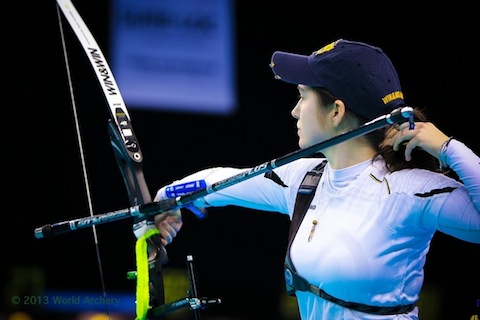
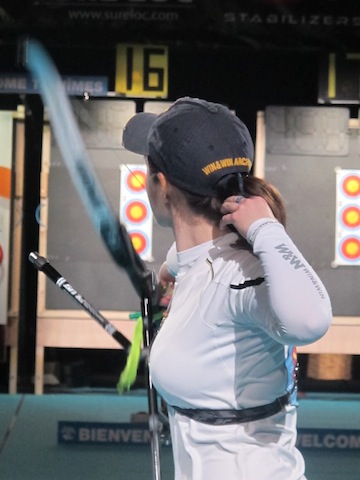 Céline SCHOBINGER defeated five time world indoor champion Natalia VALEEVA to win the Nimes Tournament in January. The young Swiss athlete took time out of her training and studies to chat with us, on the eve of the Swiss Archery Championships, where she is one of the favourites to win the recurve title.
You won the Nimes Tournament / Indoor World Cup stage 2 after a brilliant gold medal match against the multiple world champion Natalia VALEEVA (ITA). What does this victory mean to you? It is the first step towards the next four coming years, qualifying for Rio 2016 Olympic Games that encourages me to carry on. I notice that after four months training with a new coach, my results are progressing and they can only be better four years from now. This victory represents a real motivation and a beautiful success. Hopefully it is the first of a long list. How come you did not compete at the Indoor World Cup stage 3 in Las Vegas, hence you didn't qualify for the Indoor World Cup Final? I had to pass exams at University and didn't shoot for two weeks. I did not want to risk missing my exams by putting additional pressure on myself and training for Las Vegas. What is your training routine, and how often do you train? I try to train a minimum of four to five times a week. Of course, it all depends on my participation for competitions at the weekend, any major competitions scheduled on my programme and the time I have available. It also depends on the training conditions: currently, in an adapted sports hall, I shoot a a lot of arrows at the competition distances (18m or 70m). If I do not have this possibility, I also can train at home with a target positioned at 2m. In that case, I don’t shoot 500 arrows but prefer to concentrate on technique, with a smaller number of arrows.
How would you describe your training conditions at your club in Vevey compared to your aspirations? They are not ideal conditions, as I only have three evenings a week at my disposal where I can train for two hours and knowing that I cannot go by myself, as I need help to set up the targets and all the material. I therefore, do not have the option of going whenever I want – it is very different from clubs that are open nonstop. It is restrictive but I deal with it the best I can. Thanks to the target that I have at home, I can still shoot a bit in order to not lose my touch. Do you have the possibility to change to another club with better conditions? I could, and I sometimes do it when I travel to Sion for instance, but with the time that I waste in travelling there it is not worth it. However, in the summer we have an outdoor field continuously available with targets already in place. This allows me to go by myself.
In Switzerland, where does the potential of archers stand in order to rival with great archery nations? There are not many archers in Switzerland. In comparison, in Korea, an important part of the population practises archery, hence, talents are immediately identified and trained. Here in Switzerland, we have club coaches and few good archers. Youngsters with potential must make their own way to get good results, knowing that it is difficult to achieve success considering the lack of coaches. It is not encouraging. For example, we train under our national coach approximately one weekend every two months, in a group ranging between 15 and 20 archers, which makes the work tough.
How much finances do you have to raise annually to fulfill your budget? In order to cover training and competition expenses, I must raise around 20,000 Swiss Francs per year.
 What resources do you have to attract sponsors?
There are not many resources in Switzerland. Some scholarships do exist, but the process to obtain these is so long that they do not really help in the end. Unfortunately, in order to achieve good results you need money, but to get money you need to achieve good results first. Therefore, it is necessary to come across the right people who will accept to help and sponsor you. I had the chance to meet people through whom I managed to get a personal sponsor which helps me a lot, and I hope that others will follow. Besides, the approach of this sponsor made me understand that I must use this opportunity as an initiator, in order to attract more sponsors, by taking advantage of the interest and attraction that I represent.
What resources do you have to attract sponsors?
There are not many resources in Switzerland. Some scholarships do exist, but the process to obtain these is so long that they do not really help in the end. Unfortunately, in order to achieve good results you need money, but to get money you need to achieve good results first. Therefore, it is necessary to come across the right people who will accept to help and sponsor you. I had the chance to meet people through whom I managed to get a personal sponsor which helps me a lot, and I hope that others will follow. Besides, the approach of this sponsor made me understand that I must use this opportunity as an initiator, in order to attract more sponsors, by taking advantage of the interest and attraction that I represent.You were ranked first in your category’s national ranking last year. Does this mean you receive any help from the Swiss Olympic Committee or from any other sport authority? During the 2009-2012 Olympic cycle, I received a Swiss Olympic card which allowed me to obtain a scholarship from the State of Vaud. This also brought me other forms of aid, for instance, for my contact lenses. However, this year I have not yet received any financial support and I do not know if it will come.
How do you combine University studies with archery practice and competitions? If a major international competition is scheduled during an exam period, I come to an agreement with the University in order to pass them at another time, as long as I respect the deadlines to fulfill them. As for the courses, I manage directly with the professors. It is simply a question of planning in advance.
How do you adapt for indoor and outdoor competitions, and how does it affect your performance? I make sure to cut off from outside unfavourable elements and to get used to constraints, whether it is wind or rain. Nevertheless, the shooting sequence remains the same. It is a question of concentration in order to realise the best possible shot, otherwise, there is no difference in the way of shooting.
In 2011 you took a sabbatical year to concentrate on the World Championships, counting for the London Olympic Games qualification. What assessment do you make about that year? It was a way of experiencing the life of a professional athlete, which is not easy, as shooting is then all you have. I therefore, had the opportunity to go to Australia to train within professional structures, which were by far the best conditions I have ever experienced. However, such infrastructures and conditions are not available in Switzerland. The three or four months that I spent here were difficult, as I was shooting full time and by myself – it was harder to find motivation. These are not favourable conditions to practice a sport professionally: a bad performance at one competition and everything takes a major scope. There are, therefore, advantages in combining elite sport with another activity, as archery takes less importance and it prevents falling into depression in case of failure.
Would you consider going abroad if an opportunity of becoming professional arose? For the moment I do not know. I would probably prefer to have other activities besides archery, like a normal job and other occupations. I do not see archery as a potential job, and. Therefore, I do not know if I would take on an opportunity of becoming professional. I had the occasion to see the positive and negative aspects of professionalism and it is a question I would have to think about carefully.
Let’s talk about your five-month stay in Australia. You trained under the 2000 Olympic champion Simon FAIRWEATHER at the Australian Institute of Sport. Did this experience make you grow as an elite athlete? This experience changed me a lot. Simon FAIRWEATHER took care of me almost every day. When I had a problem, he was there to take care of me. This is the big difference and what I lack here in Switzerland.
 How do you consider yourself in relation to an athlete such as the current Olympic champion KI Bo Bae?
A poor little amateur (she laughs). The Koreans have different resources, but she remains a reference within women and at the end, she did not become Olympic champion by chance. Additionally, she has the talent and the infrastructure to reach this goal. I would also like to reach it but I would need the same conditions, which is impossible in Switzerland. As there is so much more rivalry in their country, it is more difficult to become Korean champion than world champion. Few archers in Europe could reach the results of Korean archers.
How do you consider yourself in relation to an athlete such as the current Olympic champion KI Bo Bae?
A poor little amateur (she laughs). The Koreans have different resources, but she remains a reference within women and at the end, she did not become Olympic champion by chance. Additionally, she has the talent and the infrastructure to reach this goal. I would also like to reach it but I would need the same conditions, which is impossible in Switzerland. As there is so much more rivalry in their country, it is more difficult to become Korean champion than world champion. Few archers in Europe could reach the results of Korean archers.
How do you feel about your non-qualification for the London Olympic Games? It was a big disappointment. I made my way through the qualifications and it did not work for many reasons.
What are your objectives in the short, medium and long term? For the moment, I focus on technique, on bringing the necessary changes to improve. Scores and results are not a goal for the time being. I want to fix my shoot and follow the training with my coach and then reaching 2015 and 2016 for scoring points. My victory in Nimes was a great surprise, it was wonderful, but this did not represent my main objective. I will still compete in some events, but not as many as in the last two years. I will focus on a World Cup stage, on a Grand Prix and on the World Championships, if possible, in order to keep up with competition.
And Rio 2016, a dream or a reachable reality? I think it is possible. I already obtained an Olympic quota place for Switzerland and it is not a problem to do it again. I realised that it was within my reach, and even more now with my coach.
Biography Extract Celine SCHOBINGER (SUI) – Born 18 September 1989 1st Individual European Indoor Tournament – Nimes 2013 6th Individual London 2012 Final Qualification Tournament - Ogden 2012 8th Individual Indoor World Cup Final – Las Vegas 2012 2nd Individual Australian Open – Adelaide 2010 2nd Team European Youth Championships – Algarve 2007
World Archery Communication
Features
Wiener: Family matters
Features