This content is archived and as has not been processed. It may contain unformatted text or images, broken links or out-of-date information.
Archive
Pierre-Julien DELOCHE: “My gold medal from Wroclaw is not an outcome, just a beginning”
Paris

Real name:
What does this Final, held in Paris, mean to you?
This is the result of an outstanding season. I am immensely proud of being an athlete in this great competition, held in my capital city, in front of a French audience. The Gardens of Trocadero is a magnificent historical setting that gives an additional value to the performance of the world’s top archers. What an incredible media potential: archery at the foot of the Eiffel Tower! It is a moment that I’m not going to forget.
You have accomplished so much this year. What is your state of mind? 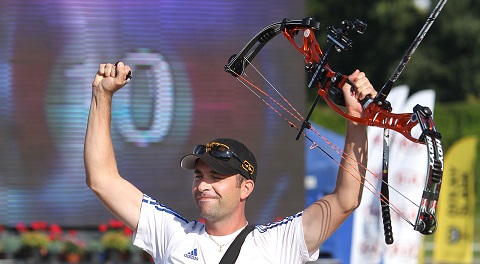 I feel good, actually better now that my bad start of the season is behind. After a flawless indoor season that culminated with the European title, I wanted to make a successful transition to the outdoor season. The requirements are different, and I had to adapt in order to apply my indoor level to outdoor shooting. I have changed my mental approach, from “why?” to “why not”. I worked very hard and gained experience. Wroclaw was my first individual title on the world scene. This gold medal is not an outcome, it’s the beginning of a new phase!
What was the key to your success in 2013?
In the wake of 2012 and my first individual World Cup medal, I wanted to solidify my ability to win in 2013. Before 2012, I had a lot of work in the French Navy, my military career was a priority, and I had to prove that I could succeed on both fronts: sports and career.
I have now become a career military officer, and this new status brings me relief: I now have professional security. My victory at the European Indoors in March 2013 led my Commander to acknowledge my level and let me arrange my work and training hours, without constraints of collective planning and night shifts, as was the case in the previous years. I was able to plan my season almost like a professional athlete.
At mid-season in June, I had to start all over technically. The team medals we won in Antalya (bronze) and Medellin (gold) helped me believe in myself, and my individual results kept improving. I really wanted to do well at the World Games, and the silver medal that I won kept whispering me “you have the level to succeed”. I never stopped my effort to set up my equipment, with almost surgical precision, and to perfect my technique over long hours of training. My loved ones supported me with endless energy, and also left me by myself when I needed it.
What did the previous World Cup Final in Tokyo teach you for the current one?
I learned a lot about running a complete season, about the particularity of a Final featuring the top eight in the world, and what it feels like after the three months break from competition that we had last year, to start immediately with quarter-finals. A Final has a special atmosphere, the shooting line is superb and each archer is highlighted.
During the season, every team stays together and few international contacts are made. In Tokyo, I discovered a “good natured”, very nice atmosphere that I really enjoyed. Being only eight archers allows one to build stronger ties. In Tokyo I did not yet have the mental strength that I have now, and it cost me a first-round defeat. I learned a lot from it. Paris will be another experience, on an even greater scale.
Shooting the Final at home in Paris: how do you find the balance between the extra motivation and the danger of trying to do too well?
The World Cup Final held in my capital, at the foot of a world famous monument, in front of over 2500 mostly French spectators and a large media platform, promises to be challenging at times! Despite all that surrounds the event, I am doing fine, I would even say that I feel good.
About the risk of “doing too well”: I learned about it in the military, I wanted to be perfect and flawless. I then applied this tendency to archery, putting a huge pressure on myself many times, and it always ended up in failure. So I changed my approach. I want to enjoy these moments and live them fully, with lightness. I tend to live the finals like the replay of something that I’ve already lived 2000 times in my head.
How do you approach the first match against Sergio PAGNI, who defeated you several times but whom you outscored in Wroclaw in the final?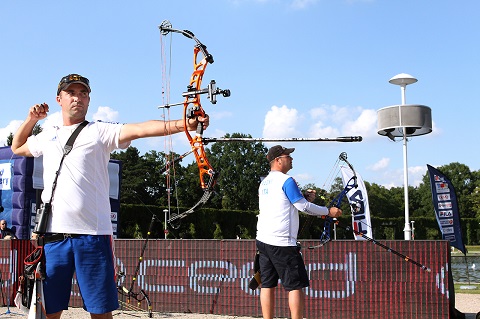 Sergio is a great archer, a friend, and a formidable opponent. He has defeated me often, especially in outdoor archery where he is more experienced. We have faced each other a lot indoors, and I beat him several times.
I’m trying to build my path in outdoor archery, where the weather conditions require a more precise management of technology, changing from one continent to another, and where the level is higher and the season longer. One match, 15 arrows, and 18 minutes: we all have an almost identical level approaching excellence. A match is very short and anything can happen, we may as well lose a lot of points as not lose any.
I like the friendly rivalry that develops between archers over several confrontations. It is the case with Sergio, it motivates me to strive to win that extra point, and to display the best possible match in a spectacular setting! However, my first competitor will always be myself.
The importance of the mental game in compound archery is increasing to a level never seen before, as exemplified by the Wroclaw World Cup where three archers shot 150 points in the semi-finals. What are your thoughts?
I think that cumulative scores are excellent for compound: this scoring system increases the match intensity and highlights the accuracy of the bow and therefore the psychological command of the “actors”.
50 metres is not an easy distance: if weather conditions worsen, they quickly have an impact on accuracy, whereas if the weather is good, performances will be tight in the search for perfection. In both cases, it is a battle of nerves, especially during matches where we shoot a small number of arrows. In Poland, where the weather conditions were good, Sergio PAGNI and I shot exactly the same number of 10s over the whole week of competition: 133 arrows out of 147 in the 10 ring!
It is definitely a mental battle, and it makes outdoor archery closer to indoor archery, but with one additional constraint: the weather. It is not a matter of who will achieve the most points, but who will lose the least! The defeats are even bitterer, and the victories even more sweet!
What are the benefits of writing about the mental approach of your sport?
I am involved in two different, and relatively unknown, environments: the military and elite sports. People know a little, but not much about it. Therefore in 2010 I created a blog to start sharing news about my sports and military life. The main goal was to inform my family and friends on my whereabouts, between earth and sea. I was away from them during two years of “nomadic life”, filled with intensive travels to international competitions and military deployments.
As time passed I extended the topics, in order to promote my sponsors and share about the bow setup... I kept running the blog until it was no longer sufficient: after two years, its success grew to the point that it developed into a website. In nine months of existence it has received over 50,000 visits!
Through my words, I create my own world. I dive into it whenever I get the chance and I invite all readers who appreciate these lines to dive with me. It is a world where I find rest, after all the (mental) frenzy of a competition or a sea rescue. These road books provide me a lot on the mental plan, they are an invaluable help, and I stick to that. Overall, it is both a help and a pleasure to share these unusual moments. “Written words remain”!
Where do you stand now between the possibility of being a fulltime athlete and your military career? 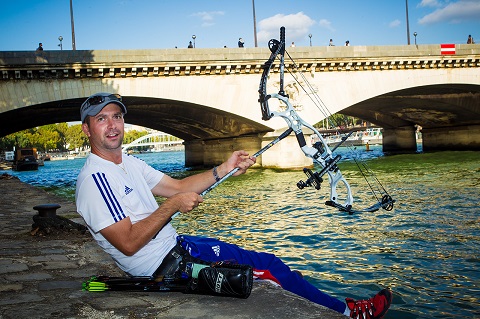 I am thinking about it and it takes time: it is an important decision about my lifestyle. For now I am busy enough with my military career and my life as an athlete, I cannot juggle with the third challenge that would be organising the transition to being a fulltime athlete. All in due time! For now, I’m in the rush of events.
Since I am a member of the French National Team (2008), counting both competitions and military duties, I am away from home 240 days per year. I am now looking to settle down in my hometown of Valence.
Archery is a real passion to which I’m sure I can bring my own touch. I strive to make my sport better known and recognised. I like to dissect the equipment in order to make it more efficient, by finding new settings. I like to share, and would like to teach what I have learned. I’m 31 years old, and at this time in my life, I have a golden opportunity to turn my passion into my job! Finally, at my age experience and maturity are major assets towards success.
The move to being a fulltime athlete is under consideration and I’m on the right track. Meanwhile I do my best to professionalise my passion, in the army or outside of it. Taking into account the huge investment, the support I receive, my current level, my determination and the question of where I want to be later, I build solid foundations in order to keep writing my story as I want to read it later!
Do you have anything else to share with the archery fans?
Yes, many things... on my website!
Go to Pierre-Julien DELOCHE's biography.
World Archery Communication
People

Features
Wiener: Family matters
Features