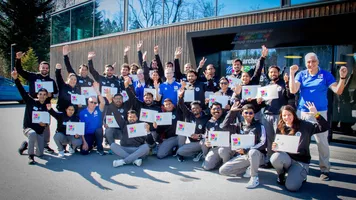
Niger builds stronger foundations as archery gains momentum


For some Nigerien archers, having enough equipment to train has been a challenge in itself.
In 2025, national team archer Assamaou Issoufou Naroua described the situation in stark terms. The federation did not have enough equipment, she explained, and the few arrows available for training were often in poor condition. At competitions, one archer could sometimes only shoot after another had finished and the arrows had been collected.
“Really, it is discouraging,” she said. “It demoralises a high-level athlete.”
A year later, equipment remains one of the challenges facing archery in Niger, but efforts to strengthen the sport are addressing the issue from several angles – from equipment and coach education to competition organisation and local skills.
“As long as a person does not have equipment, they cannot progress,” says National Technical Director Ibrahima Abdoulaye Hamzata. “We have talents who need support, especially equipment, so they can achieve good results in national and international competitions.”
That need has brought together a number of development partners. Olympic Solidarity supported a Development of National Sport Structure (DNSS) programme carried out from December 2025 to July 2026, with Carlos Freitas serving as the expert, while World Archery, World Archery Africa and World Archery Asia have provided equipment, technical support and financial assistance.
The aim is not simply to put more equipment into the hands of athletes, but to strengthen the structure around them.

The DNSS programme focused on the organisational, technical and equipment foundations of the Niger archery federation. It included online education sessions, a World Archery Level 1 coaching course, practical work on equipment building, maintenance and tuning, a national-team training camp, a seminar on competition organisation and a tournament.
The programme also set out longer-term priorities, including regular national and regional competitions, a registration system for archers, coaches and judges, greater local production of basic equipment and a more consistent annual competition calendar. The federation is targeting at least six tournaments by the end of 2026 and a structured calendar for 2027.
Equipment remains an important part of that work. World Archery supplied seven complete sets of intermediate bows, while World Archery Africa provided financial support to build targets. World Archery Asia also donated target foams.
At the same time, the development programme is designed to help the federation become more self-sufficient. Participants learned how to build, repair and maintain equipment, while plans include the local production of basic items such as PVC bows, wooden arrows, armguards, quivers and finger tabs.
For Saley Adamou, who has practised archery since 2015, the potential is already there.
“In Niger, we have a lot of talent,” he says. “We have young athletes in archery and, despite the difficulties, we continue to achieve results at national and international level despite the lack of resources.”

Adamou is one of the athletes showing what that talent can produce. He finished 21st in the individual recurve men’s competition at the 2026 African Archery Championships in Oran, Algeria, in July, before winning recurve men’s individual gold at the second Alliance of Sahel States Games in Ouagadougou, Burkina Faso, on 9-10 September.
His victory was part of a strong archery performance by Niger at these Games. The country also won the recurve men’s, women’s and mixed team events, with Niger finishing first in the archery country ranking.
The results also underline the importance of developing the next generation.
Abdoul Aziz Yachaou started archery in Niger in 2022 and finished fifth in the under-21 recurve men’s competition in Oran. His experience reflects the same challenge faced by more established athletes.
“There are people who want to practise archery in Niger, but unfortunately there is a lack of equipment for them to progress,” he says.
Yet the number of people practising the sport is growing. Asked about the development of the archery community, Yachaou says that there are now more archers in Niger than there were in the past.

That growth is one of the reasons why the development work is focused on building a sustainable national structure.
The DNSS programme identifies regular competition as a key measure of success and emphasises that training should ultimately prepare athletes to compete, supported by local production of basic equipment and greater self-sufficiency.
The journey is far from finished.
Niger still needs equipment, funding and continued access to technical expertise, while its athletes need regular opportunities to compete and develop. For 2026/2027, the federation was selected for the World Archery Knowledge Sharing programme, which will provide online expert follow-up with defined outputs, combined with an online judges’ course in French.
But the foundations are becoming stronger. International partners are contributing equipment, expertise and financial support; coaches and officials are gaining new skills; and a growing group of athletes is gaining experience on the international stage.
For Niger, the ambition is not simply to win the next medal. It is to create the conditions in which more archers can progress, compete regularly and give the country a stronger and more sustainable presence in African and international archery.


Iceland’s archery community triples

World Archery signs MOU with KAA