Archery’s history at the Olympics in the modern era has seen the competition held in some extraordinary venues, including the historic Panathenaic Stadium at Athens 2004 and the Sambadromo in Rio de Janeiro for Rio 2016.
These memorable locations have also been a big part of securing archery’s place and future as an Olympic sport – and that has often been hard-won. The late Giuseppe ‘Beppe’ Cinerella, former World Archery secretary-general, was the man that single-handedly managed to change the venue from an unremarkable field near the Athens airport to the iconic Panathenaic Stadium; a vital moment for a sport that was not as big a part of the Games as it is now.
One of archery’s great selling points as an Olympic sport is that you don’t need to build anything. Ultimately, you just need a flat piece of ground, and this flexibility has allowed the sport to grace some venues that other sports simply could not.
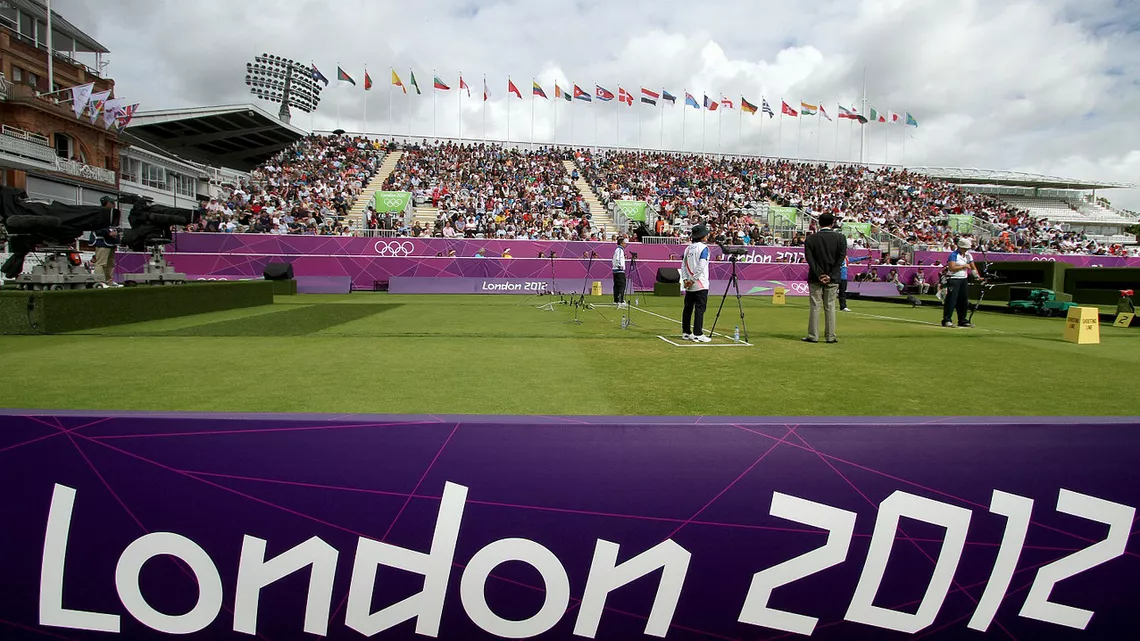
At the London 2012 Olympic Games, archery took over the home of cricket, the iconic Lord’s Cricket Ground in west London.
This was the first time that archery had found itself in the home of another sport for an Olympic competition – and not just any old home. Lords is revered worldwide as the spiritual heart of cricket, and the centre of its rich heritage and traditions. Established in 1814, the venue has hosted countless historic matches, including iconic battles in the Ashes.
But from 27 July to 3 August 2028, 128 athletes from all over the world competed across four events in front of crowds never before seen at an archery event, with temporary stands holding almost 5000 spectators and a total of over 60,000 tickets sold.
London was the first – and possibly last – Olympics ever to sell out, and people who were there still talk about the extraordinary atmosphere of that Games.
All Olympic Games change and shape their sports, some more than others – and the event at Lords would be an immense milestone on archery’s journey.
The venue
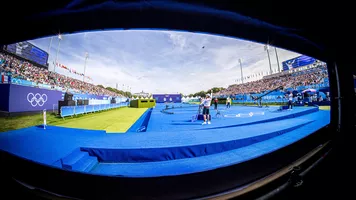
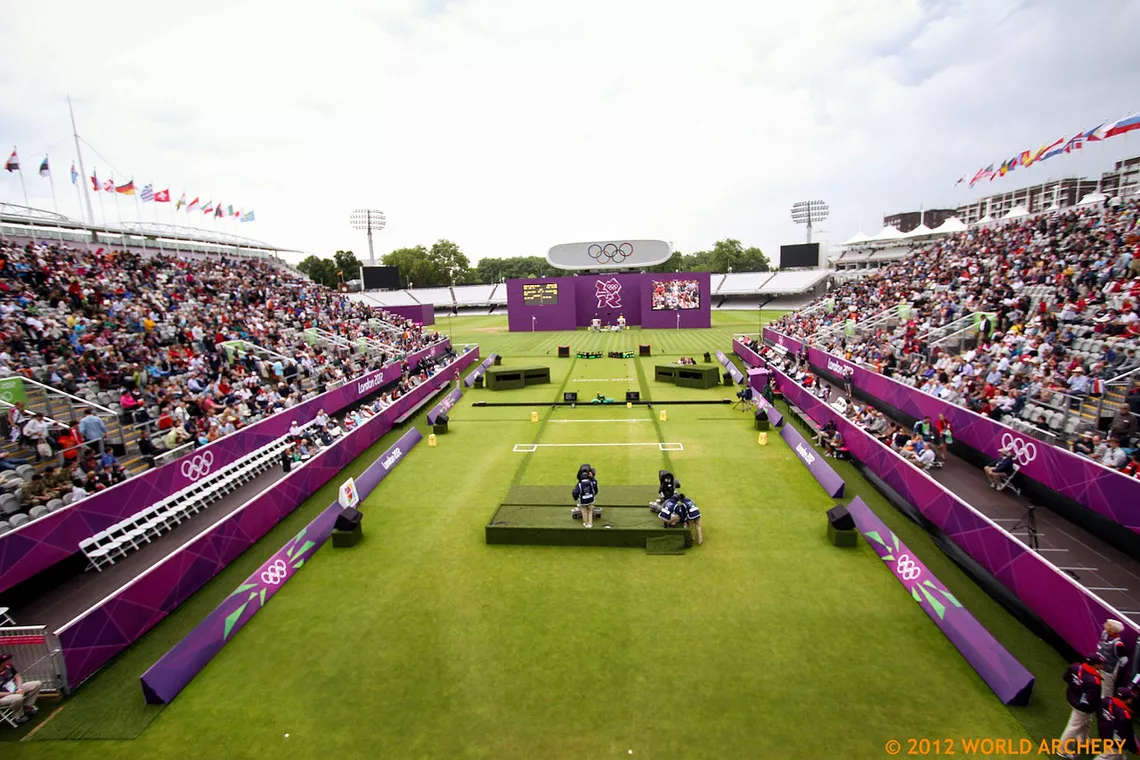
Lords had been discussed as a potential venue for a London Olympics for decades, but during the bid process in the mid-2000s, archery was identified as the perfect sport for it; one that could use the venue without disturbing the carefully-managed central wicket area of the field, so important to elite cricket.
Many years of planning would follow. Chris Marsh, a former national team member, was the archery sport manager responsible for the venue set up and competition, ensuring the athletes had the very best environment to perform to their best.
“It was amazing and a great challenge to work on one of Britain’s historic iconic venues,” said Marsh, who now works for the International Olympic Committee. “While it was easier to work with a venue that is already built, it also presented an interesting challenge to get a purpose-built cricket venue to stage a pinnacle event in archery.”
“There was a deep responsibility, a duty of care, to ensure we maintained and gave back the venue in the excellent condition in which we received it, to ensure there was no damage to the sacred cricket square and fit in with a packed cricket season.”
That season meant Lord’s was the very last venue at London 2012 to be handed over to the organising committee, requiring a lightning turnaround and a similarly quick exit – with an international cricket match between England and South Africa scheduled less than two weeks afterwards.
The logistics were dizzying.
“Two 2450-seat temporary spectator stands and a huge safety wall all needed to be disassembled and removed from the venue within three days of competition finishing to allow replacement of the outer turf for the next match,” explained Marsh.
“Fifty refrigerated lorries were travelling down from northern England to the ground with rolls of new turf that had been ordered two years prior to the Games. There could be no delay in the journey and unloading of these lorries to avoid risk of the turf dying.”
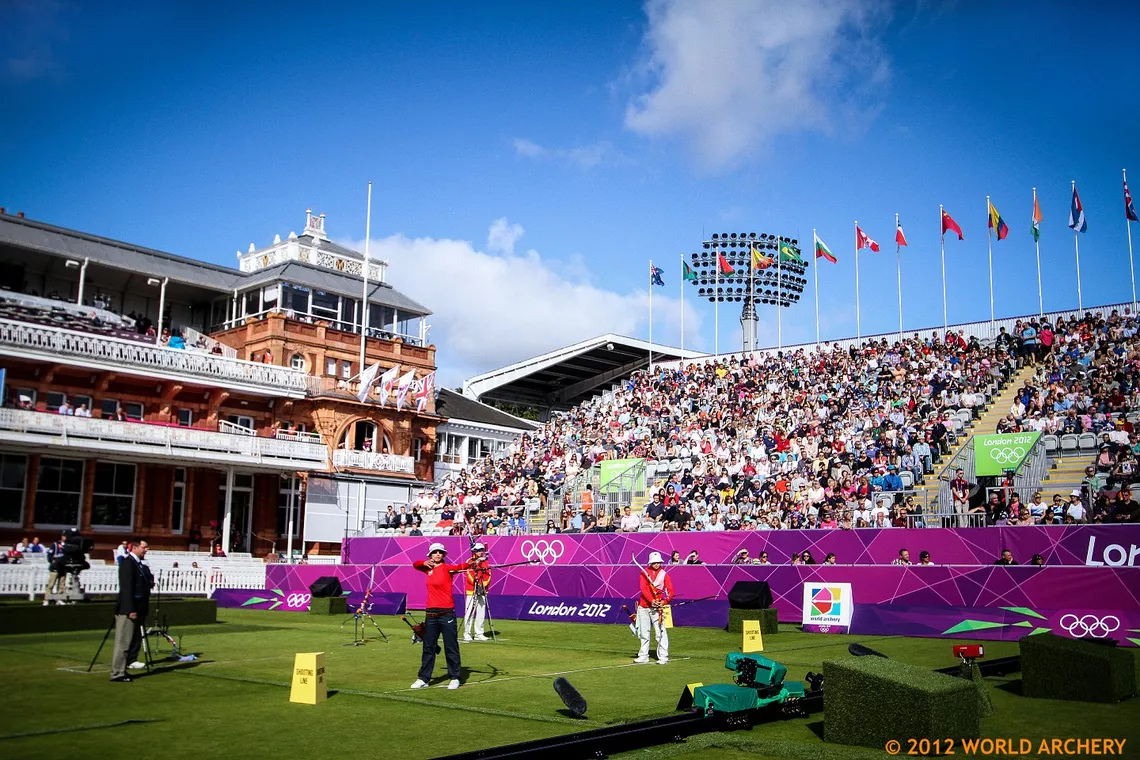
In October 2011, a test event was held at the venue, notable for Korea’s Im Dong Hyun breaking two world records, including his own 72-arrow ranking round record with 693.
Im would go on to break the record again at the Games, this time scoring 699 in the ranking round held behind closed doors on 27 July. This achievement would make global news because, thanks to an interview mistranslation, it was claimed that Im achieved this while being ‘legally blind‘. It was simply untrue – but the story had already made its way around the world.
It wasn’t the only big news that day. Janine Self was the archery reporter for the Olympic News Service, and a presence at Lords throughout the Games.
“The most extraordinary moment for me was on the first day,” explains Self. “Due to incorrect communication being given out an unofficial website said that tickets were available for the ranking round.”
“The opening ceremony was in London on the Friday night and so was the ranking round. There was no other live Olympics action anywhere in the country on that Friday, and a huge crowd turned up outside asking to come in and watch. We had all these people outside trying to buy tickets that didn’t exist.”
Marsh managed to get all the disappointed spectators standing outside an official London 2012 official pin badge as a token of good faith.
“The ranking round took place down at the Nursery End at Lord’s which had no facility for spectators, there was no way you could let people in,” said Self.
Archery had finally taken its spot as a major sport and a major news event, and every Olympic ranking round since then has been besieged by the world’s press and photographers – although the public still aren’t allowed in.
The crowd
Many of the spectators throughout the London 2012 Olympic Games were new to most of the sports and archery was no exception.
“I was very apprehensive to know how would the spectators take to archery,” explains Marsh.
“It was hard to imagine because for the days leading up to the start, I saw empty stands then, on Saturday 28 July, for the men’s team, all the seats were full, the atmosphere was buzzing and the noise was incredible when the archers started competing.”
London, as a truly global city, is home to large communities of people from all over the world, and tourists and residents – including thousands of Koreans – helped fill seats in St. Johns Wood and ensure a truly unforgettable atmosphere. The noise of 4500 fans in the stands was a big part of that, but they quickly understood the preference of archers for quiet when going through their process.
“It was funny to see almost all the spectators, their heads go from side to side as the arrow left the bow and hit the target,” adds Marsh.
“I don’t know why, I hadn’t anticipated it, but I absolutely loved that some of them got into the spirit of it and dressed up in fancy dress, wearing Robin Hood, Maid Marian or medieval knight outfits.”
The competition
After all that buildup, and with full houses promised, London was notable for being one of the most exciting Olympics of all on the field.
Korea would inevitably top the medal table, but as so often at the Olympics, they had some narrow escapes on the way. The second-ranked Korean man, Kim Bub Min got a scare in the first round when Fiji’s Rob Elder, ranked 63rd, shot brilliantly to push things to a final tense fifth set.
France’s veteran Bérengère Schuh beat Korea’s Choi Hyeonju in a one arrow shoot-off after Choi came back from four set points down to tie the match in the fifth set. Choi, who had struggled in the buildup to the Games, had qualified in a most-un-Korean 21st place, although she would end up performing well in the team event.
The USA men’s team beat Korea in the semifinals, in one of the great upsets of the sport. That USA men’s team featured Brady Ellison in his second Olympic appearance; but he would end up falling in the individual competition to Australia’s Taylor Worth – a man who had already cited shooting at Lords as one of the greatest honours of his life, as a venue that everyone in cricket-mad Australia knows.
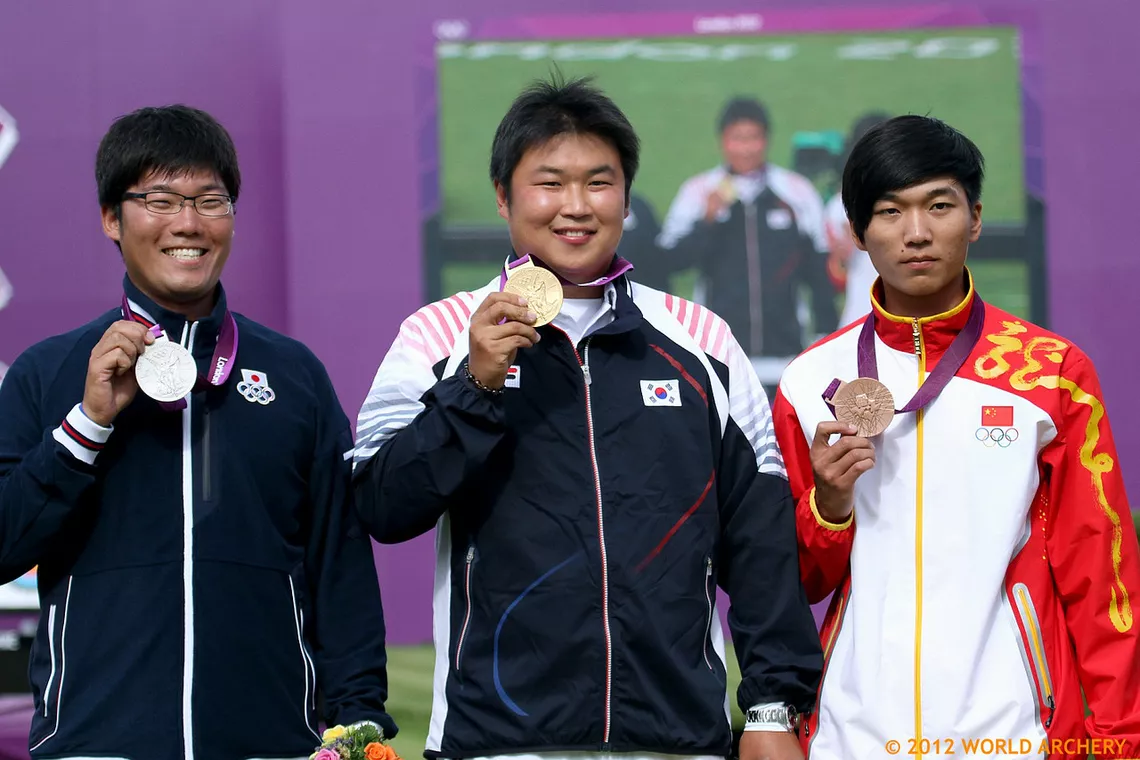
On the men’s side, while Im Dong Hyun was the Korean favourite for gold, it would be Oh Jin Hyek, a long-in-the-tooth professional who would ultimately become the first Korean man to win individual gold at an Olympics.
Somehow, it had never been done before.
“It was incredible to see Oh finally achieve Korea’s first men’s individual gold medal having watched Oh’s predecessors achieve silver at past Games,” said Marsh. “At the closing stages of the match, I vividly recall being constantly on the radio with our victory ceremonies team, to let them know when the match was over so they could bring in the podium and get everyone lined up for the medal ceremony.”
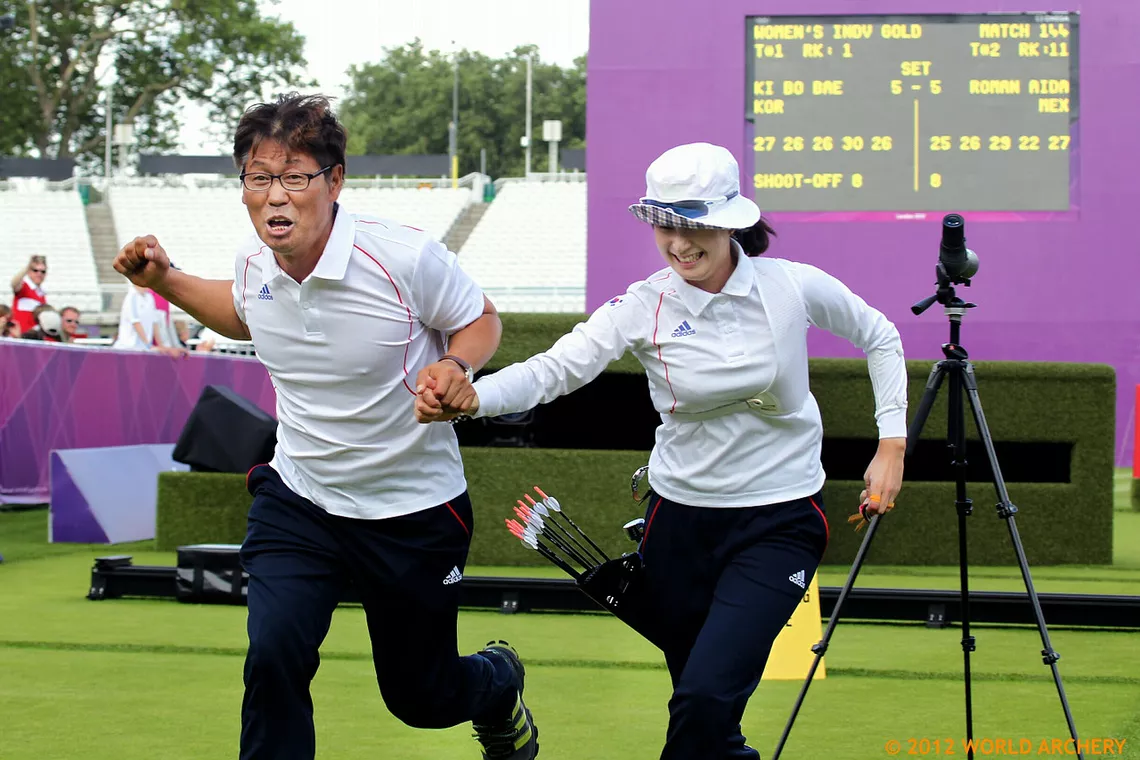
In the women’s individual competition, a new star emerged in Ki Bo Bae, whose career had peaked at the perfect moment. She was the favourite to win, although the apple cart was almost upset by Aida Roman in one of the great women’s Olympic finals.
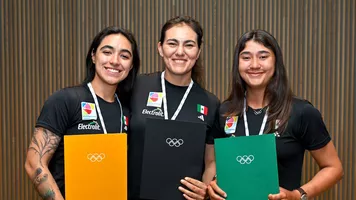
“It was great to see the brilliant new talents emerging at the time and to see a new strong archery nation of Mexico establish itself to challenge the ever-successful Korea team,” said Marsh. The individual silver and bronze medals for Aida Roman and Mariana Avitia would change the entire sport in their country and eventually see Mexico becoming a major archery nation. (You can read more about their story here and here).
The Korean women’s team, of course, fulfilled their inevitable destiny and became champions for the seventh consecutive time – although they fended off a furious challenge from China in the final. Bo Bae would go on to become the biggest star of the era, returning at Rio 2016 to take team gold and indvidual bronze.
Indeed, all four gold medal finals: men’s team, women’s team, men’s individual and women’s individual were notable thrillers: making history or turning on dramatic final arrows.
There was one memory for Marsh which proved to be a little bit problematic for the company producing the TV footage from Lord’s: another well-publicised incident where Khatuna Lorig shot out a camera embedded in the centre of the target.
“I recall the Olympic Broadcasting Service not being very happy that she shot the TV camera embedded in the target during her bronze medal match against Avitia,” explained Marsh.
“They needed to get more spare camera lenses pretty sharpish in time for the men’s finals the next day, as they originally only had stock of four replacement camera lenses for archery but these were also all shot in the first two days of the competition.”
So many memories, but as usual, it would not have been possible without one set of people, according to Marsh. “The Games Makers (volunteers) made the London 2012 Games,” he said.
"I will forever be grateful to all of them. Working at London was an absolute honour – and I would do it all again.”
Medallists: London 2012
Men’s recurve individual
- Oh Jin Hyek, Korea
- Takaharu Furukawa, Japan
- Dai Xiaoxiang, China
Men’s recurve team
 Italy (Michele Frangilli, Marco Galiazzo, Mauro Nespoli)
 USA (Brady Ellison, Jake Kaminski, Jacob Wukie)
 Korea (Im Dong Hyun, Kim Bubmin, Oh Jin Hyek)
 Italy (
 USA (
USA ( Korea (
Women's individual
- Ki Bo Bae, Korea
- Aida Roman, Mexico
- Mariana Avitia, Mexico
Women’s recurve team
- Korea (Choi Hyeonju, Ki Bo Bae, Lee Sung Jin)
 China (Cheng Ming, Fang Yuting, Xu Jing)
 Japan (Ren Hayakawa, Miki Kanie, Kaori Kawanaka)
 China (
 Japan (