Roger Rees-Evans: The driving force behind visually impaired archery

ATHLETE SPOTLIGHT is presented by WIAWIS.
For all the clubs, national teams and franchises that archers now represent – including the recent introduction of the Indian Premier League – archery remains, at its core, an individual pursuit.
Athletes are supported by coaches, managers and strong networks, but ultimately, it is the archer alone who steps to the line and executes each shot, time and again.
That same individual determination defines Roger Rees-Evans.
A silver medallist at the Donaueschingen 2015 World Archery Para Championships, Rees-Evans has dedicated his life not only to competing, but to building visually impaired archery from the ground up – work for which he has since been recognised.
The category in which he won that medal did not truly exist before him. It is now a staple of para archery world championships – the result of more than 35 years of effort.
“There was archery for able-bodied people and other disabilities, but there were no rules for visually impaired archery,” said Rees-Evans, now 73. “I met with the chairman of Archery GB – then the Grand National Archery Society – back in 1986, and we tried to formulate some rules.”
“It enabled a blind person to shoot alongside able-bodied people in competitions. There were simple enough rules, but this just gave a little bit of leeway by the organisers – and it grew from there.”
Rees-Evans had been shooting for six years by that point, but even reaching that stage required ingenuity.
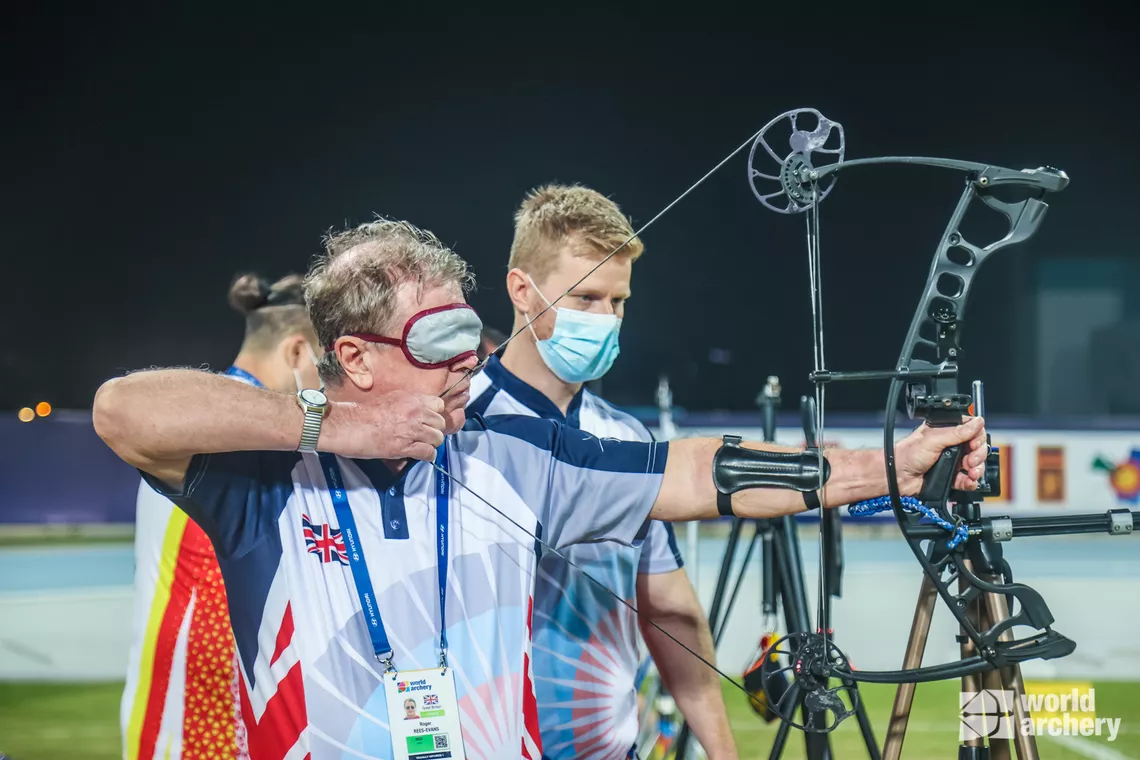
Born with glaucoma, he had first competed in para athletics in the late 1970s before leaving the sport after a fall in a 100-metre race in 1980. It was at that same competition that he was introduced to archery.
With no adapted equipment available, he and his parents improvised so that he was able to shoot in a local club in South Wales.
“We got a drip stand from the hospital, so that acted as a tripod,” Rees-Evans explained. “We put a piece across the top so the back of my hand could touch it – and that’s how I started.”
“Obviously the equipment has moved on from there, but we still use the back-of-the-hand sight.”
Two years later, he founded the archery arm of British Blind Sport, helping introduce the discipline across the country through have-a-go sessions and outreach at disability sports clubs.
Recognising a clear gap, and with support from the national federation, Rees-Evans looked beyond Great Britain. At the time, only France had a comparable form of visually impaired archery.
Throughout the 1990s, he helped organise regular international matches between the two nations – alternating hosts – even as approaches differed.
“France saw it more as an art form than a sport at first,” he said.
One of those meetings, held in Poitiers, proved pivotal. A seminar the following day laid the groundwork for a basic international rule set that would later spread globally.
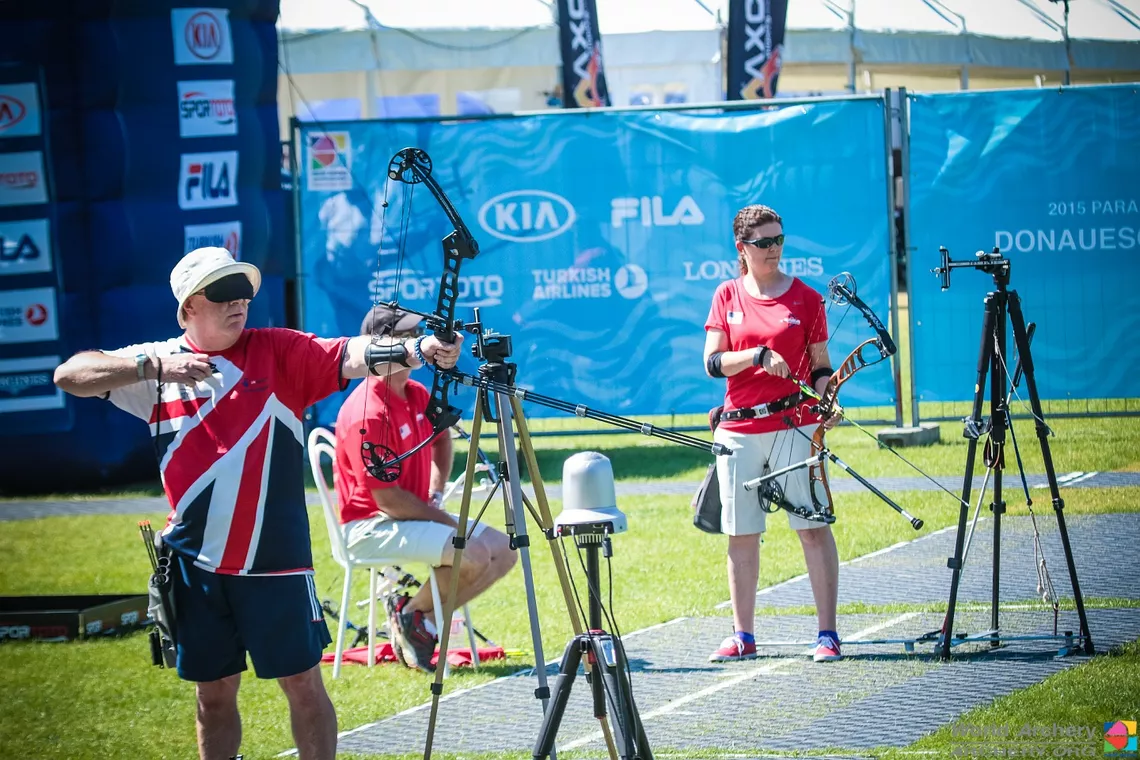
Momentum continued into the 2000s.
“In 2002, we were invited to the Czech Republic for a European para championships, where we did a demonstration event so that people could see how archery for the visually impaired was done,” he said. “We had also demonstrated it at Stoke Mandeville the year before that, speaking to people from Japan and Australia.”
“Then in 2005, our rules were presented internationally, and that’s when they were accepted by the International Paralympic Committee.”
That moment marked a turning point. Visually impaired archery was no longer a concept – it was a recognised discipline.
A key evolution made the format viable for elite competition: standardisation.
Rather than varying distances, the discipline adopted a fixed distance and target, allowing visually impaired archers to compete more seamlessly alongside others and making the format easier to follow.
Today, the visually impaired round is shot at 30 metres on an 80cm target face, with 72 arrows for qualification followed by head-to-head matches.
By then, Rees-Evans and British Blind Sport had already established national championships in Great Britain, running annually since 1991, before both outdoor and indoor championships moved permanently to Archery GB performance centre in Lilleshall.
The breakthrough came in 2015.
At the World Archery Para Championships in Donaueschingen, visually impaired archery debuted with two official categories: VI1 (blindfolded) and VI2/3 (partially sighted).
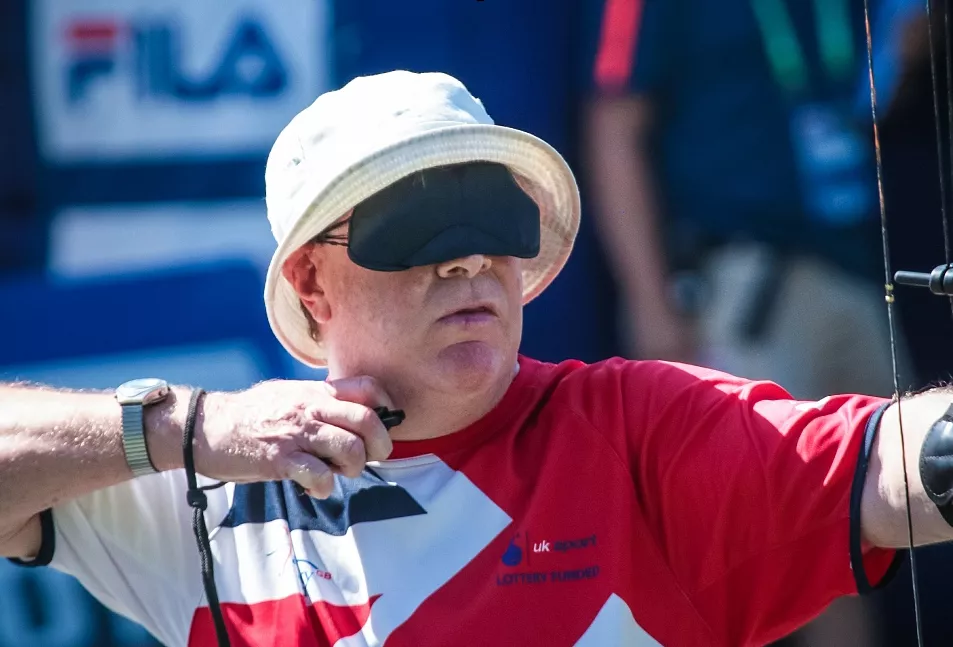
For Rees-Evans, it was both a milestone and a personal test.
“I was totally terrified of shooting in front of a crowd to start with,” said Rees-Evans, who lost to USA’s Janice Walth in the gold medal match in straight sets. “After competing, I burst into tears because it was so stressful.
“But it was really brilliant. It probably was the peak of my career at the time.”
It was also a full-circle moment.
For decades, he had worked to create the opportunity simply to stand on that stage and compete. From almost nothing, visually impaired archery had become a global discipline with world championship status.
His long-term vision remains unchanged: Paralympic inclusion.
While the category will not feature at LA28, there is growing optimism around Brisbane 2032, with World Archery actively pushing for its inclusion.
If that happens, Rees-Evans’ legacy will be undeniable – not just as a rule-maker, but as a pioneer who helped transform lives across continents.
And yet, he remains characteristically modest.
“In the early days I never was thinking about recognition or anything like that. I just thought it had to be done, so we got on with it.”
“I’m sure someone else could have done it – it was just being there at the right time, being involved and trying to create something that’s now worldwide.”
“I’ve never really thought about it myself.”