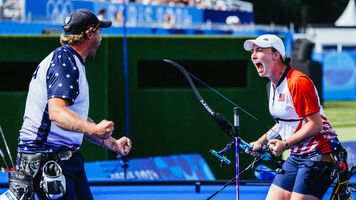
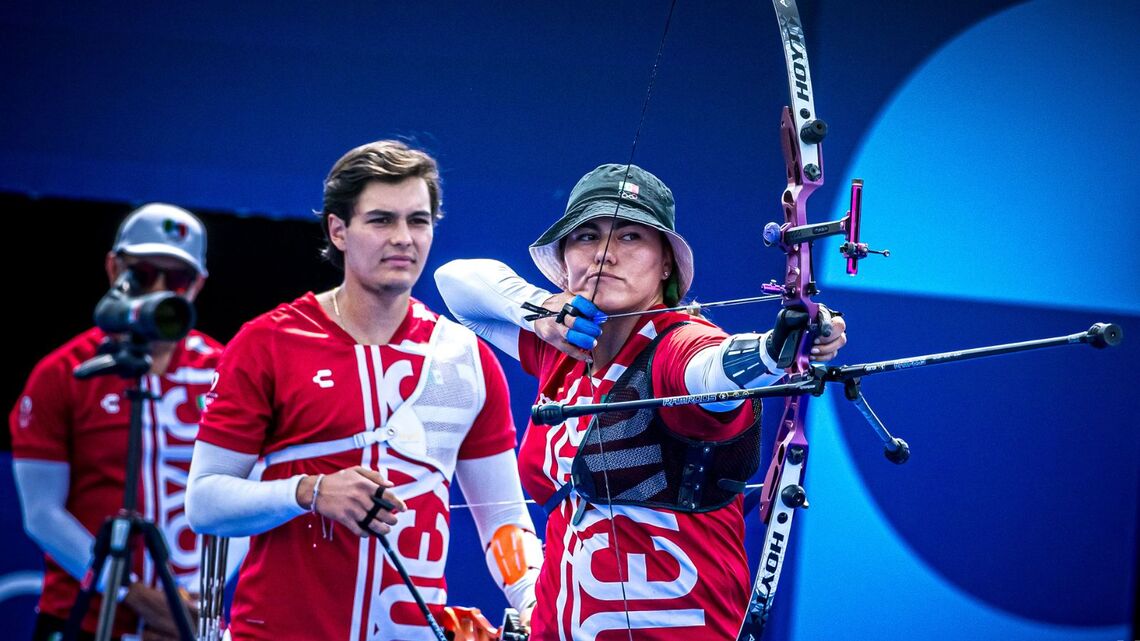
Alejandra Valencia has spent enough time in mixed team archery to know the margin for error is thin – and the margin for decision-making even thinner.
This month, as World Archery highlights mixed team ahead of the outdoor season and the 20th anniversary of the Hyundai Archery World Cup in 2026, that question is back in focus.
By the time the decorated recurve archer arrived at the Paris 2024 Olympic Games, Mexico’s mixed team had already been decided. Weeks earlier, coaches informed Valencia she would partner with 20-year-old Matias Grande, a pairing built not just on qualification scores but on a season’s worth of shared results and trust.
“We had a lot of experience working together, and they didn’t want to put extra pressure on us with the thought that we wouldn’t be competing together in the Olympics,” said Valencia, who won mixed team gold with Grande at the 2024 Hyundai Archery World Cup in Yecheon and previously claimed bronze with Luis Alvarez at the event’s Olympic debut in Tokyo.
It was a deliberate choice – and not the most common one.
At most international events, mixed teams are determined by qualification results, with the highest-scoring man and woman earning their spots. The logic is simple: reward performance on the day.
“Most of the time in Mexico, mixed team is decided by qualification – the best woman and man,” Valencia said. “But in some special cases it’s decided before the event.”
But in a format shaped by speed, communication and shared pressure, the decision is rarely that straightforward.
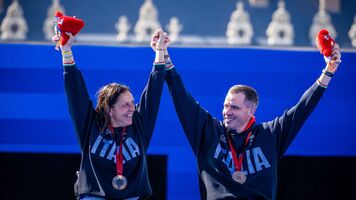
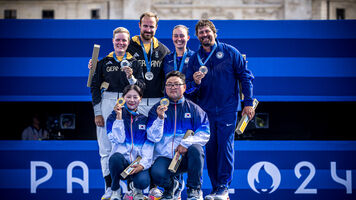
Those factors often only become clear in competition, as seen in the partnership between Casey Kaufhold and Brady Ellison, whose communication and trust helped deliver Olympic bronze in Paris.
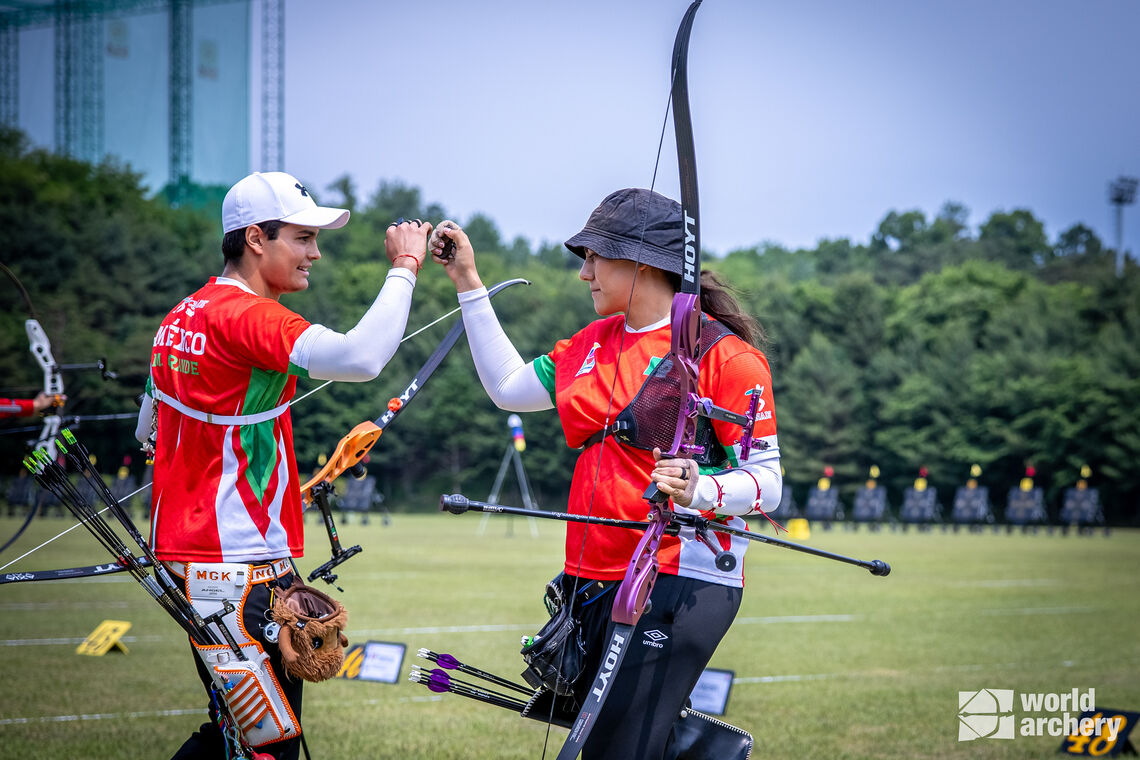
What began as a push for gender equity has evolved into one of the sport’s most complex events – not just in how it’s shot, but in how teams are chosen.
At any international competition, the standard is already high. But mixed team adds another layer, with two athletes sharing not just arrows, but rhythm, responsibility and decision-making in real time.
The tension begins in qualification, where internal competition can shape the outcome before matches even start.
“It definitely puts more pressure on us when we’re qualifying,” said Estonian compound archer Lisell Jaatma. “Sometimes you can feel the tension – that we each want to shoot better than the other. But at the same time, it’s a good thing. It pushes us more.”
For coaches, that pressure creates a central dilemma.
Qualification offers clarity: the scores are objective, the process is transparent and the stakes are clear – and for many programmes, that matters.
“If you shoot the best qualification score of everyone on the team, you should continue to shoot the same,” said USA coach Elias Cuesta.
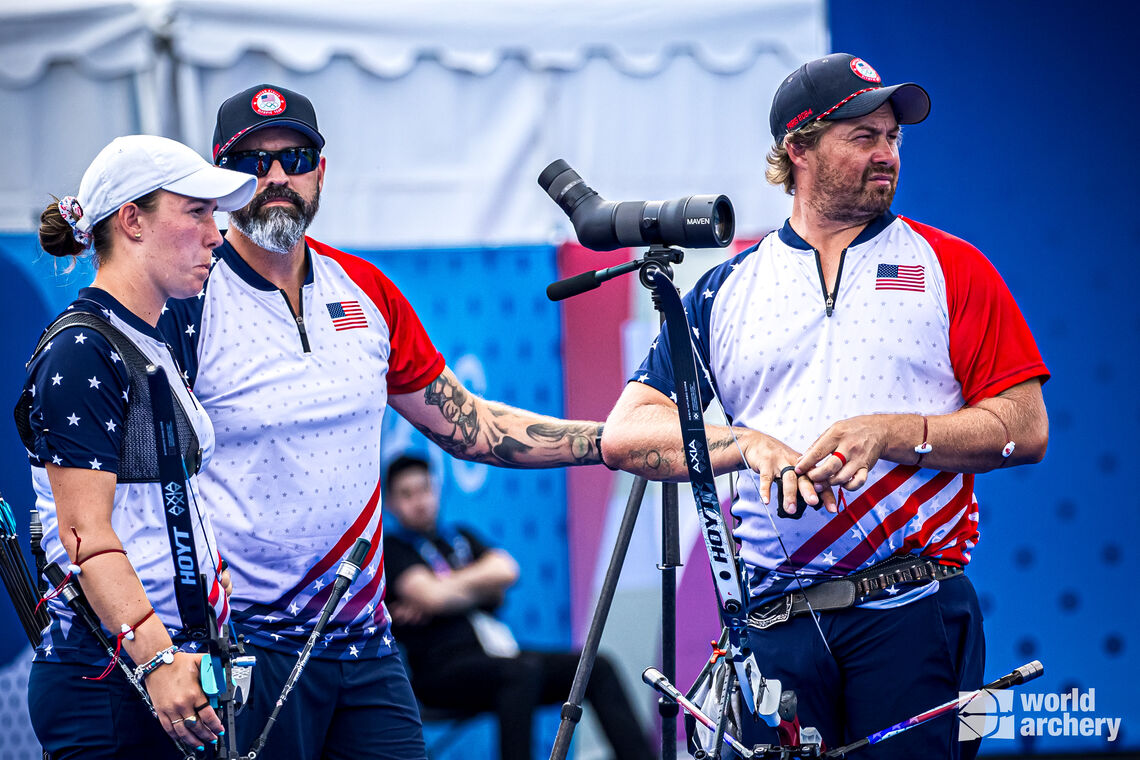
Even so, qualification does not always capture what mixed team requires. The decision often comes down to something less visible – not just who is shooting well, but who works well together.
“It can be such a difficult decision,” said Luxembourg’s Mariya Klein. “If the difference is very small, but you know another combination works better together, there’s always room for discussion.”
“Everyone wants a chance to get a medal.”
In practice, those conversations centre on compatibility. Mixed team asks two athletes to operate as a unit, with constant communication between arrows about timing, wind and execution.
“It’s one of the key factors,” Klein said. “You can really benefit from any type of talk through the shot to your teammate.”
Complicating matters further, male and female archers are not always seeing the same shot. Differences in bow poundage and arrow speed can affect how each reads the wind, making mid-match adjustments harder to translate.
As a result, some coaches prioritise pairs who not only trust each other, but who can communicate clearly under pressure.
In those cases, selection can diverge from the rankings.
At the 2024 Hyundai Archery World Cup in Shanghai, Estonia opted not to pair compound standout Robin Jaatma with higher-ranked Meeri-Marita Paas. Instead, they chose Robin’s sister, Lisell – a partnership built on familiarity – and the siblings went on to win silver.
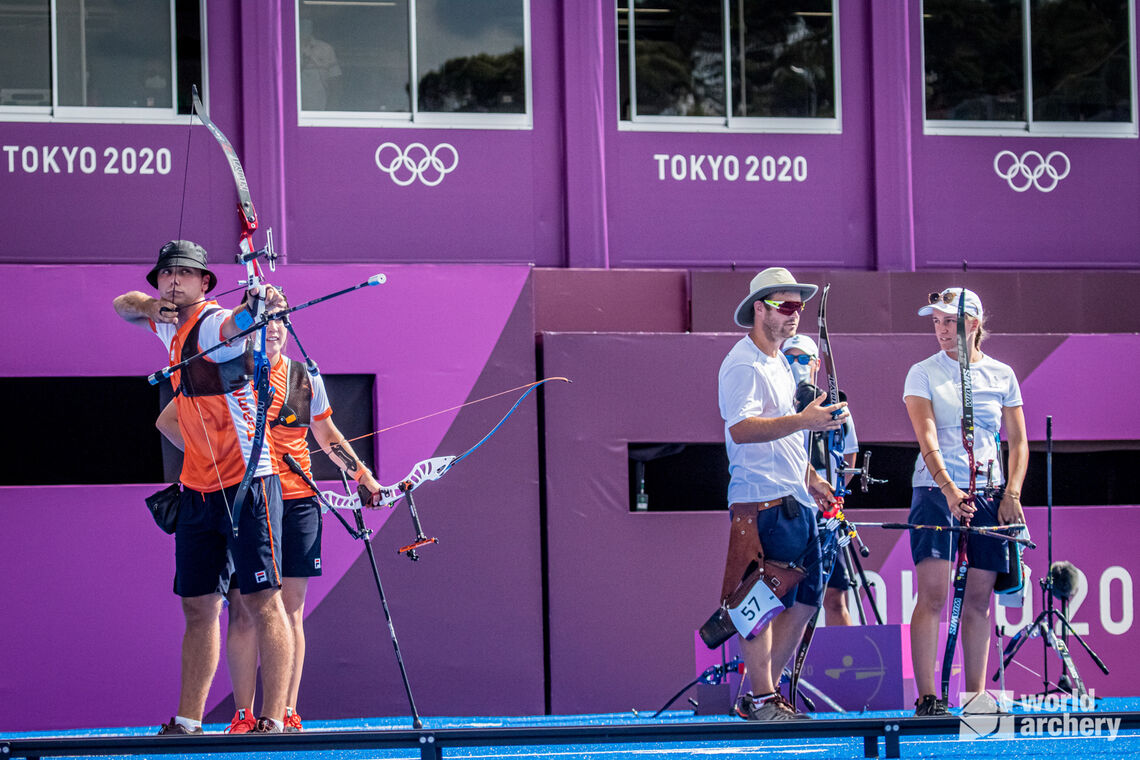
A similar calculation appeared in Salt Lake City in 2018. Dutch recurve archer Sjef Van Den Berg shot 666 in qualification, 20 points higher than Steve Wijler, but it was Wijler who was selected to shoot mixed team alongside Gaby Schloesser.
The Netherlands exited early, but Wijler later took individual silver and helped secure team gold, underscoring the broader view behind the decision.
And perhaps the boldest example came at the first Olympic mixed team event in Tokyo. France replaced higher-ranked Pierre Jangnäs (then-Plihon) with Jean-Charles Valladont to shoot alongside Lisa Barbelin, even though Valladont’s qualification score would have left the pair outside the cut had it been used to determine entry.
The lineup, according to reports at the time, had been decided in advance.
These examples reflect how coaches weigh performance, potential and partnership. Turkish national coach Yusuf Goktug Ergin said those decisions often come down to observation and flexibility.
“We try different variations,” he said. “Some archers are better in qualification, some are better in mixed team matches. It’s my job to put everyone in the best position to succeed.”
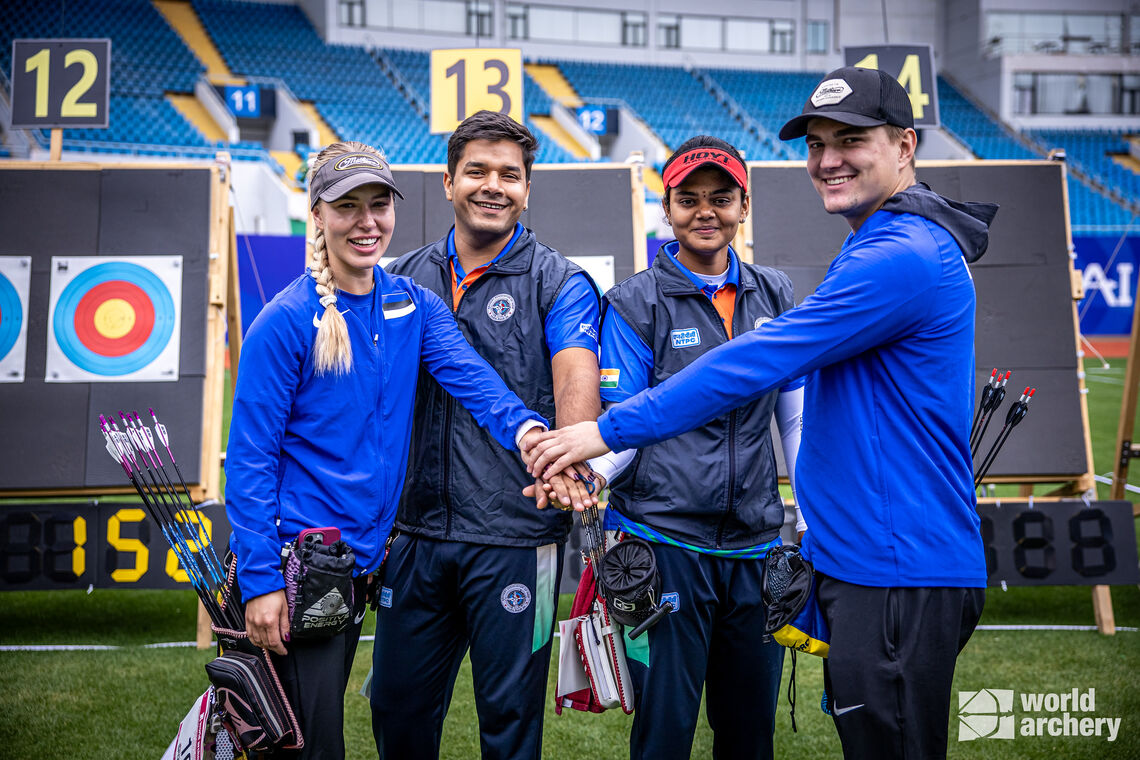
That flexibility often extends right up to competition. Even after the two athletes are identified, another decision remains: who shoots first?
The answer varies. Some athletes prefer to lead, setting the tone without knowing the result, while others prefer to shoot second, reacting to the situation.
One of the quirks of the sport is that the same information can be interpreted in completely different ways –some archers want to know what their teammate shot, while others would rather not.
Cuesta said the USA has rotated shooting orders across different pairings, sometimes leading with Brady Ellison, other times with partners like Casey Kaufhold or Jennifer Mucino, depending on form, rhythm and how each athlete responds in the moment.
“As a coach, you always have a preference,” Cuesta said. “But you also need to have a good enough relationship with the archers so they can be honest about what they feel comfortable with.”
That interplay between structure and trust runs through every part of mixed team.
“If you have strong relationships with your teammates and strong cohesion between archers, your chances of performing well are higher,” Cuesta said. “But at the end of the day, if you’re a professional, it shouldn’t matter who your teammate is.”
Other coaches see selection as part of a longer process. Indonesia coach Lilies Handayani said she is willing to prioritise development when decisions are close.
“If a team consists of both senior and junior athletes, and the junior athlete narrowly outperforms the senior athlete, I will still select the junior athlete,” she said. “It provides valuable preparation for future competitions.”
British coach Naomi Folkard believes the sport is still searching for the right balance between performance and continuity.
“Most teams just go off qualifications,” she said. “Some teams have tried having predetermined teams. It’s still evolving.”
Her instinct is that continuity can offer an advantage.
“You have to start with the understanding that sport isn’t fair,” Folkard said. “If you can get that team working well and nail the way they communicate, that’s going to be a better team than if every event is a different person.”
There is no single model that guarantees success. Some teams trust the ranking round, others trust the partnership, and many try to balance both, adjusting from event to event based on form, fit and feel.
The strongest mixed teams tend to find that alignment – two athletes working on the same wavelength, supporting each other and building a shared rhythm that holds under pressure.
And in a format where the difference between athletes can be measured in a point or two, the final decision often comes down to something harder to quantify: not just who is shooting best, but who shoots best together.


Energy, trust and a winning bond
Mixed team: The ‘gold standard’
Five iconic World Cup moments
Top 5: Mixed team moments of Paris