This content is archived and as has not been processed. It may contain unformatted text or images, broken links or out-of-date information.
Archive
Morten WILMANN (NOR): “FITA is on the right path!”
Ulsan (KOR) – 2 September 2009

Real name:
The Norwegian Morten WILMANN is the Chairman for the FITA Judges Committee since 2007 and was awarded a Silver Plaquette last Sunday at the FITA Congress in Ulsan. We sat down with him for an interview.
Morten Wilmann (right) and FITA President Prof Dr Ugur ERDENER 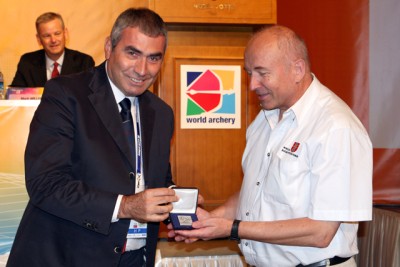 How did you start archery and get into the judging world?
I got into archery thanks to my parents in 1957. I sold programmes at the 1961 World Championships in Oslo and I started shooting myself (recurve) in 1965. I was an active archer for ten years. In 1979 I was employed as general secretary of the Norwegian Archery Association. So I’m celebrating my 30-year anniversary this year as general secretary!
How did you start archery and get into the judging world?
I got into archery thanks to my parents in 1957. I sold programmes at the 1961 World Championships in Oslo and I started shooting myself (recurve) in 1965. I was an active archer for ten years. In 1979 I was employed as general secretary of the Norwegian Archery Association. So I’m celebrating my 30-year anniversary this year as general secretary!
As for judging, I actually started very early. I began judging nationally in 1968, when I was still very young, and I became an international judge in 1989. I was elected to the FITA Judges Committee in 1991 and I have been there ever since.
What major developments have happened in archery since you started being involved in the sport? I was Chairman of the Organising Committee for the World Field Championships in 1990 and these championships were interesting for many reasons, but mainly because they were the first FITA Championships featuring compound bows.
I would like to say also that I have started to be interested in the archery administration and rules before FITA even had a rules book. This came after I started my activity in the sport.
And what is your opinion on the evolution of judging? Judges have developed from being a kind of policemen to being more like assistants of the competition. The consistency of the judges worldwide has improved considerably.
A major input was given since I started judging. I like to think I have been an important part in that. The global evolution of the sport has been possible because archery became an Olympic sport, which brought more money and allowed for more worldwide education.
Today the Judges Committee is the more active committee in FITA, organizing seminars, observing events. I’m very pleased with the development of the new, young judges. Our goal must be that every Member Association put efforts into creating a judges structure in their countries.
How do you think the new rules that were approved yesterday by the FITA Congress will affect the future of archery? They should help bringing more recognition to archery, because the format of the competition creates more interest in the media. The way FITA is doing it is very well. They have already managed to produce a lot of interest and hopefully they will continue in that direction. As general secretary of a Member Association, the challenge is that we have more events, which is very demanding in money to send teams.
As a judge, how will you adapt to these new rules? In general, the Judges Committee and the Chairman must apply what the FITA Congress decides. We are not there to make political decisions. Every change creates a new challenge for the Committee. We don’t know yet how we will adapt to the new rules, as we are awaiting the adoption of relevant by-laws. Generally speaking, we judges would like to be more involved in the creation of new rules and by-laws to ensure that we will have rules that are possible to enforce fairly and consistently.
How do you see the future of archery in general and judging in particular? Concerning the judging, I’m optimistic. I think the judges will continue to be better and better and I hope that cooperation with archers, coaches and organizers will continue to improve. For archery in general, I think FITA is on the right track, so I’m quite optimistic.
Do you have any ideas on how we could improve the visibility of our sport even more? Not really. At the national level, it is important to train better archers who could really be at the top level internationally. Also, in this respect, the development efforts initiated by FITA in the coaching areas is very important.
In Norway we have had a success in creating a sponsor pool for less visible sports, which also includes production of TV programmes. Last year archery had four times four minutes on a national TV sports programme, compared to nothing the year before.
Thank you Morten and keep up the good work!
Vanahé ANTILLE FITA Communication
How did you start archery and get into the judging world?
I got into archery thanks to my parents in 1957. I sold programmes at the 1961 World Championships in Oslo and I started shooting myself (recurve) in 1965. I was an active archer for ten years. In 1979 I was employed as general secretary of the Norwegian Archery Association. So I’m celebrating my 30-year anniversary this year as general secretary!As for judging, I actually started very early. I began judging nationally in 1968, when I was still very young, and I became an international judge in 1989. I was elected to the FITA Judges Committee in 1991 and I have been there ever since.
What major developments have happened in archery since you started being involved in the sport? I was Chairman of the Organising Committee for the World Field Championships in 1990 and these championships were interesting for many reasons, but mainly because they were the first FITA Championships featuring compound bows.
I would like to say also that I have started to be interested in the archery administration and rules before FITA even had a rules book. This came after I started my activity in the sport.
And what is your opinion on the evolution of judging? Judges have developed from being a kind of policemen to being more like assistants of the competition. The consistency of the judges worldwide has improved considerably.
A major input was given since I started judging. I like to think I have been an important part in that. The global evolution of the sport has been possible because archery became an Olympic sport, which brought more money and allowed for more worldwide education.
Today the Judges Committee is the more active committee in FITA, organizing seminars, observing events. I’m very pleased with the development of the new, young judges. Our goal must be that every Member Association put efforts into creating a judges structure in their countries.
How do you think the new rules that were approved yesterday by the FITA Congress will affect the future of archery? They should help bringing more recognition to archery, because the format of the competition creates more interest in the media. The way FITA is doing it is very well. They have already managed to produce a lot of interest and hopefully they will continue in that direction. As general secretary of a Member Association, the challenge is that we have more events, which is very demanding in money to send teams.
As a judge, how will you adapt to these new rules? In general, the Judges Committee and the Chairman must apply what the FITA Congress decides. We are not there to make political decisions. Every change creates a new challenge for the Committee. We don’t know yet how we will adapt to the new rules, as we are awaiting the adoption of relevant by-laws. Generally speaking, we judges would like to be more involved in the creation of new rules and by-laws to ensure that we will have rules that are possible to enforce fairly and consistently.
How do you see the future of archery in general and judging in particular? Concerning the judging, I’m optimistic. I think the judges will continue to be better and better and I hope that cooperation with archers, coaches and organizers will continue to improve. For archery in general, I think FITA is on the right track, so I’m quite optimistic.
Do you have any ideas on how we could improve the visibility of our sport even more? Not really. At the national level, it is important to train better archers who could really be at the top level internationally. Also, in this respect, the development efforts initiated by FITA in the coaching areas is very important.
In Norway we have had a success in creating a sponsor pool for less visible sports, which also includes production of TV programmes. Last year archery had four times four minutes on a national TV sports programme, compared to nothing the year before.
Thank you Morten and keep up the good work!
Vanahé ANTILLE FITA Communication

Features
Horackova: Overcoming fear

Features