This content is archived and as has not been processed. It may contain unformatted text or images, broken links or out-of-date information.
Archive
Meeting of the FITA Medical & Sport Sciences Committee in Merida
Lausanne

Real name:
Medical & Sport Sciences Committee Lausanne – 10 November 2006 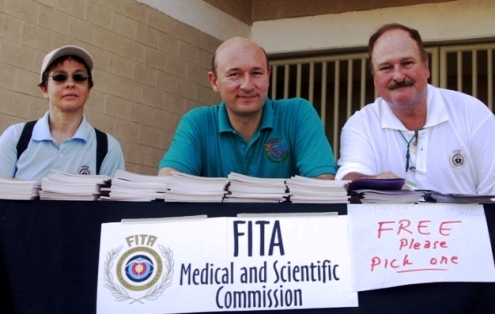 The FITA Medical & Sports Sciences Committee (MSSC) has held its annual meeting in Merida (MEX), on 17 and 18 October 2006, on the occasion of the Junior Outdoor World Championships. The Committee has worked on its many current activities and projects in the area of medical and sports sciences which include: Ø the next edition of the Sport Medicine and Science in archery book, and its translation in Spanish, Ø the follow-up of the Junior Injury Survey, Ø the review of the medical services and the possibility to offer physiotherapy services at FITA events, Ø the compliance of the FITA rules with the newly adopted Olympic Medical Code, Ø consideration for the need of sun protection on the shooting line under intense sun. The MSSC is also involved in anti-doping matters, and on that subject: Ø has expressed his concern regarding the doping controls at Continental Championships and FITA World Ranking Tournaments. Each Continental Association will be asked to nominate an official continental liaison whose role will be to ensure that FITA rules are enforced in this area; Ø will seek clarifications on the World Anti-Doping Agency (WADA) accredited laboratory requirements for urine samples analysis; Ø has launched a research project on the possible performance-enhancing effects of anxyolitics in the sport of archery. Partnership with other interested IFs in precision sports will be considered; Ø has discussed the issue of beta-blockers, with regard to the FITA Therapeutic Use Exemptions statistics showing a great number of beta-blockers TUEs for club-level athletes, and has issued an official statement on this matter (see below). Beyond their two days meeting, the MSSC members have also been very active on the field in Merida: Ø They have conducted interviews with the Cadet/Juniors archers who had declared a previous injury in Lilleshall two years ago and were present again in these Merida Championships. Ø They have been present at the entrance of the Inalambrica venue dining room for three days, during the competitions break, in order to discuss anti-doping matters with athletes, coaches, team officials, etc… FITA Medical & Sport Sciences Committee statement on the use of beta-blockers in the sport of archery: Ø The FITA Medical & Sport Sciences Committee (MSSC) is in the opinion that there can be pathologies where only beta-blockers can be administered. However, it acknowledges also that many pathologies can be treated with substances other than beta-blockers that are not on the prohibited list of substances and methods. Ø Therefore the MSSC recommends the FITA TUE panel a strict application of the World Anti-Doping Agency (WADA) Standards for granting TUEs for beta-blockers. This is to include the formal conclusion that there is no therapeutic alternative to the use of beta-blocker, based on provision by the applicant of a comprehensive medical history, results of examinations, laboratory investigations and imaging studies relevant to the application. Ø In addition, the MSSC strongly supports the feedback presented by number of stakeholders on the occasion of the World Anti-Doping Code current revision process, questioning the definition of an athlete, and raising the idea that recreational and low-level athletes should not be covered by certain areas of the Code (e.g. possibility of “retroactive TUEs”). FITA MSSC, 18 October 2006 Photo © FITA/Dean Alberga: FITA Medical Committee’s stand at 2006 Junior & Cadet World Championships in Mexico: from left to right, Françoise Dagouret (FITA), Dr. Emin Ergen and Dr. Carlos A. Hermes.
Features
Horackova: Overcoming fear

Features