This content is archived and as has not been processed. It may contain unformatted text or images, broken links or out-of-date information.
Archive
Inna STEPANOVA: “a victory at the Olympics is the ultimate goal”
Wroclaw

Real name:
Inna STEPANOVA climbed to the top spot of the podium last month in Medellin, for the second World Cup victory of her career after Shanghai 2011. It was also the first individual victory for Russia in recurve since then. The 23-year-old athlete from Buryatia (Siberia) is now positioned to qualify for the World Cup Final in Paris.
Please tell us about your golden performance at the Medellin World Cup.
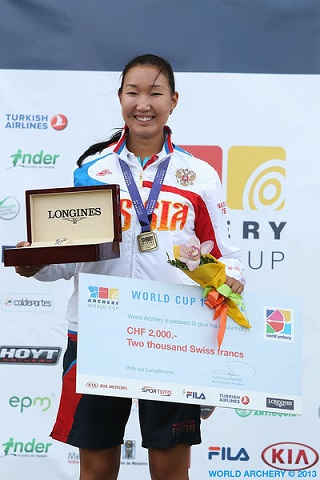 I am obviously very happy to have won gold in Colombia. There is a very big time difference between my city of Ulan-Ude and Medellin; fortunately we landed in Colombia in the evening, went to sleep immediately to be able to get a good rest, and had an efficient training the next day to test the weather and adapt to local conditions. I wouldn’t say that I scored very high in qualifications – I shot 1334 points, whereas I was aiming to score at least 1340. Following that round, I understood how to manage the wind and when we shot the mixed team eliminations it was already much better. By the time I shot the individual matches I already knew exactly how the wind was oriented and how to handle the conditions.
With your performances in Antalya and Medellin, you are currently third in the running for the World Cup Final.After the second stage of the World Cup in Antalya, where I reached the quarter-finals, the possibility appeared for me to qualify for the Finals in Paris. I had to take that chance. This is why I travelled to Medellin, despite not being originally scheduled. And I’m now in third place in the race! I think I can hold the position. I already competed in the Finals in 2011 thanks to a victory at the Shanghai stage that year.
Did your victory at Shanghai 2011 help you win in Medellin?Yes. When I shot my first final in Shanghai, I was very nervous. I had more difficulty handling the pressure then than now. In Medellin, I was able to shoot like a more experienced archer. The wind was very strong, it rather helped me because it was there not only for me, but also for my opponent, who didn’t handle the wind so well in the final. The field where I train in Buryatia is located next to a river and it is always windy during the day.
Can we say that 2013 is the best year in your career so far?I don’t know…until the end of the season it’s hard to say! We’ll see if I qualify for the World Cup Finals and how the World Championships go. It is my main goal of the season, our team is preparing for it very seriously. I also have the Rio 2016 Olympic Games in mind. A victory at the Olympics is the ultimate goal.
Your team won the Ogden World Cup in June 2012 and just missed the Olympic bronze medal one month later. What impact did it have on you and your team?We have a very strong bond among us. What we didn’t manage at the Olympics – the few points that we lost here and there – can be considered as an experience. We still like each other and always support each other in any situation. We have a considerable reservoir of talent at home: there are about eight girls fighting for the four World Cup spots and the three World Championships spots. This obviously helps us stay in shape and strive for good results.
Please tell us about archery in Buryatia. Archery is an ancient tradition in Buryatia. It is one of the three national sports, along with wrestling and horse racing. As a result we have a strong local school, from which a lot of talented archers have the opportunity to develop. Besides that, many people practice archery for pleasure with traditional wooden bows and arrows that are made locally, often by the shooters themselves. We have a traditional festivity called Sukharban which is held every year and comprises wrestling, horse racing and archery contests. Competitors shoot with traditional equipment, wearing the national costume and shoes. The winner receives a herd of around fifty sheep!
Tell us how you got your start in archery.A schoolmate of mine, whose aunt was an archery coach, introduced me to the sport when I was 11 years old. I tried it once, but didn’t start training until one year later. I currently train under Gerelma and Konstantin ERDYNIYEV, who are the parents of my teammate Natalia ERDYNIYEVA. They guide me and support me in every situation; when I fail or get upset, they are there for me. I am very grateful to them. My team is also a big support.
How do you train in the extreme weather conditions of Siberia?Buryatia is hot in summer (up to 35 C°) and we train outdoors, whereas in the winter we train indoors at 18 metres. Because of the long Russian winter, thanks to our national coach, we have a special training programme which includes training camps in warmer countries, which allows us to practice at long distances for the longest possible time. We typically travel to Turkey as soon as the Indoor European and World Championships are over, before the start of the outdoor season. We have one more training camp at the end of the season, in November, before going back home and beginning our winter programme.
What do you do besides archery?I’m a student in Physical Education. I want to graduate this year; I was supposed to have done so last year, but took a break from studies because of the Olympic Games. This year I would like to receive my diploma after the end of the outdoor season. I will become an archery coach. Besides this, my hobby is to listen to music of many kinds: classic, R&B, hip hop, and so on. I also enjoy dancing, and would like to learn something like tango or valse. Maybe I will learn Latin dances next year in Colombia!
Go to Inna STEPANOVA’s biography and watch the video of her victory in Medellin this year.
World Archery Communication
Please tell us about your golden performance at the Medellin World Cup.
I am obviously very happy to have won gold in Colombia. There is a very big time difference between my city of Ulan-Ude and Medellin; fortunately we landed in Colombia in the evening, went to sleep immediately to be able to get a good rest, and had an efficient training the next day to test the weather and adapt to local conditions. I wouldn’t say that I scored very high in qualifications – I shot 1334 points, whereas I was aiming to score at least 1340. Following that round, I understood how to manage the wind and when we shot the mixed team eliminations it was already much better. By the time I shot the individual matches I already knew exactly how the wind was oriented and how to handle the conditions.With your performances in Antalya and Medellin, you are currently third in the running for the World Cup Final.After the second stage of the World Cup in Antalya, where I reached the quarter-finals, the possibility appeared for me to qualify for the Finals in Paris. I had to take that chance. This is why I travelled to Medellin, despite not being originally scheduled. And I’m now in third place in the race! I think I can hold the position. I already competed in the Finals in 2011 thanks to a victory at the Shanghai stage that year.
Did your victory at Shanghai 2011 help you win in Medellin?Yes. When I shot my first final in Shanghai, I was very nervous. I had more difficulty handling the pressure then than now. In Medellin, I was able to shoot like a more experienced archer. The wind was very strong, it rather helped me because it was there not only for me, but also for my opponent, who didn’t handle the wind so well in the final. The field where I train in Buryatia is located next to a river and it is always windy during the day.
Can we say that 2013 is the best year in your career so far?I don’t know…until the end of the season it’s hard to say! We’ll see if I qualify for the World Cup Finals and how the World Championships go. It is my main goal of the season, our team is preparing for it very seriously. I also have the Rio 2016 Olympic Games in mind. A victory at the Olympics is the ultimate goal.
Your team won the Ogden World Cup in June 2012 and just missed the Olympic bronze medal one month later. What impact did it have on you and your team?We have a very strong bond among us. What we didn’t manage at the Olympics – the few points that we lost here and there – can be considered as an experience. We still like each other and always support each other in any situation. We have a considerable reservoir of talent at home: there are about eight girls fighting for the four World Cup spots and the three World Championships spots. This obviously helps us stay in shape and strive for good results.
Please tell us about archery in Buryatia. Archery is an ancient tradition in Buryatia. It is one of the three national sports, along with wrestling and horse racing. As a result we have a strong local school, from which a lot of talented archers have the opportunity to develop. Besides that, many people practice archery for pleasure with traditional wooden bows and arrows that are made locally, often by the shooters themselves. We have a traditional festivity called Sukharban which is held every year and comprises wrestling, horse racing and archery contests. Competitors shoot with traditional equipment, wearing the national costume and shoes. The winner receives a herd of around fifty sheep!
Tell us how you got your start in archery.A schoolmate of mine, whose aunt was an archery coach, introduced me to the sport when I was 11 years old. I tried it once, but didn’t start training until one year later. I currently train under Gerelma and Konstantin ERDYNIYEV, who are the parents of my teammate Natalia ERDYNIYEVA. They guide me and support me in every situation; when I fail or get upset, they are there for me. I am very grateful to them. My team is also a big support.
How do you train in the extreme weather conditions of Siberia?Buryatia is hot in summer (up to 35 C°) and we train outdoors, whereas in the winter we train indoors at 18 metres. Because of the long Russian winter, thanks to our national coach, we have a special training programme which includes training camps in warmer countries, which allows us to practice at long distances for the longest possible time. We typically travel to Turkey as soon as the Indoor European and World Championships are over, before the start of the outdoor season. We have one more training camp at the end of the season, in November, before going back home and beginning our winter programme.
What do you do besides archery?I’m a student in Physical Education. I want to graduate this year; I was supposed to have done so last year, but took a break from studies because of the Olympic Games. This year I would like to receive my diploma after the end of the outdoor season. I will become an archery coach. Besides this, my hobby is to listen to music of many kinds: classic, R&B, hip hop, and so on. I also enjoy dancing, and would like to learn something like tango or valse. Maybe I will learn Latin dances next year in Colombia!
Go to Inna STEPANOVA’s biography and watch the video of her victory in Medellin this year.
World Archery Communication
People

Features